
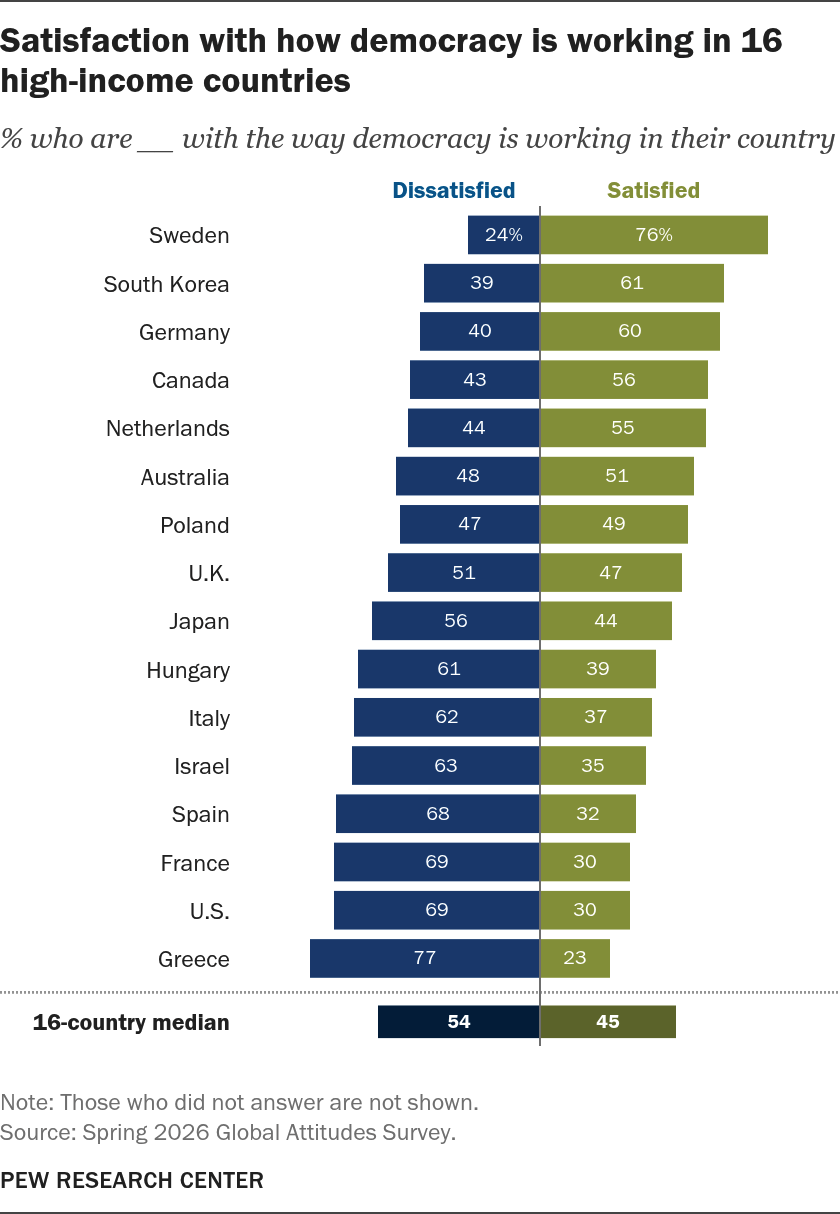
Around seven-in-ten U.S. adults (69%) say they are dissatisfied with the way democracy is working in their country. This share is higher than in most other high-income countries surveyed by Pew Research Center this spring.
| Country | Dissatisfied | Satisfied | Group |
|---|---|---|---|
| Sweden | 24 | 76 | 1 |
| South Korea | 39 | 61 | 1 |
| Germany | 40 | 60 | 1 |
| Canada | 43 | 56 | 1 |
| Netherlands | 44 | 55 | 1 |
| Australia | 48 | 51 | 1 |
| Poland | 47 | 49 | 1 |
| U.K. | 51 | 47 | 1 |
| Japan | 56 | 44 | 1 |
| Hungary | 61 | 39 | 1 |
| Italy | 62 | 37 | 1 |
| Israel | 63 | 35 | 1 |
| Spain | 68 | 32 | 1 |
| France | 69 | 30 | 1 |
| U.S. | 69 | 30 | 1 |
| Greece | 77 | 23 | 1 |
| 16-country median | 54 | 45 | 2 |
A large majority of Democrats and Democratic-leaning independents (86%) are dissatisfied with how American democracy is working. Around half of Republicans and GOP leaners (51%) say the same.
Related: Americans stand out internationally for their pessimism about the nation’s political system
Across all 16 countries polled, a median of 54% of adults are dissatisfied with the way their democracy is working, while a median of 45% are satisfied.
But opinions vary substantially by nation. For example, around three-in-four Greeks are dissatisfied with how their democracy is working, while a similar share of Swedes are satisfied.
Changes since last year
In most surveyed countries, satisfaction with the way democracy is working has not changed significantly since 2025. But satisfaction has increased significantly in South Korea and Japan, while it has decreased in Australia and the United States.

| Year | Response | South Korea | Japan | Australia | U.S. |
|---|---|---|---|---|---|
| 2021 | Satisfied | 53 | 38 | 69 | 41 |
| 2021 | Dissatisfied | 47 | 59 | 30 | 58 |
| 2022 | Satisfied | 50 | 39 | 57 | 37 |
| 2022 | Dissatisfied | 50 | 59 | 43 | 62 |
| 2023 | Satisfied | 38 | 35 | 67 | 33 |
| 2023 | Dissatisfied | 62 | 63 | 33 | 65 |
| 2024 | Satisfied | 36 | 31 | 60 | 31 |
| 2024 | Dissatisfied | 63 | 67 | 39 | 68 |
| 2025 | Satisfied | 28 | 24 | 61 | 37 |
| 2025 | Dissatisfied | 71 | 76 | 39 | 62 |
| 2026 | Satisfied | 61 | 44 | 51 | 30 |
| 2026 | Dissatisfied | 39 | 56 | 48 | 69 |
South Korea: Following the impeachment of President Yoon Suk Yeol, South Korea held an early presidential election between our 2025 and 2026 surveys, resulting in the election of former opposition leader Lee Jae Myung. The share of South Korean adults who are satisfied with the way democracy is working more than doubled in a year, from 28% in 2025 to 61% in 2026. This was the largest increase in any nation we surveyed.
Japan: Prime Minister Shigeru Ishiba resigned and was replaced by Sanae Takaichi between our 2025 and 2026 surveys. In February 2026, just days before we fielded our survey in Japan, Takaichi’s party won snap elections in a landslide. Satisfaction with democracy in Japan increased from 24% in 2025 to 44% in 2026.
In 2025, Japanese men were more likely than women to be satisfied with the functioning of democracy. But the gender gap disappeared in 2026, after Takaichi became the country’s first female prime minister.
Australia: Satisfaction with democracy in Australia dropped from 61% to 51% in the past year. Over the same period, Australians have also become much more negative on the economy, with the share who describe the country’s economic situation as good dropping from 37% in 2025 to 20% in 2026.
United States: In the U.S., satisfaction with democracy has declined somewhat, from 37% in 2025 to 30% in 2026. This decrease is largely driven by Republicans. Six-in-ten Republicans were satisfied in 2025, compared with 48% today. Satisfaction with democracy among Democrats has not changed significantly.
Majorities of Americans in both parties also say that democracy in the U.S. used to be a good example for other countries to follow but has not been in recent years. In total, 68% of Americans hold this view.
Related: Multiple indicators show a decline in the health of America’s democracy in 2025
Note: Here are the survey questions used for this analysis, along with responses, and the survey methodology.