

Digital books have grown in popularity over the past decade, but more Americans still read books in print than in digital formats.
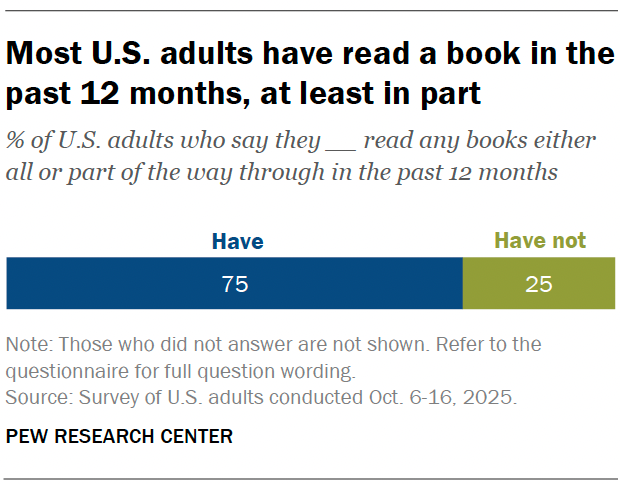
Overall, 75% of U.S. adults say they have read all or part of at least one book in the past 12 months, according to a Pew Research Center survey conducted in October 2025. While book reading is widespread, the survey also shows that participation in book clubs is much less common.
Print books remain on top
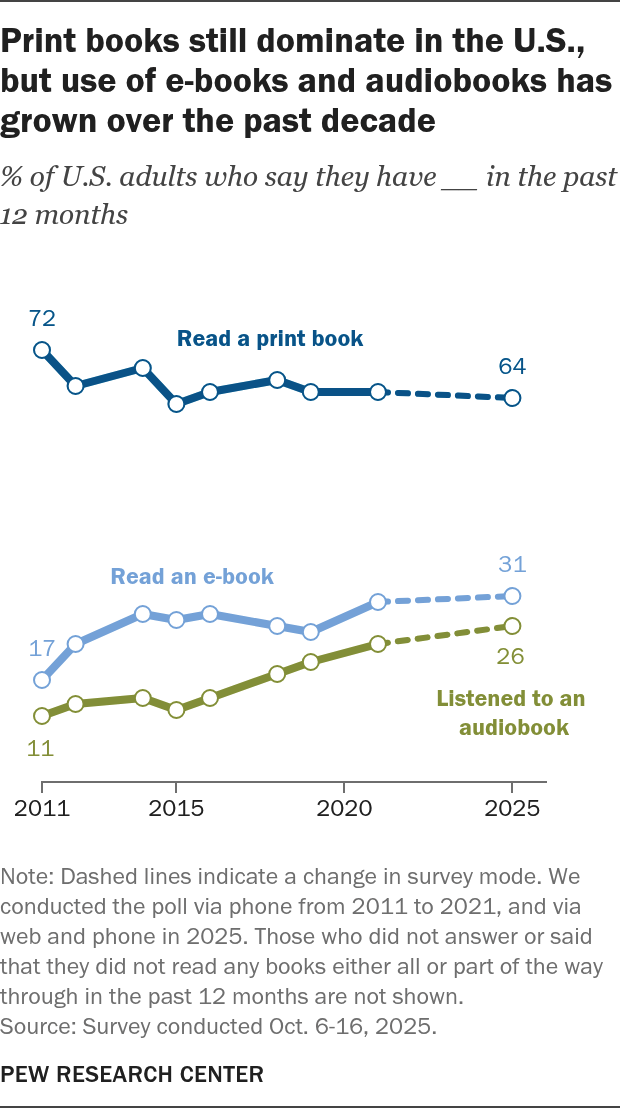
| Date | Read a print book | Read an e-book | Listened to an audiobook |
|---|---|---|---|
| 2011 | 72% | 17% | 11% |
| 2012 | 66% | 23% | 13% |
| 2014 | 69% | 28% | 14% |
| 2015 | 63% | 27% | 12% |
| 2016 | 65% | 28% | 14% |
| 2018 | 67% | 26% | 18% |
| 2019 | 65% | 25% | 20% |
| 2021 | 65% | 30% | 23% |
| 2025 | 64% | 31% | 26% |
Print continues to be the only book format used by a majority of Americans. Roughly two-thirds of adults say they have read a physical book in the past 12 months, according to our October survey.
Much smaller shares say they have read an e-book or listened to an audiobook in the past year.
How book reading habits have changed over time
The overall share of Americans who have read a book in the past year has remained fairly stable since we first asked this question in 2011.
But there have been some changes in how Americans read books. The share of adults who have read a print book in the past 12 months has declined from 72% in 2011 to 64% in October 2025.
Digital and audiobooks, by comparison, have become more widely used. About three-in-ten adults (31%) now report reading an e-book in the past year, up from 17% in 2011. Audiobooks have seen similar growth, with use of this format more than doubling in the same period.
But these changes have slowed in recent years. There has been little change in the overall share of Americans who read books – or in the formats they use – since we last asked these questions in 2021.
How book reading differs across demographic groups
Majorities of Americans across demographic groups say they’ve read a book in the past 12 months, according to our October survey. Still, there are some differences both in overall reading habits and in the formats Americans use:
- College graduates are more likely than non-college grads to have read a book in the past year. Around nine-in-ten adults with a bachelor’s degree (88%) say they’ve read a book in the past 12 months. This drops to 78% among those with some college experience and 60% among those with a high school education or less. This pattern holds across all formats of book-reading.
- Americans under 50 are more likely than older adults to read e-books and audiobooks. For example, 41% of adults under 30 say they’ve read an e-book in the past 12 months. By comparison, a third or fewer of those from older age groups say this.
- White Americans are most likely to read print books, while Asian Americans stand out in their use of e-books. About two-thirds of White adults say they’ve read a print book in the past year, compared with smaller shares of Black, Hispanic and Asian Americans. When it comes to e-books, 42% of Asian Americans say they’ve read one in the past year, compared with around three-in-ten White, Hispanic and Black adults.
- Women are more likely than men to say they’ve read a book in the past 12 months. This pattern extends to print and e-books.

Note: Those who did not answer or said that they did not read any books either all or part of the way through in the past 12 months are not shown. White, Black and Asian adults include those who report being only one race and are not Hispanic. Hispanic adults are of any race.
| Population | Group | Read a book in any format | Read a print book | Read an e-book | Listened to an audiobook |
|---|---|---|---|---|---|
| U.S. adults | Total | 75 | 64 | 31 | 26 |
| Men | Gender | 71 | 60 | 28 | 24 |
| Women | Gender | 78 | 68 | 33 | 27 |
| White | Race | 77 | 67 | 30 | 27 |
| Black | Race | 69 | 57 | 27 | 25 |
| Hispanic | Race | 70 | 57 | 29 | 24 |
| Asian* | Race | 70 | 53 | 42 | 24 |
| Ages 18-29 | Age | 78 | 66 | 41 | 32 |
| 30-49 | Age | 76 | 64 | 33 | 33 |
| 50-64 | Age | 71 | 61 | 26 | 23 |
| 65+ | Age | 73 | 65 | 23 | 13 |
| H.S. or less | Educ | 60 | 50 | 20 | 17 |
| Some college | Educ | 78 | 67 | 30 | 27 |
| College+ | Educ | 88 | 76 | 42 | 35 |
Note: Those who did not answer or said that they did not read any books either all or part of the way through in the past 12 months are not shown. White, Black and Asian adults include those who report being only one race and are not Hispanic. Hispanic adults are of any race.
How many books do Americans read?
While most Americans have read at least one book in the past year, how many they read varies widely. As of October 2025:
- 38% of U.S. adults say they read one to five books in the past year
- 13% read six to 10
- 10% read 11 to 20
- 14% read more than 20
And 25% of Americans say they read none.
Few Americans are members of a book club
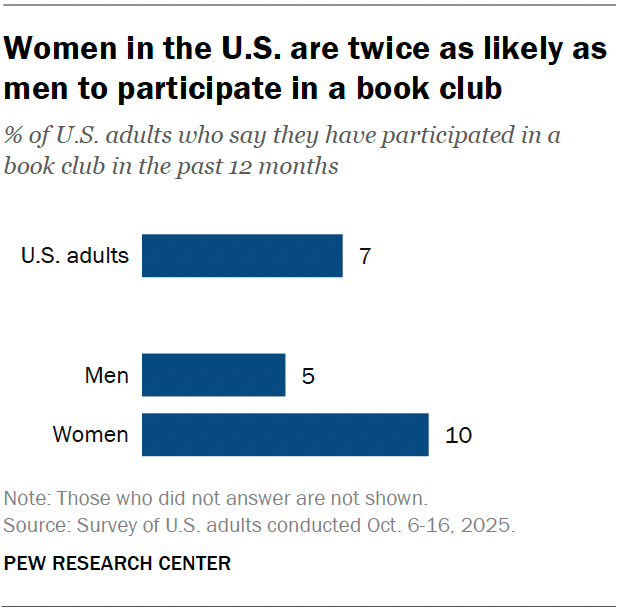
Book clubs are not a common activity for most Americans, according to the recent survey. Only 7% of adults say they have participated in a book club in the past 12 months, according to our October survey.
Women are more likely than men to say they have done so (10% vs. 5%).
Note: Here are the questions used for this analysis, the topline and the survey methodology.
