The 14th Amendment to the U.S. Constitution says that “[a]ll persons born or naturalized in the United States, and subject to the jurisdiction thereof, are citizens of the United States and of the State wherein they reside.”
That broad language, granting U.S. citizenship automatically to virtually anyone born in the country, is now under challenge. The Supreme Court is considering whether President Donald Trump can, by executive order, limit “birthright citizenship” to children born in the U.S. to citizens or legal permanent residents.
Since a landmark 1898 Supreme Court decision, courts have generally held that the 14th Amendment covers everyone except children of foreign diplomats, members of occupying foreign forces or members of Native American tribes. Congress extended birthright citizenship to Native Americans by statute in 1924.
Thirty-two other countries around the world, most of them in the Western Hemisphere, have birthright citizenship laws that are substantially similar to the U.S., according to a Pew Research Center analysis. Another 50 or so countries have more limited variations of birthright citizenship.
This analysis examines the many ways that countries decide who is and isn’t a citizen and who can and can’t become one. It’s based on a dataset of national citizenship laws compiled by the Global Citizenship Observatory, a research project at the European University Institute’s Robert Schuman Centre for Advanced Studies.
Many countries have more than one way of acquiring citizenship, or different rules for different groups, so the categories discussed below can and sometimes do overlap.
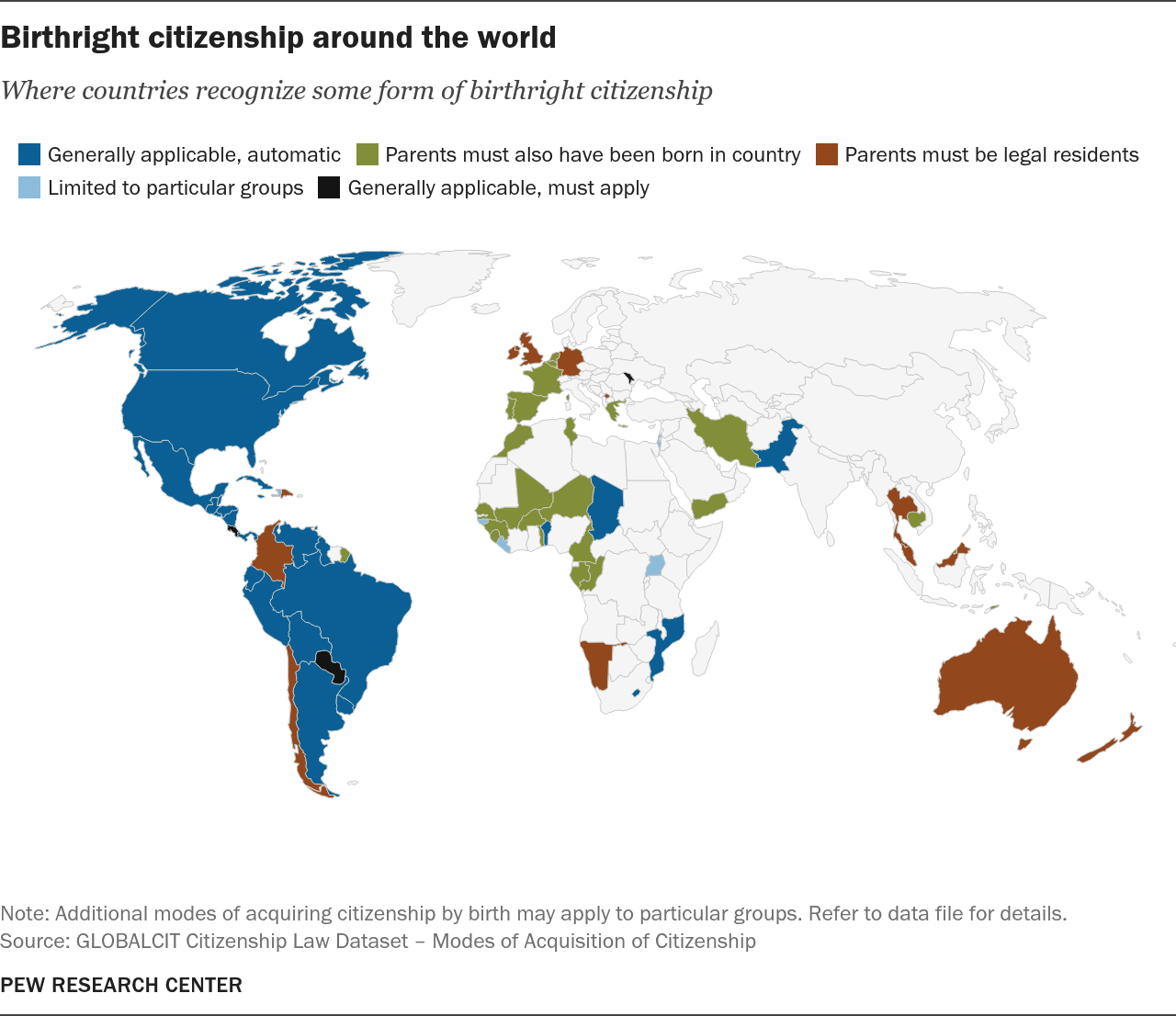
| Country | ISO | Category | Group |
|---|---|---|---|
| Antigua and Barbuda | 028 | Generally applicable, automatic | 1 |
| Argentina | 032 | Generally applicable, automatic | 1 |
| Barbados | 052 | Generally applicable, automatic | 1 |
| Belize | 084 | Generally applicable, automatic | 1 |
| Benin | 204 | Generally applicable, automatic | 1 |
| Bolivia | 068 | Generally applicable, automatic | 1 |
| Brazil | 076 | Generally applicable, automatic | 1 |
| Canada | 124 | Generally applicable, automatic | 1 |
| Chad | 148 | Generally applicable, automatic | 1 |
| Cuba | 192 | Generally applicable, automatic | 1 |
| Dominica | 212 | Generally applicable, automatic | 1 |
| Ecuador | 218 | Generally applicable, automatic | 1 |
| El Salvador | 222 | Generally applicable, automatic | 1 |
| Grenada | 308 | Generally applicable, automatic | 1 |
| Guatemala | 320 | Generally applicable, automatic | 1 |
| Guyana | 328 | Generally applicable, automatic | 1 |
| Honduras | 340 | Generally applicable, automatic | 1 |
| Jamaica | 388 | Generally applicable, automatic | 1 |
| Lesotho | 426 | Generally applicable, automatic | 1 |
| Mexico | 484 | Generally applicable, automatic | 1 |
| Mozambique | 508 | Generally applicable, automatic | 1 |
| Nicaragua | 558 | Generally applicable, automatic | 1 |
| Pakistan | 586 | Generally applicable, automatic | 1 |
| Panama | 591 | Generally applicable, automatic | 1 |
| Peru | 604 | Generally applicable, automatic | 1 |
| St. Kitts and Nevis | 659 | Generally applicable, automatic | 1 |
| St. Lucia | 662 | Generally applicable, automatic | 1 |
| St. Vincent and the Grenadines | 670 | Generally applicable, automatic | 1 |
| Trinidad and Tobago | 780 | Generally applicable, automatic | 1 |
| Tuvalu | 798 | Generally applicable, automatic | 1 |
| United States | 840 | Generally applicable, automatic | 1 |
| Uruguay | 858 | Generally applicable, automatic | 1 |
| Venezuela | 862 | Generally applicable, automatic | 1 |
| Belgium | 056 | Parents must also have been born in country | 2 |
| Brunei | 096 | Parents must also have been born in country | 2 |
| Burkina Faso | 854 | Parents must also have been born in country | 2 |
| Cambodia | 116 | Parents must also have been born in country | 2 |
| Cameroon | 120 | Parents must also have been born in country | 2 |
| France | 250 | Parents must also have been born in country | 2 |
| Gabon | 250 | Parents must also have been born in country | 2 |
| Greece | 300 | Parents must also have been born in country | 2 |
| Guinea | 324 | Parents must also have been born in country | 2 |
| Iran | 364 | Parents must also have been born in country | 2 |
| Luxembourg | 442 | Parents must also have been born in country | 2 |
| Mali | 466 | Parents must also have been born in country | 2 |
| Malta | 470 | Parents must also have been born in country | 2 |
| Morocco | 504 | Parents must also have been born in country | 2 |
| Netherlands | 528 | Parents must also have been born in country | 2 |
| Niger | 562 | Parents must also have been born in country | 2 |
| Portugal | 620 | Parents must also have been born in country | 2 |
| Republic of the Congo | 178 | Parents must also have been born in country | 2 |
| Senegal | 686 | Parents must also have been born in country | 2 |
| Sierra Leone | 694 | Parents must also have been born in country | 2 |
| Spain | 724 | Parents must also have been born in country | 2 |
| Timor-Leste | 626 | Parents must also have been born in country | 2 |
| Togo | 768 | Parents must also have been born in country | 2 |
| Tunisia | 788 | Parents must also have been born in country | 2 |
| Yemen | 887 | Parents must also have been born in country | 2 |
| Australia | 036 | Parents must be legal residents | 3 |
| Cape Verde | 132 | Parents must be legal residents | 3 |
| Chile | 152 | Parents must be legal residents | 3 |
| Colombia | 170 | Parents must be legal residents | 3 |
| Dominican Republic | 214 | Parents must be legal residents | 3 |
| Germany | 276 | Parents must be legal residents | 3 |
| Ireland | 372 | Parents must be legal residents | 3 |
| Kosovo | 412 | Parents must be legal residents | 3 |
| Malaysia | 458 | Parents must be legal residents | 3 |
| Namibia | 516 | Parents must be legal residents | 3 |
| New Zealand | 554 | Parents must be legal residents | 3 |
| Sao Tome and Principe | 678 | Parents must be legal residents | 3 |
| Thailand | 764 | Parents must be legal residents | 3 |
| United Kingdom | 826 | Parents must be legal residents | 3 |
| Guinea-Bissau | 624 | Limited to particular groups | 4 |
| Haiti | 332 | Limited to particular groups | 4 |
| Israel | 376 | Limited to particular groups | 4 |
| Liberia | 430 | Limited to particular groups | 4 |
| Uganda | 800 | Limited to particular groups | 4 |
| Costa Rica | 188 | Generally applicable, must apply | 5 |
| Moldova | 498 | Generally applicable, must apply | 5 |
| Paraguay | 498 | Generally applicable, must apply | 5 |
Related: About 9% of U.S. births in 2023 were to unauthorized or temporary legal immigrant mothers
Many ways to gain citizenship by birth
In most countries, citizenship at birth is primarily determined by descent – that is, by the citizenship status of the parents. Most countries in the EUI dataset (156 out of 191) automatically confer citizenship on newborns within their territory only if one or both parents are citizens.
In 59 countries, at least some people can become citizens simply by being born there. In 52 of those countries, citizenship is acquired automatically. In the others, parents must apply for their children to be declared citizens, and officials have varying degrees of discretion in whether or not to approve those applications.
However, many countries restrict who can benefit from birthright citizenship. In 17 of the 59 countries mentioned above, citizenship isn’t extended automatically to children of noncitizen parents unless the parents are living in the country legally. In six other countries, birthright citizenship only applies to members of particular racial, ethnic or religious groups. (Guinea-Bissau, for instance, extends it only to children whose parents are citizens of a Portuguese-speaking country.)
That leaves 33 countries, including the U.S., where birthright citizenship is automatic and generally applicable regardless of the parents’ legal status.
There’s another group of 26 countries (including five of the ones mentioned above) that require two generations of in-country birth for birthright citizenship. That is, a child born in the country must also have one or both parents who also were born in that country, even if the parents never became citizens themselves. Nearly half (11) of these “second-generation” countries also restrict eligibility by parental residency status, gender or membership in a particular group.
Related: U.S. public is split on birthright citizenship for people whose parents immigrated illegally