This Pew Research Center analysis focuses on how Black Americans define and experience family – that is, who is included in their family networks and how they provide support to one another.
Why did we do this?
Pew Research Center conducts research to inform the public, the media and decision-makers. This analysis builds on previous work about the importance of identity and family among Black Americans. It also builds on the Center’s work studying American families and relationships.
We surveyed 6,871 U.S. adults from June 16-29, 2025. Of the full sample, 3,657 respondents are members of Pew Research Center’s American Trends Panel, including 1,057 Black respondents. The remaining 3,214 respondents are Black adults who are members of SSRS’s Opinion Panel. This brings the total Black sample in the survey to 4,271 Black adults. The survey is representative of the views of the full U.S. adult population.
The Pew Research Center is a subsidiary of The Pew Charitable Trusts, its primary funder. This report was made possible with support from the Trusts and from the People & Voices Initiative.
Terminology
The terms Black Americans,Black adults and Black people are used interchangeably throughout this report to refer to U.S. adults who self-identify as Black, either alone or in combination with other races or Hispanic identity.
The terms being Black and Blackness are used interchangeably throughout the report to describe respondents’ answers to a question about Black racial identity: “How important is being Black to how you think about yourself?”
Black single-race, non-Hispanic respondents are those who identify as single-race Black and are not Hispanic. Black Hispanic respondents are those who identify as Black and Hispanic. Blackmultiracial respondents are those who indicate two or more racial backgrounds (one of which is Black) and say they are not Hispanic.
This analysis includes comparisons between Black Americans and other Americans. In these cases, other Americans,other adults and non-Black adults are used interchangeably to refer to U.S. adults who do not self-identify as Black.
Family refers to a group of people who are related to each other by birth, marriage, law or choice. In this analysis, family includes nuclear family members, such as spouses or partners, parents, and siblings; extended family members such as grandparents, aunts, uncles and cousins; and non-relative family members such as longtime friends and people who have bonded over shared identities and experiences.
Immigrants refers to people born outside the 50 U.S. states, the District of Columbia, Puerto Rico or other U.S. territories. U.S. born refers to people born in the 50 U.S. states, D.C., Puerto Rico or other U.S. territories.
References to college graduates or people with a college degree comprise those with a bachelor’s degree or more education. People with some collegeeducation are those with an associate degree or those who attended college but did not obtain a degree. People with a high school education or less refers to those who have a high school diploma or its equivalent, such as a General Educational Development (GED) certificate, or less education.
To create the upper, middle and lower income tiers, respondents’ 2023 or 2024 family incomes were adjusted for differences in purchasing power by geographic region and household size. Respondents were then placed into income tiers: Middle income is defined as two-thirds to double the median annual income for the entire survey sample. Lower income falls below that range, and upper income lies above it. For more information about how the income tiers were created, read the methodology.
Democrats are respondents who identify politically with the Democratic Party or those who are independent or identify with some other party but lean toward the Democratic Party. Similarly, Republicans are those who identify politically with the Republican Party and those who are independent or identify with some other party but lean toward the Republican Party.
This is one of five detailed sections in a report on how Black Americans define and support their family networks. The report also includes an overview of key findings.
Many Black adults have a broad idea of family that includes people who are not related to them by birth, marriage or law. But within these wide networks, who are the people Black Americans share close family bonds with?
We conducted a national survey of U.S. adults – including 4,271 Black adults – in June 2025 to explore this question and understand how respondents experience emotional closeness and other elements of family life.
A note on the analysis
Percentages for the questions on emotional closeness are based only on respondents who have such a family member. For more information on how we asked these questions, refer to the questionnaire and topline.
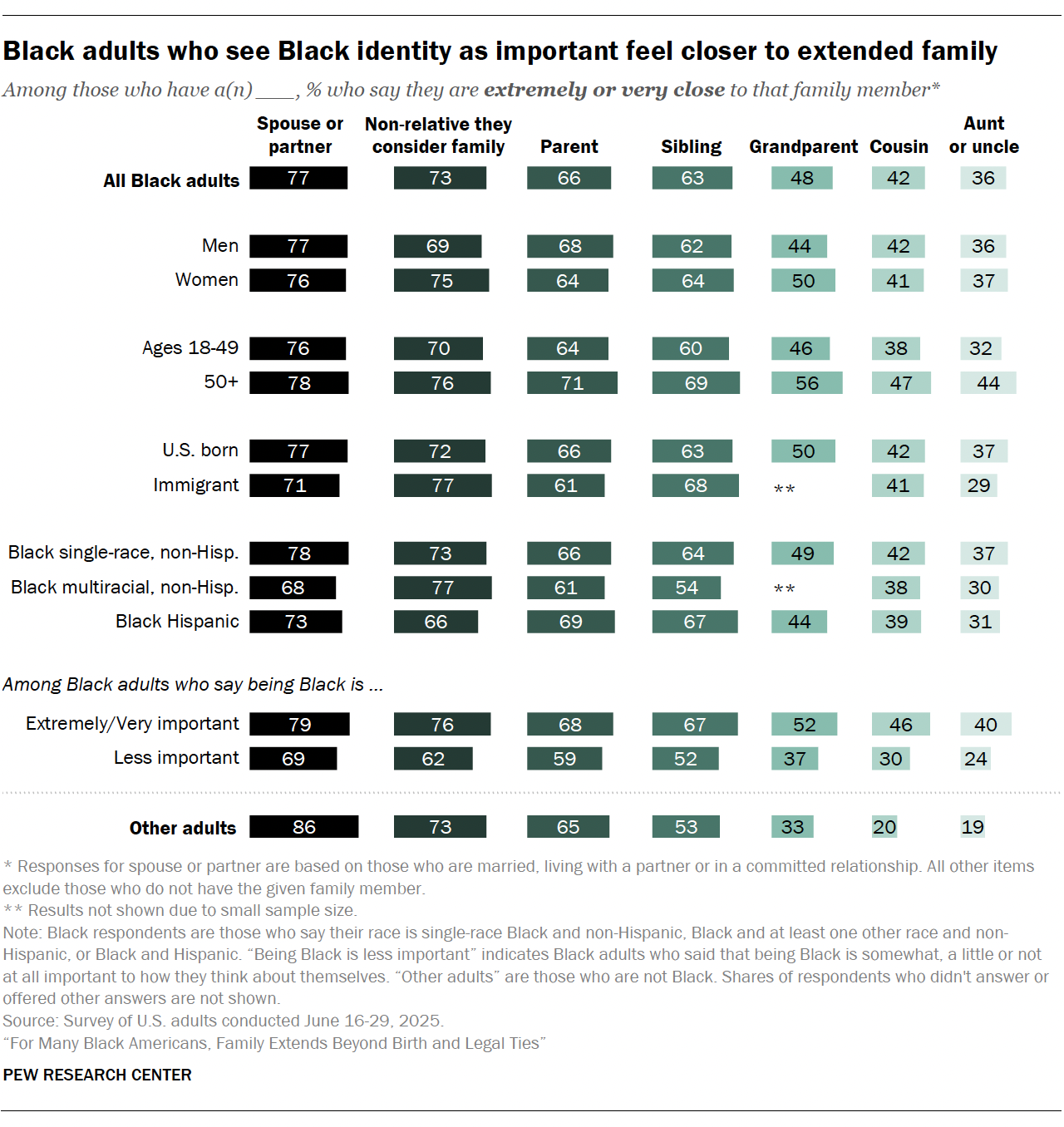
Black adults report strong feelings of closeness across many relationships. Large majorities say they feel extremely or very close to their spouse or partner (77%) and to a non-relative family member (73%). Most also feel close to a parent (66%) or a sibling (63%).
For many Black Americans, closeness extends beyond the nuclear family. More than a third say they feel close to family members researchers typically refer to as extended family. Compared with other Americans, Black adults are more likely to say they feel close to:
A grandparent (48% of Black adults vs. 33% of non-Black adults)
A cousin (42% vs. 20%)
An aunt or uncle (36% vs. 19%)
Black Americans’ feelings of closeness with family are also tied to views about their Black identity. Respondents who say being Black is extremely or very important to them are more likely than those who say being Black is less important to be close to each of the family members we asked about. For instance, 67% of those who say being Black is important to their identity are close to a sibling, compared with 52% among those who say being Black is less important to their identity.
Closeness also varies by age. Black adults ages 50 and older are more likely than those under 50 to say they are close to almost every family member we asked about.