While Americans overall have become somewhat less religious in recent years, measures of various beliefs and practices have been relatively stable among those who identify with a religion (e.g., Protestants, Catholics). The current survey shows a similar pattern among U.S. Muslims. About four-in-ten Muslims say they attend religious services at least weekly, and a similar share say they perform five daily prayers (salah). These numbers have changed little since 2007. In addition, about four-in-ten Muslim women say they always wear hijab in public, almost identical to the share who said this in previous surveys.
If there is one measure that shows a modest decline in religious observance among U.S. Muslims over the past decade, it is in the share who say religion is very important in their lives: 65% now say this, compared with 69% in 2011 and 72% in 2007.
Eight-in-ten U.S. Muslims say they fast during the Islamic holy month of Ramadan, and most are satisfied with the quality of mosques available to them – though few see the mosque as central to their spiritual life.
Beyond these measures of religious practice, many Muslim Americans see room for multiple and more contemporary interpretations of their faith. A majority of U.S. Muslims say there is more than one true way to interpret Islam, and about half say traditional understandings of the faith need to be reinterpreted to address current issues.
This chapter discusses those topics and more on the way Muslim Americans view themselves, through both a religious and a spiritual lens, as well as the ways in which they practice and observe their faith.
Two-thirds of Muslims say religion very important to them, six-in-ten pray daily
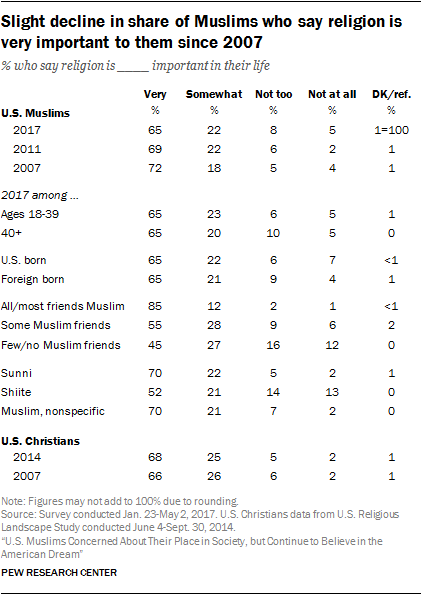
A majority of U.S. Muslims (65%) say religion is “very important” to them. About one-in-five (22%) say religion is “somewhat important” in their lives, while fewer say religion is “not too” (8%) or “not at all” (5%) important. These figures are similar to the level of importance U.S. Christians place on religion (in 2014, 68% said religion is very important).
Sunni Muslims place more importance on religion (70% very important) than do Shiites (52%). And U.S. Muslims whose friends are all or mostly Muslim place more importance on religion than do those with fewer Muslim friends.
Younger and older Muslims attach similar levels of importance to religion, and there are no differences between immigrant Muslims and U.S.-born Muslims on the importance of religion.
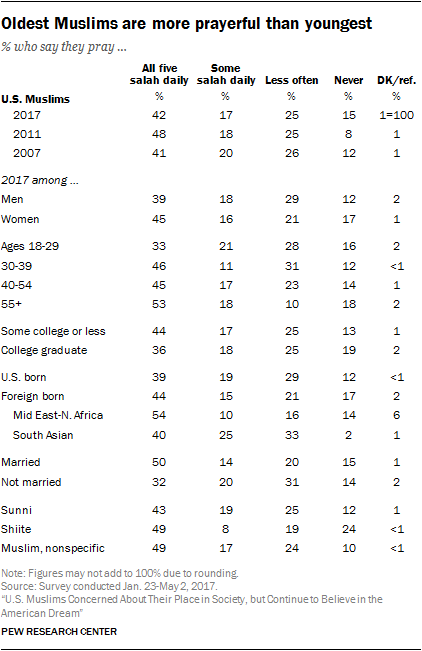
Six-in-ten Muslim Americans report praying at least some of the five salah every day, with 42% saying they pray all five daily, and 17% praying some salah each day. A quarter (25%) say they pray less often, and 15% say they never pray. These findings are broadly in line with those from 2011 and 2007.
College graduates are somewhat less likely than those with lower levels of education to say they pray all five salah daily: 36% say they do this, compared with 44% of those without college degrees. The survey also finds that older Muslims are more likely to pray all five salah every day than are younger Muslims: Just a third of U.S. Muslims ages 18 to 29 (33%) say they complete this practice daily, compared with 53% of Muslims ages 55 and older.
Many Muslims attend mosque weekly, but most say they pursue spiritual life mainly outside the mosque
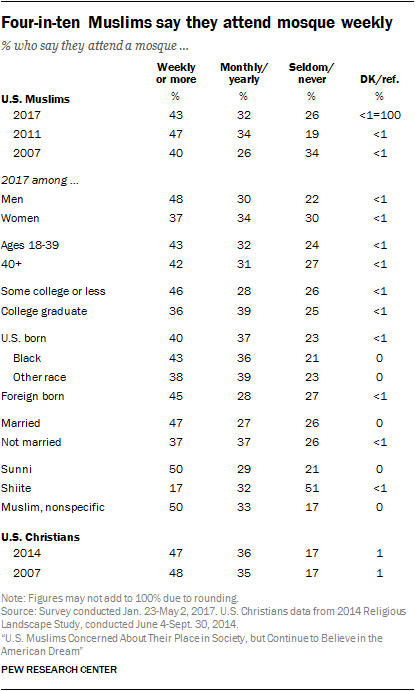
Four-in-ten American Muslims attend a mosque or Islamic center at least weekly, including 18% who say they attend more than once a week and 25% who say they attend once a week for Jumah prayer (Friday congregational prayer). About a third (32%) say they attend once or twice a month or a few times a year, and a quarter (26%) say they seldom or never attend.
Levels of attendance at religious services among U.S. Muslims are comparable to those of Christians. According to the 2014 Religious Landscape Study, nearly half of U.S. Christians say they attend worship services weekly or more (47%), another 36% attend monthly or yearly, and 17% seldom or never attend.
Among Muslims, those who are highly educated attend mosque with less frequency than others, and the same is true of unmarried Muslims compared with those who are married. In addition, Shiite Muslims are far less likely than Sunnis to say they attend on a weekly basis.
Younger Muslims and older Muslims report attending mosque at roughly similar rates, as do U.S.-born and foreign-born Muslims. But more Muslim men than women say they attend mosque regularly; this may reflect a traditional understanding among many Muslims that regular mosque attendance is expected of men but not required of women.
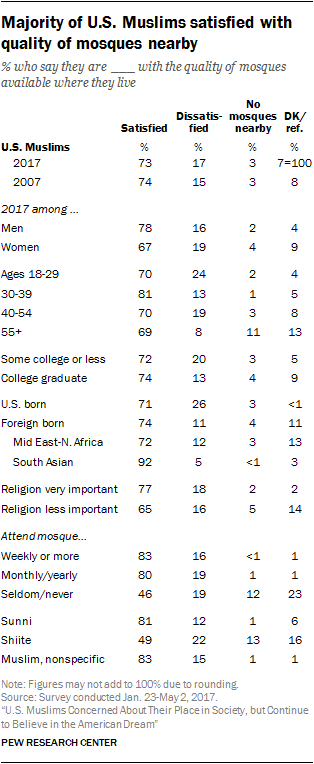
Roughly three-quarters of American Muslims say they are satisfied with the quality of mosques available to them (73%), while 17% are dissatisfied and just 3% say there are no mosques nearby. There has been virtually no change on this question since 2007.
Most Muslims are satisfied with the quality of mosques regardless of gender, age, education, nativity or race/ethnicity. Some groups, such as immigrants from South Asian countries, stand out as being especially satisfied (92%), while Shiite Muslims stand out for their relatively low rates of satisfaction with the mosques near where they live (49% satisfied).
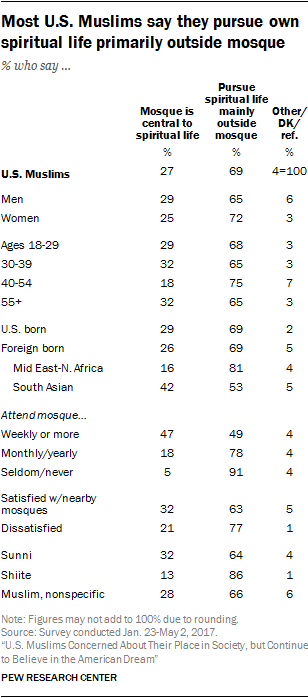
While a majority of U.S. Muslims are satisfied with the mosques in their area, just a quarter (27%) say the mosque is central to their spiritual life. By contrast, about seven-in-ten (69%) say they pursue their spiritual life primarily outside the mosque.
Even among U.S. Muslims who attend mosque at least weekly, views are divided: 47% say the mosque is central to their spiritual lives, while 49% say they pursue their spiritual life primarily outside the mosque.
Four-in-ten Muslim women always or usually wear hijab; eight-in-ten Muslims fast during Ramadan
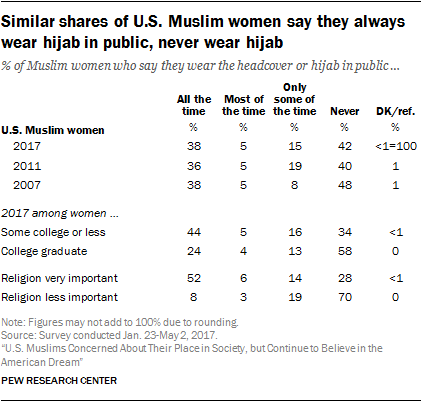
The percentage of U.S. Muslim women who say they wear the hijab all the time in public has remained steady over the past decade: About four-in-ten say they always wear the headcover or hijab in public (38%) or that they do so most of the time (5%). Just 15% say they wear hijab some of the time, and 42% say they never wear it.
Muslim women who have not completed college are more likely than college graduates to wear the hijab in public all the time (44% vs. 24%).
Half of American Muslim women who say religion is very important in their lives say they wear the hijab all the time (52%). By contrast, just 8% of women who say religion is not very important always cover their head.
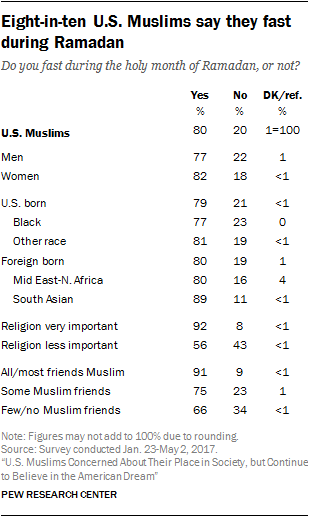
Another common religious practice for Muslims is fasting during the holy month of Ramadan. Eight-in-ten Muslim Americans say they fast, while one-in-five do not. Fasting is common across all demographic groups analyzed in the survey.
Most U.S. Muslims are Sunnis
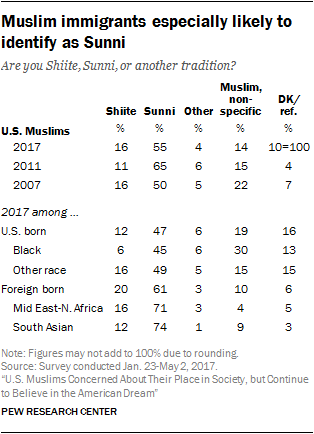
Slightly more than half of Muslim Americans identify with the Sunni branch of Islam (55%), while 16% identify as Shiite, 4% identify with other groups (such as Ahmadiyya or the Nation of Islam), and 14% do not specify a tradition.32 An additional 10% declined to answer the question. These results are consistent with data on Muslims around the world in that Muslims are more likely to identify with Sunni Islam than any other branch. (For more information on these groups, see the glossary.)
Muslims born outside the U.S. are more likely than U.S.-born Muslims to identify as Sunni (61% vs. 47%). Compared with immigrants, U.S.-born Muslims are more likely to identify as just Muslim.
Most Muslims open to multiple ways of interpreting Islam
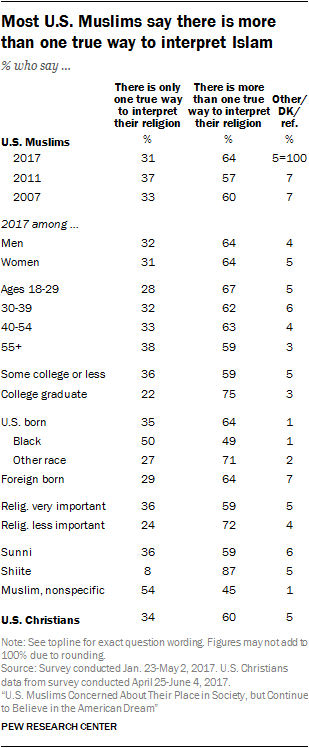
Roughly two-thirds of U.S. Muslims say there is more than one true way to interpret the teachings of Islam (64%), while 31% say there is only one true way to interpret the teachings of the faith. Changes in opinions on this question have been modest since the past two iterations of this survey.
Among U.S. Christians, the balance is similar: 60% say there is more than one true way to interpret the teachings of Christianity, while 34% say there is just one true way to interpret their faith.
While majorities in most Muslim subgroups say there are multiple interpretations of Islam, U.S.-born black Muslims are evenly divided, with 50% saying there is only one true way to interpret Islam and 49% saying there are multiple ways.
On the other hand, the view that there are multiple valid ways to interpret Islam is especially common among those who have a college degree (75%) and those who say religion is not very important in their lives (72%). It is also much more common among Shiite Muslims (87%) than among Sunnis (59%).
Muslim men and women, as well as older and younger Muslims, express similar views on this question.
A separate question asked whether the traditional understandings of Islam need to be reinterpreted to address modern issues, or whether the traditional understandings of the religion are all that is needed. Fully half of U.S. Muslims (52%) say Islam’s teachings need to be reinterpreted, while 38% say this is not necessary.
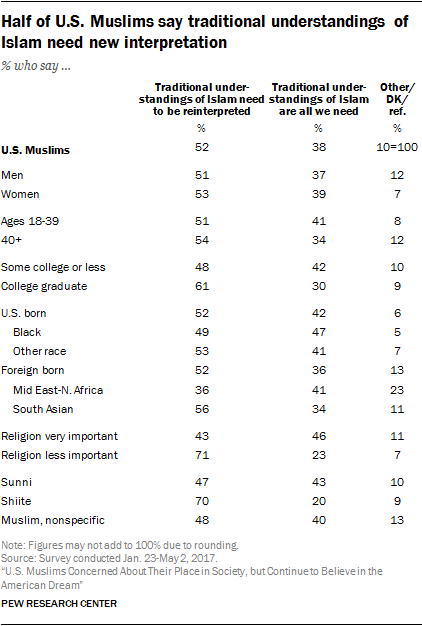
Again, the view that Islam needs to be reinterpreted to address today’s issues is especially common among Muslims with college degrees and those who say religion is not very important in their lives: Majorities of both groups take this position. By contrast, among Muslims who say that religion is very important in their lives, roughly equal shares say there is room for reinterpreting Islam (43%) and that traditional understandings are all that is needed (46%).
The survey also finds that Shiite Muslims are more likely than Sunnis to say that reinterpretation of traditional understandings of Islam is needed. And among Muslim immigrants, those from South Asia are more likely than those from the Middle East and North Africa to say traditional understandings of Islam need to be reinterpreted for modern times.
In their own words: What Muslims said about interpreting Islam
Pew Research Center staff called back some of the Muslim American respondents in this survey to get additional thoughts on some of the topics covered. Here is a sampling of what they said about how to interpret Islam:
“When people take the Quran absolutely literally, this is when we have problems. There are multiple layers, and you can’t just read it and say ‘this is what I should do.’ This is what ISIS does. They read one quote from the Quran and then they go and kill people. … You are not supposed to take it literally. My friend said he did not know that. It changed his mind. There are two interpretations – literal and tafsir [interpretation of the Quran by scholars].” – Muslim man under 30
“There are obviously people who interpret [Islam] strictly, and there is also loose interpretations and more toward modern-day issues, and that is where the problem arises – with the different ways Islam can be taken. I think the more modern approach is better: faith and no violence.” – Muslim man under 30
“I’m not a scholar and haven’t studied. My understanding of Islam is just what I hear, and I could be misinformed. I can tell you about how I view the world as a Muslim and it is a very liberal way and – I’m afraid to use say the word modern – it’s a way in which I feel it incorporates the features of the society I’m in. … There are things you are exposed to here [in the West] that would be different if you grew up in a more strict culture. And I don’t know if that framework is driven by … the local culture and value system versus what you would experience here. When I was … in Africa, there were things I saw, and they were more culture than the [religion]. For example, female genital mutilation, for example. It’s practiced in Africa but not here. So for me, I’m liberal in that mindset. What drives that? Is that Quran that drives that? Or the cultural practice in that area? Because it’s something I’m opposed to.” – Immigrant Muslim man
“There’s only one way. The way is to the Sunnah of our dear beloved Prophet Muhammad, may peace and blessings be upon him. There are 77 sects of Muslims and only one goes to Jannah [paradise]. It’s cut and it’s delivered. There’s no way around it. We do not add; we do not take away.” – Muslim woman in 30s
“We have different situations now than we did before in the past. So maybe they could be reinterpreted a little bit, like with Islamic extremists who are taking it too far. Jihad was a very long time ago when the non-Muslims were battling the Muslims and stuff like that. But we don’t have that anymore. So the fact that people are still doing this as extremists, it’s definitely terrible. I definitely think people should reinterpret it.” – Muslim woman under 30
“I think there is more than one true way to interpret Islam, and that’s what makes the beauty of it. … People might interpret quite literally, without taking into context; they may look at just the Quran. While others – in fact the majority – they look at both the Quran and the sayings, or the Hadith, of the prophet. There’s also the schools of thought, and there’s differences in what the scholars throughout the centuries in time have believed, so people interpret it based off of their school of thought as well.” – Muslim man under 30
Half of Muslims say they are both religious and spiritual
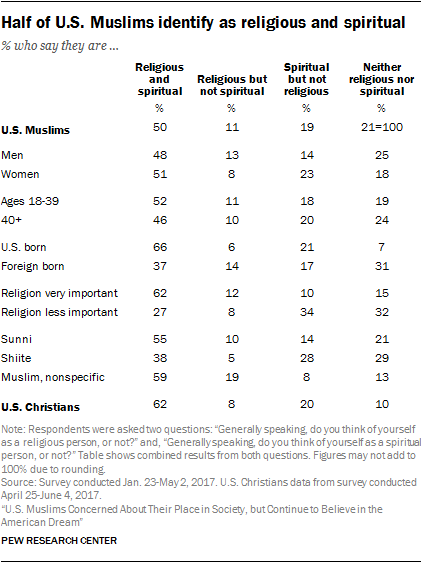
When asked if they consider themselves “spiritual,” roughly two-thirds of U.S. Muslims (68%) say they do. In a separate question, slightly fewer (60%) say they consider themselves “religious.” Many Muslims do not see religion and spirituality in conflict: Half answer both questions affirmatively, saying they consider themselves both religious and spiritual (50%). One-in-five (19%) identify as spiritual but not religious, 11% say they are religious but not spiritual, and 21% say they are neither spiritual nor religious.
By comparison, U.S. Christians (62%) are somewhat more likely than Muslims (50%) to say they are both religious and spiritual, but the two groups are about equally likely to identify as spiritual but not religious (20% of U.S. Christians, compared with 19% of U.S. Muslims). Muslims are roughly twice as likely as Christians to identify as neither religious nor spiritual.
Muslims born in the U.S. are far more likely than immigrants to identify as both religious and spiritual (66% vs. 37%). By comparison, Muslim immigrants eschew both the religious and spiritual labels at a much higher rate than do U.S.-born Muslims (31% vs. 7%).
Importance of religion in one’s life also plays a role in this identity. About six-in-ten of those who say religion is very important in their lives also say they are both religious and spiritual. By comparison, those who say religion is less important in their lives are about evenly split between saying they are both religious and spiritual (27%), neither religious nor spiritual (32%), or spiritual but not religious (34%).
One-in-five Muslims are converts
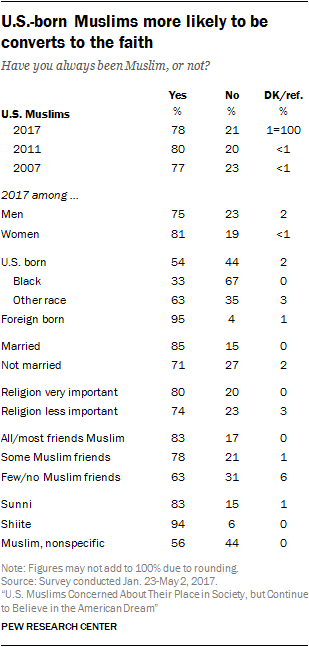
Roughly eight-in-ten U.S. Muslims (78%) say they have always been Muslim, while 21% converted to Islam. These figures have been relatively stable since 2007.
Switching to Islam from another faith is much more common among U.S.-born Muslims than immigrants. Among Muslim immigrants surveyed, nearly all (95%) have always been Muslim. By contrast, only about half (54%) of Muslims born in the U.S. say this. Fully two-thirds of American-born black Muslims say they have not always been Muslim.
Muslim Americans who have primarily Muslim friend networks are also especially likely to be have always been Muslim (83%) compared with those who have few or no Muslim friends (63%).
Among U.S. Muslims who converted into the faith, about half previously identified as Protestant (53%), one-in-five as Catholic, 19% as religiously unaffiliated, 4% as Orthodox Christian, and another 4% with other religions, such as Judaism or Buddhism.
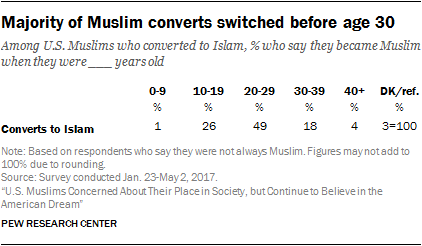
Muslim converts tend to say they were on the younger side when they converted to Islam. About one-in-four converts (26%) say they switched between the ages of 10 and 19. And roughly half (49%) did so during their 20s. By contrast, 18% say they changed religions in their 30s, and just 4% say they switched at age 40 or older.
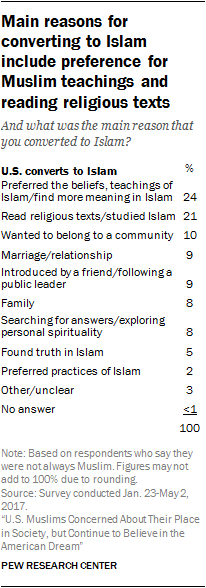
Those who said they converted to Islam were asked to explain, in their own words, why they became Muslim. Converts give a variety of reasons for changing faiths. Roughly one-in-four (24%) say they prefer the beliefs and teachings of Islam or find more meaning in Islam than in their previous faith, and one-in-five say reading religious texts and studying the faith were the main reasons for their conversion. About one-in-ten say they wanted to belong to a community (10%), were introduced to the faith by a friend or public leader (9%), converted due to marriage (9%), converted for other family reasons (8%), or were exploring their personal spirituality (8%).