Pew Knight Initiative
The Pew-Knight Initiative supports new research on how Americans absorb civic information, form beliefs and identities, and engage in their communities.
Pew Research Center is a nonpartisan, nonadvocacy fact tank that informs the public about the issues, attitudes and trends shaping the world. Knight Foundation is a social investor committed to supporting informed and engaged communities. Learn more >
About half of LGBTQ Americans (49%) say they are part of an online community, according to a Pew Research Center survey of U.S. adults from the Pew-Knight Initiative. This drops to 35% among those who are not LGBTQ.
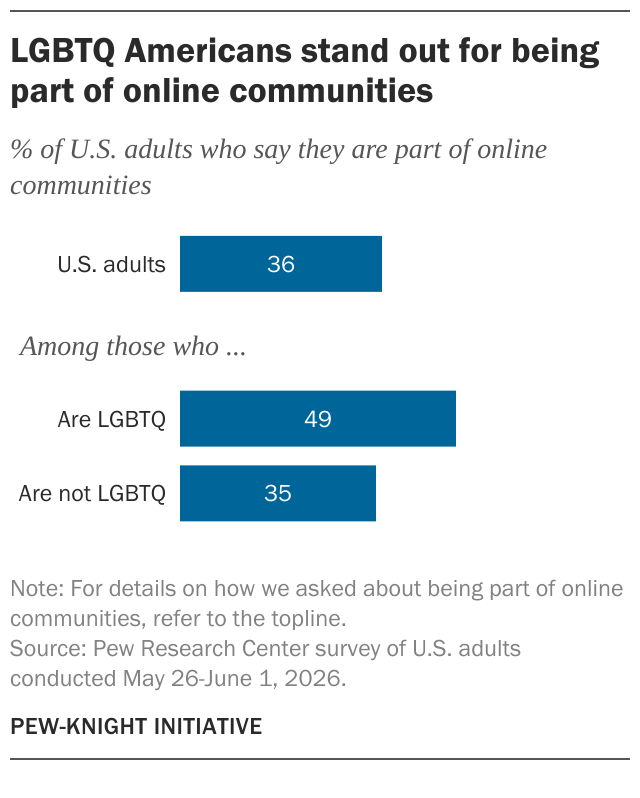
| % | |
|---|---|
| U.S. adults | 36 |
| Among those who … | |
| Are LGBTQ | 49 |
| Are not LGBTQ | 35 |
Since the early days of the internet, lesbian, gay, bisexual, transgender and queer people have carved out spaces for themselves in the digital world. In our survey, these Americans are also more likely than those who aren’t LGBTQ to describe online communities as valuable and to say they turn to the ones they visit most for acceptance.
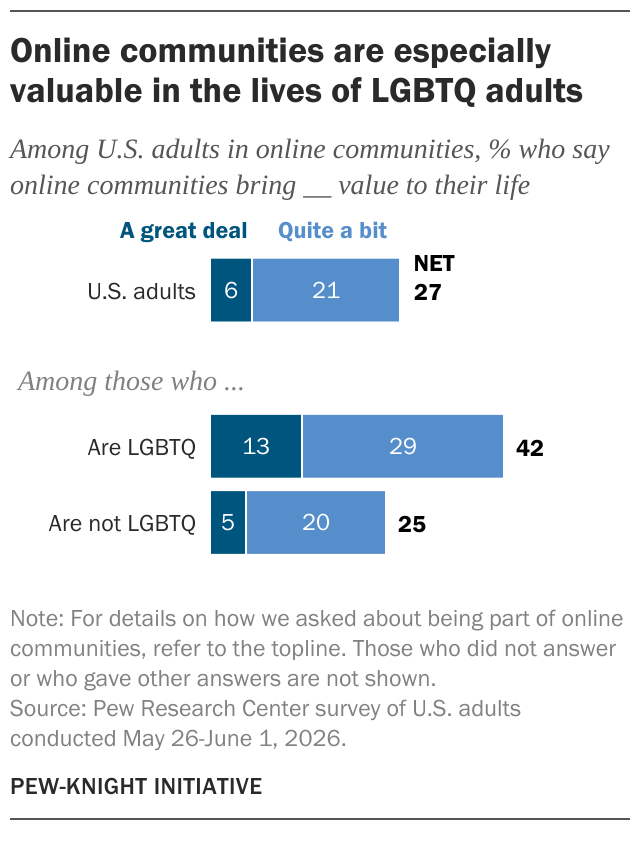
| A great deal | Quite a bit | NET | |
|---|---|---|---|
| U.S. adults | 6 | 21 | 27 |
| Among those who … | |||
| Are LGBTQ | 13 | 29 | 42 |
| Are not LGBTQ | 5 | 20 | 25 |
Among those in online communities:
- About four-in-ten LGBTQ Americans say these spaces bring a great deal or quite a bit of value to their lives, compared with a quarter of those who are not LGBTQ.
- 73% of LGBTQ adults say a reason they visit their go-to community is because they feel accepted there. This drops to about half for adults who aren’t LGBTQ.
LGBTQ adults in online communities are also more likely than those who aren’t LGBTQ to cite several other reasons for being involved in the spaces they visit most, like sharing thoughts and seeing if there’s drama. (The differences discussed hold up even when we take other factors into consideration, like age.)
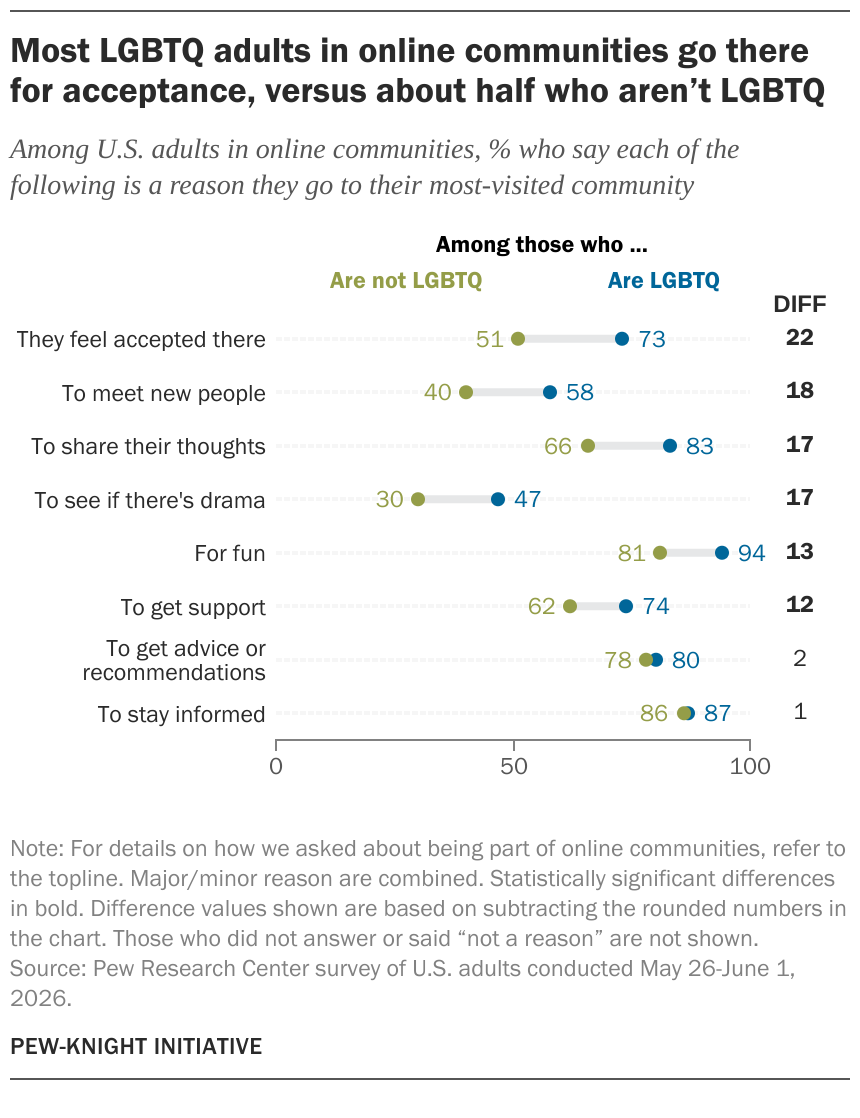
| Are LGBTQ | Are not LGBTQ | DIFF | |
|---|---|---|---|
| They feel accepted there | 73 | 51 | 22 |
| To meet new people | 58 | 40 | 18 |
| To share their thoughts | 83 | 66 | 17 |
| To see if there’s drama | 47 | 30 | 17 |
| For fun | 94 | 81 | 13 |
| To get support | 74 | 62 | 12 |
| To get advice or recommendations | 80 | 78 | 2 |
| To stay informed | 87 | 86 | 1 |
The importance of online connection for LGBTQ adults extends beyond the communities they participate in. LGBTQ Americans are more likely than those who aren’t LGBTQ to say relationships that form online can be just as meaningful as in-person ones (59% vs. 31%).
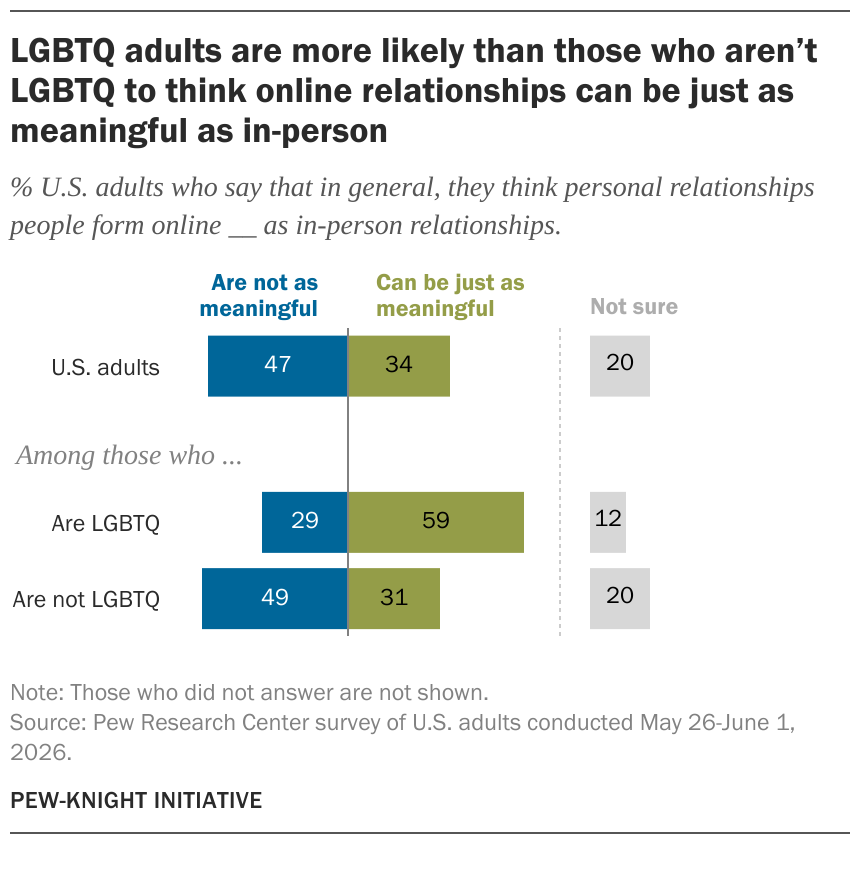
| Are not as meaningful | Can be just as meaningful | Not sure | |
|---|---|---|---|
| U.S. adults | 47 | 34 | 20 |
| Among those who … | |||
| Are LGBTQ | 29 | 59 | 12 |
| Are not LGBTQ | 49 | 31 | 20 |
The online communities people visit most cover a vast range of topics. LGBTQ adults also differ from those who are not LGBTQ in what kinds of online communities they’re part of overall. For example, they’re more likely to be part of spaces about movies, books or TV shows, hobbies, video games, and for people of their gender.
Chart: What kinds of online communities do LGBTQ adults stand out for being part of?
Even as online communities can offer connection and value, these spaces can have their downsides. LGBTQ adults who have left an online community are more likely than those who aren’t LGBTQ to say a reason for leaving was people being harassed (57% vs. 41%) or not feeling they belonged (57% vs. 44%).
Chart: Why do LGBTQ Americans leave online communities?
Note: Here are the survey questions used for this analysis, the detailed responses and the methodology.