Around two-thirds of Americans (65%) disapprove of the way President Donald Trump is handling the U.S. military action in Iran, while a third (33%) approve, according to a new Pew Research Center survey.
% who say they __ of how Donald Trump is handling the U.S. military action against Iran
% who say they are __ confident the Trump administration will achieve its goals in the conflict with Iran
How much longer do you think the U.S. military action against Iran will last? (%)
| % who __ of how Donald Trump is handling the U.S. military action against Iran | |||||
|---|---|---|---|---|---|
| NET Disapprove | Strongly disapprove | Somewhat disapprove | Somewhat approve | Strongly approve | NET Approve |
| 65 | 44 | 20 | 20 | 14 | 33 |
| % who are __ confident the Trump administration will achieve its goals in the conflict with Iran | |||||
| Not too/Not at all | Somewhat | Extremely/Very | Not sure | ||
| 52 | 16 | 16 | 8 | 15 | |
| % who say the U.S. military action against Iran will last another … | |||||
| Less than 1 month | 1 to 6 months | 6 to 12 months | More than a year | ||
| 2 | 18 | 30 | 47 | ||
The conflict has been unpopular with the American public from the start. But it has grown more so over time: In March, shortly after it began, 61% disapproved of Trump’s handling of the conflict while 37% approved.
Evaluations of the initial decision to use force are similar: 34% now view this as the right decision – down 4 percentage points from March.
On both measures, Republicans and Republican-leaning independents have grown more negative about the conflict. Democrats and Democratic leaners have remained overwhelmingly negative in their views.
Meanwhile, most Americans expect the conflict to continue for at least another six months, according to the new survey, conducted Sept. 28-Oct. 4, 2026, among 5,062 adults:
- 47% think it will last longer than another year, while 30% say it will last another six months to a year. Roughly two-in-ten say it will end in the next six months.
- In March, Americans were relatively optimistic the operation would end quickly: 43% said it would be over in six months or less.
How Republicans and Democrats view Trump’s handling of the Iran conflict
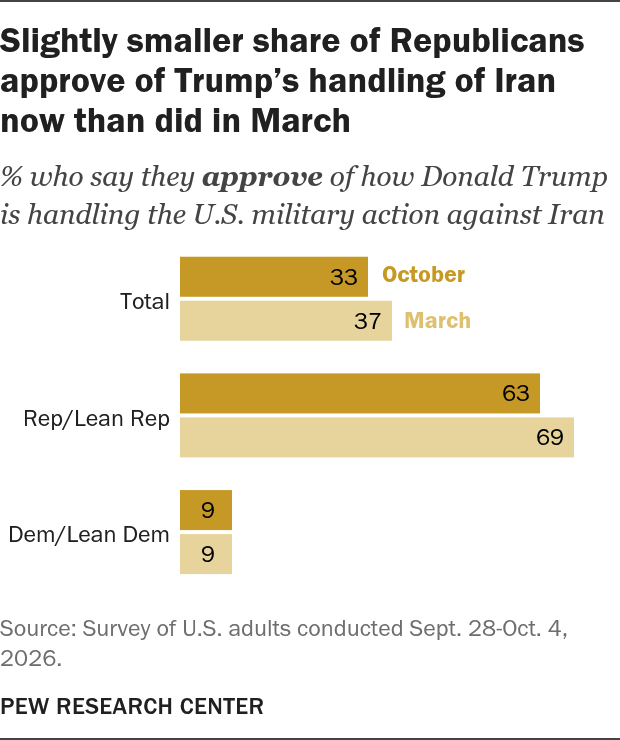
Republicans and Democrats continue to differ widely in their views of military action in Iran. But the partisan gap has narrowed somewhat, as Republican support for Trump’s handling of the conflict – as well as the initial decision to use military force – have declined over the last several months.
| Date | March | October |
|---|---|---|
| Total | 37 | 33 |
| Rep/Lean Rep | 69 | 63 |
| Dem/Lean Dem | 9 | 9 |
Today, 33% of adults say they approve of how Trump is handling the U.S. military action against Iran – down from 37% in March.
This decline has come entirely from Republicans: At the start of the conflict, 69% approved of his handling of the conflict. Today, 63% do. Democrats’ views are unchanged.
There is a similar pattern in views of the initial decision to use for in Iran.
Today, 65% of Republicans say the decision to use force in Iran was the right one – down from 71% in March. One-in-ten Democrats now say the initial decision was the right one – essentially unchanged.
What are Americans’ top concerns about the Iran conflict?
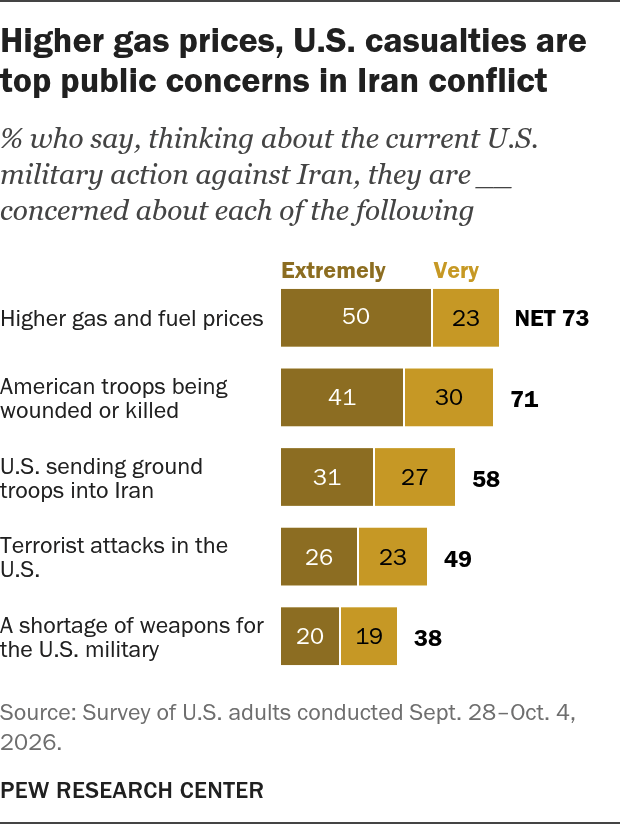
When asked about specific concerns related to the conflict with Iran, large majorities of adults say they are extremely or very concerned about higher gas and fuel prices (73%) and American troops being wounded or killed (71%).
| Topic | Extremely concerned | Very concerned | NET concerned |
|---|---|---|---|
| Higher gas and fuel prices | 50 | 23 | 73 |
| American troops being wounded or killed | 41 | 30 | 71 |
| U.S. sending ground troops into Iran | 31 | 27 | 58 |
| Terrorist attacks in the U.S. | 26 | 23 | 49 |
| A shortage of weapons for the U.S. military | 20 | 19 | 38 |
Democrats are more likely than Republicans to be concerned about higher gas prices and U.S. troops being wounded or killed. But majorities in both parties express these concerns.
A narrower majority of adults (58%) say they are extremely or very concerned about the U.S. sending ground troops into Iran. Democrats are far more likely than Republicans to say this (72% vs. 43%).
Americans express lower levels of concern about terrorist attacks in the U.S. (49% are extremely or very concerned) or a shortage of weapons for the U.S. military (38%).
Note: The survey was conducted prior to comments by Trump this week about Iran possibly striking U.S. cities.
How have Americans’ concerns about the Iran conflict changed?
Gas and fuel prices
Since March, there has been an increase in the share of Americans who say they are concerned about higher gas and fuel prices as a result of the conflict in Iran.
Much of this shift has come among Democrats: 85% say they are extremely or very concerned about this, up from 79% in March.
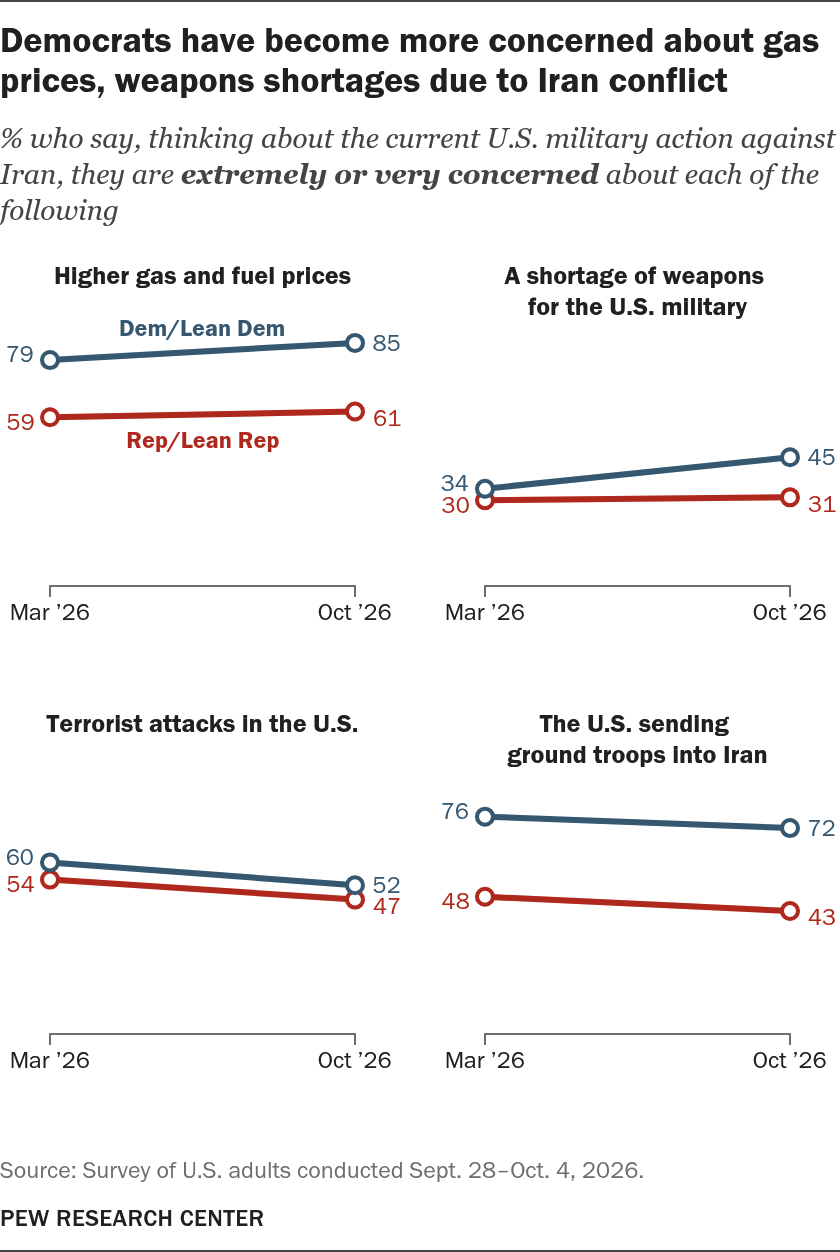
| Date | Statement | Total | Rep/Lean Rep | Dem/Lean Dem |
|---|---|---|---|---|
| 10-2026 | Higher gas and fuel prices | 73 | 61 | 85 |
| 03-2026 | Higher gas and fuel prices | 69 | 59 | 79 |
| 10-2026 | A shortage of weapons for the U.S. military | 38 | 31 | 45 |
| 03-2026 | A shortage of weapons for the U.S. military | 31 | 30 | 34 |
| 10-2026 | Terrorist attacks in the U.S. | 49 | 47 | 52 |
| 03-2026 | Terrorist attacks in the U.S. | 56 | 54 | 60 |
| 10-2026 | The U.S. sending ground troops into Iran | 58 | 43 | 72 |
| 03-2026 | The U.S. sending ground troops into Iran | 61 | 48 | 76 |
Among Republicans, 61% express this concern – largely consistent with the 59% who said this in March.
Weapons stockpiles
Democrats also now express higher levels of concern about a shortage of weapons for the U.S. military: 45% say they are extremely or very concerned about this, up from 34% in March.
Republicans’ concerns about weapons shortages are much lower and largely unchanged from the spring.
Terrorist attacks and ground troops
Since the start of the conflict, Americans in both partisan coalitions have grown less concerned about terrorist attacks at home and the possibility of the U.S. sending ground troops into Iran.
There continues to be a wide partisan gap, however, in views of the prospect of ground troops in Iran: 72% of Democrats are extremely or very concerned about this, while 43% of Republicans say the same.
Note: Here are the survey questions used for this analysis, the detailed responses and the survey methodology.