
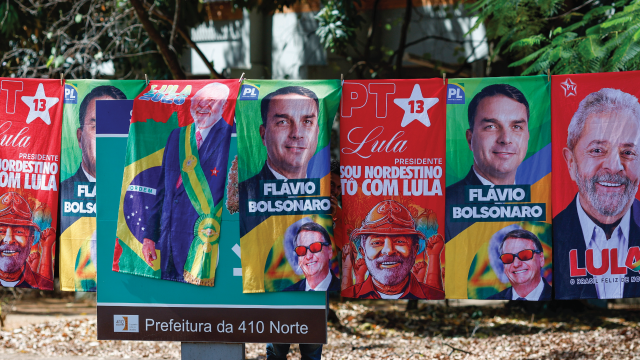
Brazilian President Luiz Inacio Lula da Silva is running for a fourth term in the general elections set to take place on Oct. 4. One of his prominent opponents is Sen. Flavio Bolsonaro, son of former President Jair Bolsonaro. If no candidate gets 50% of the votes in the first round, there will be a runoff on Oct. 25.
Among the issues at stake in this election are Brazil’s relationships with its main trading partners, China and the United States. Lula is likely to seek stronger trade relations with China if reelected. On the other hand, Flavio Bolsonaro is expected to align more closely with the Trump administration.
As Brazilians prepare to cast their ballots, here are four facts about how they view their country and Brazil’s main trading partners, according to a spring 2026 Pew Research Center survey.
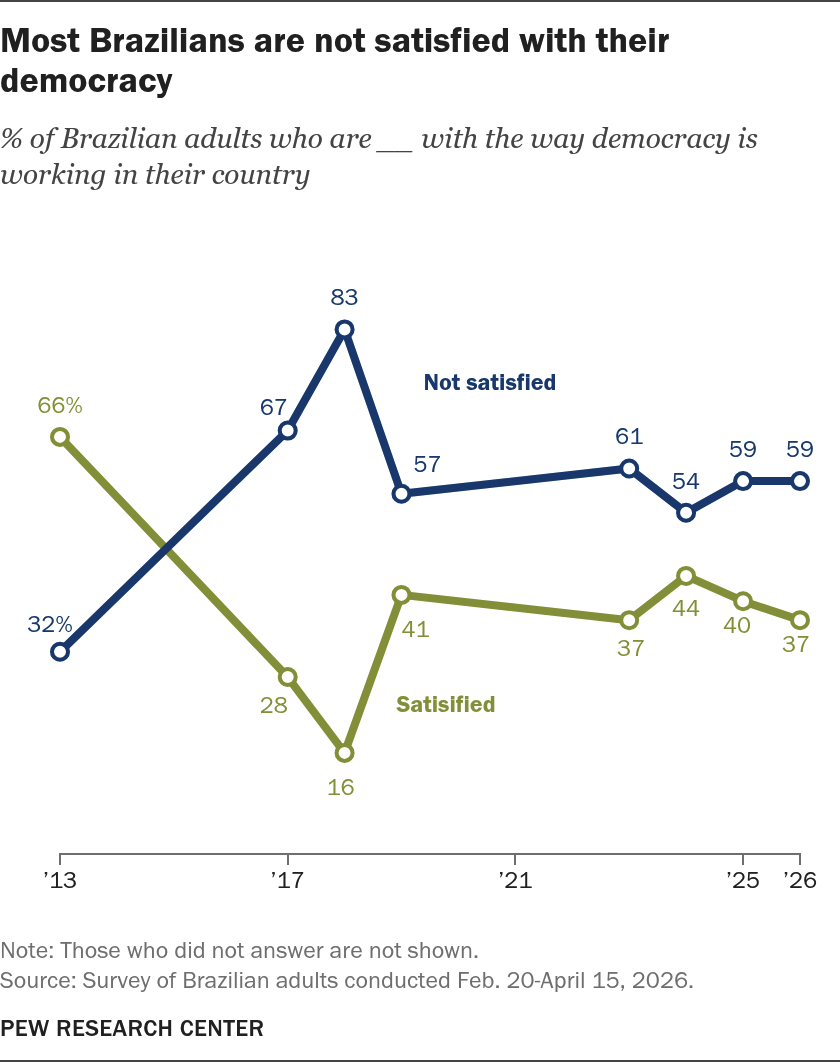
About four-in-ten Brazilian adults are satisfied with the way democracy is working in their country. Since Lula took office for a third term in January 2023, the share who say this has been relatively stable.
However, satisfaction has shifted a lot since we started asking this question in 2013.
Nearly two-thirds of Brazilians were happy with their democracy in 2013, under the administration of Dilma Rousseff. But in 2018, under President Michel Temer, 83% of Brazilians expressed dissatisfaction with their democracy. That’s the highest share in more than a decade of our surveys.
| Label | Satisified | Not satisfied |
|---|---|---|
| Spring 2026 | 37 | 59 |
| Spring 2025 | 40 | 59 |
| Spring 2024 | 44 | 54 |
| Spring 2023 | 37 | 61 |
| Spring 2019 | 41 | 57 |
| Spring 2018 | 16 | 83 |
| Spring 2017 | 28 | 67 |
| Spring 2013 | 66 | 32 |
Majorities of Brazilians lack confidence in elected officials (68%) and business leaders (57%) to act in the best interest of the public. But more express confidence in college and university professors, scientists, police officers and journalists to act in the public’s best interest than do not. Brazilians are divided when it comes to their confidence in the military and religious leaders.

| Not too much/None at all | A lot/Some | |
|---|---|---|
| College and university professors | 24 | 73 |
| Scientists | 27 | 70 |
| Police officers | 42 | 56 |
| Journalists | 43 | 54 |
| The military | 46 | 51 |
| Religious leaders | 47 | 50 |
| Business leaders | 57 | 39 |
| Elected officials | 68 | 29 |
Brazilians who support the governing party and its coalition partners are more likely than other Brazilians to express confidence in some of these groups:
- College and university professors (87% among supporters vs. 68% among others)
- Elected officials (41% vs. 25%)
- Journalists (63% vs. 51%)
Brazilians view their two main trading partners, China and the U.S., in a similar light: 47% have a favorable view of the U.S. and 46% have a positive view of China.

| Label | U.S. | China |
|---|---|---|
| Spring 2026 | 47 | 46 |
| Spring 2025 | 56 | 51 |
| Spring 2024 | 64 | 45 |
| Spring 2023 | 63 | 39 |
| Spring 2019 | 56 | 51 |
| Spring 2018 | 55 | 49 |
| Spring 2017 | 50 | 53 |
| Spring 2015 | 73 | 55 |
| Spring 2014 | 64 | 44 |
| Spring 2013 | 72 | 65 |
| Spring 2012 | 61 | 50 |
| Spring 2011 | 61 | 49 |
| Spring 2010 | 63 | 52 |
Attitudes toward these two powers have fluctuated greatly over the years. Since President Donald Trump’s second term began, Brazilians’ favorability toward the U.S. has sharply declined. Meanwhile, views of China have become more positive since 2023, when favorable views of China were near historic lows.
Brazilians’ views of each country vary heavily by ideology. Brazilian adults who place themselves to the ideological left are more likely than those on the right to think positively of China (57% vs. 40%).
The opposite is true for views of the U.S.: 30% of those on the left view the U.S. favorably, compared with 58% of those on the right.
Related: How do views of the U.S. and China compare in Latin America?
Three-in-ten Brazilians express confidence in Trump to do the right thing regarding world affairs. This has not changed significantly since last year.
Although confidence in Trump remains low, the share of Brazilians who say this has doubled since 2018, when 15% of Brazilians had confidence in him.
Meanwhile, 22% of Brazilians have confidence in Chinese President Xi Jinping.
Like with views of the U.S. and China, confidence in these countries’ leaders depends on where Brazilians place themselves in the ideological spectrum. Brazilians on the right are about three times as likely as those on the left to express confidence in Trump (46% vs. 14%). And they are less likely than those on the left to say the same about Xi (18% vs. 31%).
Note: Here is the survey methodology used for this analysis. Refer to toplines for questions about Brazilians’ views of their country, their views of the U.S. and President Donald Trump, and their views of China and President Xi Jinping.
