
A new Pew Research Center survey finds that views of the United States have grown more negative over the last year in five of six Latin American countries surveyed. Views of China, on the other hand, have mostly held steady. As a result, ratings of the two countries are now fairly close in several places throughout the region.
The U.S. and China have both spent significant resources to exert influence over Latin America. China, for example, is South America’s top trading partner and has developed close economic and security ties with countries including Brazil and Peru. President Donald Trump, meanwhile, declared at the Shield of Americas summit in March 2026 that the U.S. would “not allow hostile foreign influence to gain a foothold in this hemisphere,” which prompted a response from China’s foreign minister.
In this report, we compare views of the U.S. and China based on a new Pew Research Center survey of 6,132 people in Argentina, Brazil, Chile, Colombia, Mexico and Peru. These findings are part of a broader report on how people in 36 countries see the U.S. and China.
Across Latin America, we find that:
- Views of China are now slightly more positive than views of the U.S., due largely to worsening views of the U.S.
- People generally lack confidence in both Trump and Chinese President Xi Jinping to do the right thing regarding world affairs.
- People are much more likely to say the U.S. interferes in the affairs of other countries than they are to say the same of China, but the two superpowers are seen in a fairly similar light when it comes to their reliability as a partner and contributions to global peace and stability.
Views of the U.S., China and their leaders
In four of the six Latin American countries surveyed – Argentina, Chile, Mexico and Peru – people now view China more favorably than the U.S. In Brazil and Colombia, views of the two countries are about even.
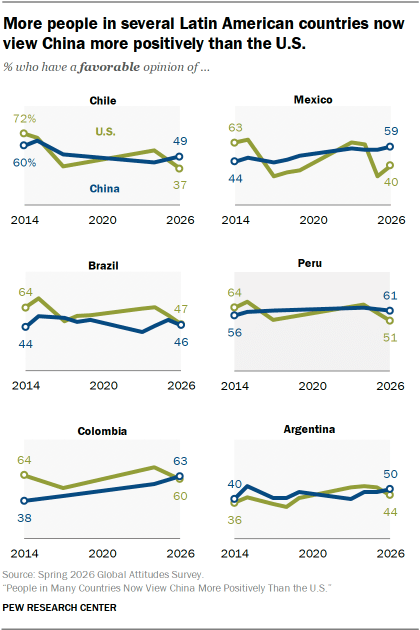
This marks a significant change from older surveys. In 2014, people in each of these countries (except Argentina) viewed the U.S. more positively than China.
In Brazil, Chile and Peru, views of the U.S. today are on par with 2017 levels, which are the least favorable we have measured in our surveys.
In Brazil, people on the ideological right are much more likely than those on the left to have a positive view of the U.S. (58% vs. 30%). The opposite is true for China, with Brazilians on the right less favorable than those on the left (40% vs. 57%). Views in Colombia follow the same ideological pattern.
In several of these countries, views of the U.S. and China also differ by age. Younger adults in Brazil, Chile, Mexico and Peru are more likely than older adults to view both superpowers positively. In Mexico, for example, 52% of people ages 18 and 34 view the U.S. positively, and 70% view China positively. In Brazil, around six-in-ten people under 35 have a positive view of both countries, compared with around four-in-ten of those ages 50 and older.
People in these six countries generally lack confidence in both U.S. President Donald Trump and Chinese President Xi Jinping to do the right thing regarding world affairs. In none of the six nations does either leader receive a majority-confident rating.
But views vary here. Mexican adults are about three times more likely to have confidence in Xi than Trump (35% vs. 11%). Colombian adults, on the other hand, are more positive toward Trump than Xi (43% vs. 33%). For more on how these leaders compare in the full 36-country survey, refer to “Confidence in Trump and Xi.”
Views of U.S. and Chinese foreign policy role
In each of the six Latin American countries surveyed, large majorities say the U.S. interferes in the affairs of other countries, while fewer say China does this. In Colombia, for example, 75% say the U.S. interferes a great deal or a fair amount, compared with 30% who say the same about China.
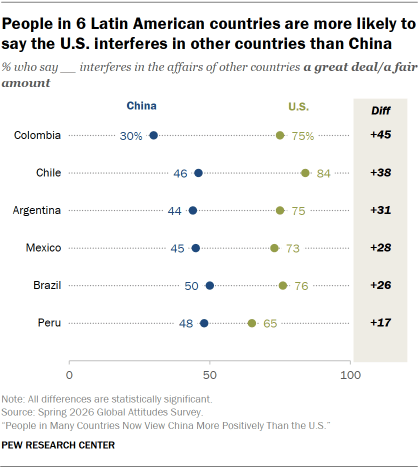
In Argentina, Brazil and Mexico, we asked this same question in 2023. Since then, the shares saying the U.S. interferes in the affairs of other countries have not changed significantly, but the shares saying China interferes have decreased in Brazil and Mexico.
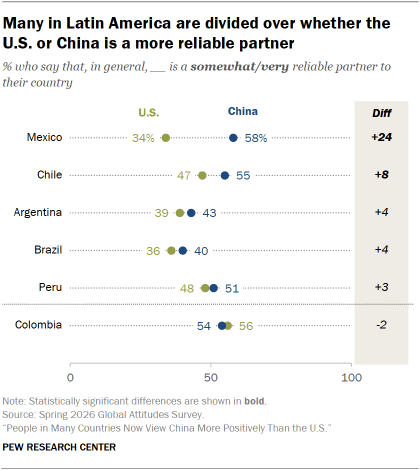
When it comes to which country is a more reliable partner, views are more divided. In Mexico and Chile, more say that China is a reliable partner than the U.S.
In the other four Latin American countries surveyed, there is no clear difference. In Argentina and Brazil, around four-in-ten say the U.S. and China are reliable partners. In Peru and Colombia, roughly half or more describe them this way.
Similarly, in four of the six countries surveyed, there is no significant difference in the shares who say that the U.S. and China account for the interests countries like theirs when making international policy decisions. In Mexico and Peru, more say China accounts for other countries’ interests.
And people in these six countries feel differently when it comes to views that the U.S. and China contribute to peace and stability around the world. In Mexico, people are more likely to say China contributes to peace than the U.S. (47% vs. 28%). But in Colombia, people are slightly more likely to say the U.S. contributes to peace than China (34% vs. 26%).
Views of the U.S. and Chinese governments’ respect for personal freedoms
In Argentina, Chile, Brazil and Colombia, more people still say the U.S. government respects its people’s personal freedoms than say the Chinese government does. Though half or more say each government does not respect its people’s freedoms. And the gap between the U.S. and China on this question has generally shrunk.
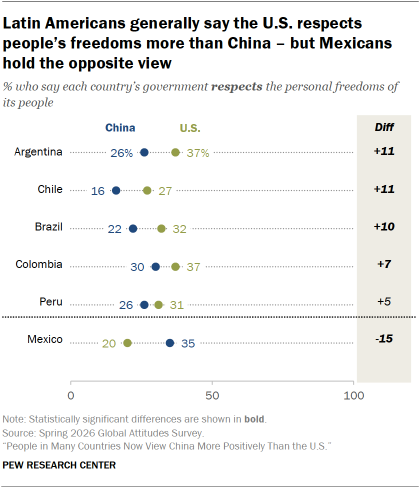
In 2014, people in all six Latin American countries surveyed were much more likely to say the U.S. government respects the personal freedoms of its people than to say the same of the Chinese government. In Chile, for example, around half (53%) said this of the U.S., while just 20% said the same of China.
Now the gap is smaller, driven largely by declines in the shares saying the U.S. government respects personal freedoms. Since we last asked these questions in 2018, the percentage saying the U.S. respects its people’s freedoms has declined in all of these countries except Argentina, where it has held steady.
In most of these countries, the shares saying China respects its people’s freedoms have not changed since we last asked the question. Colombia is the exception, where the share saying China respects personal freedoms increased from 19% in 2017 to 30% in 2026.


