Democrats and Republicans vary a lot in how they rate themselves ideologically, and most don’t see themselves in perfect alignment with their party. In both coalitions, those who say they are more liberal or conservative than their party are also more critical of it.
| Response numeric | Response | Dem/Lean Dem | Rep/Lean Rep (data) | Rep/Lean Rep |
|---|---|---|---|---|
| 0 | (0) Very liberal | 10% | 1 | 1% |
| 1 | 1 | 8 | 0.5 | <1 |
| 2 | 2 | 14 | 1 | 1 |
| 3 | 3 | 16 | 2 | 2 |
| 4 | 4 | 12 | 4 | 4 |
| 5 | 5 | 25 | 18 | 18 |
| 6 | 6 | 4 | 13 | 13 |
| 7 | 7 | 3 | 16 | 16 |
| 8 | 8 | 2 | 16 | 16 |
| 9 | 9 | 1 | 11 | 11 |
| 10 | (10) Very conservative | 2 | 17 | 17 |
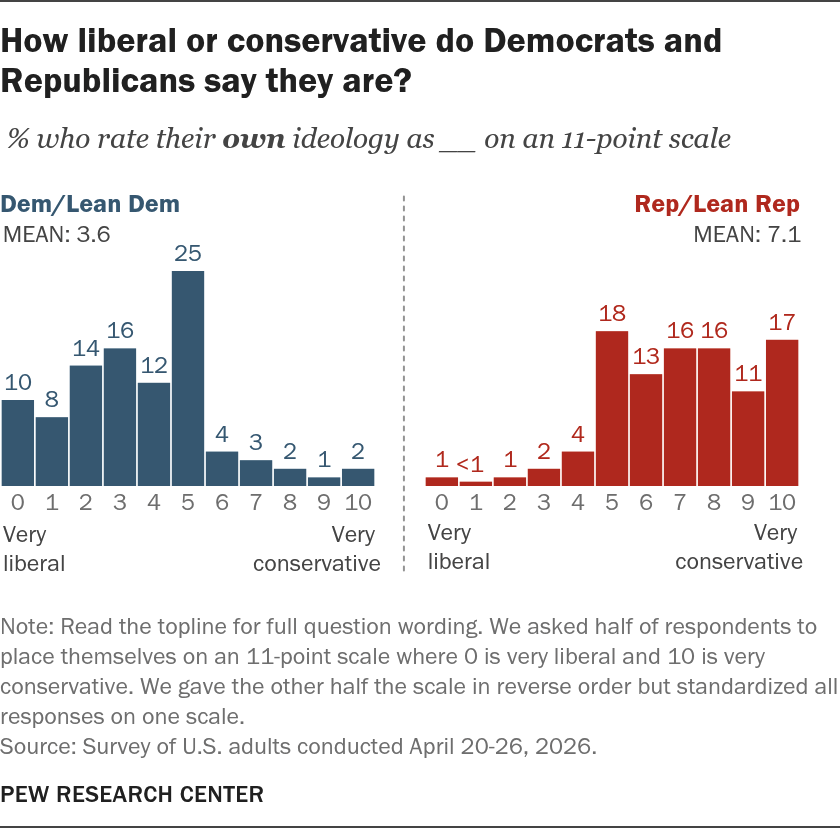
In a survey of 5,103 U.S. adults from April 20 to 26, 2026, we asked people to rate themselves on an 11-point scale, where 0 is very liberal and 10 is very conservative. A majority of Democrats and Democratic-leaning independents (60%) place themselves to the left of center. But Democrats’ average of 3.6 is closer to the middle of the scale (5) than to the very liberal end (0).
Similarly, 73% of Republicans and GOP leaners place themselves to the right of center, and the average of 7.1 is closer to the middle (5) than the very conservative end (10).
The average placement Democrats and Republicans give their parties is very similar to how they rate themselves. But only about a quarter in each coalition give themselves the exact same rating that they give their party. Instead:
- 39% of Democrats rate themselves as more liberal than how they rate the Democratic Party, while 36% rate themselves as more conservative.
- The pattern is nearly identical among Republicans: 38% rate themselves more conservatively than they rate the GOP, and 36% rate themselves as more liberal.
Party favorability and ideology within the partisan coalitions
| Party | Group | % who view own party favorably | % who view own party unfavorably |
|---|---|---|---|
| Dem/Lean Dem | Total | 70 | 30 |
| Dem/Lean Dem | Place themselves to the left of own party (39%) | 68 | 32 |
| Dem/Lean Dem | Place themselves the same as own party (23%) | 78 | 21 |
| Dem/Lean Dem | Place themselves to the right of own party (36%) | 67 | 32 |
| Rep/Lean Rep | Total | 75 | 24 |
| Rep/Lean Rep | Place themselves to the left of own party (36%) | 68 | 31 |
| Rep/Lean Rep | Place themselves the same as own party (26%) | 82 | 18 |
| Rep/Lean Rep | Place themselves to the right of own party (38%) | 77 | 22 |
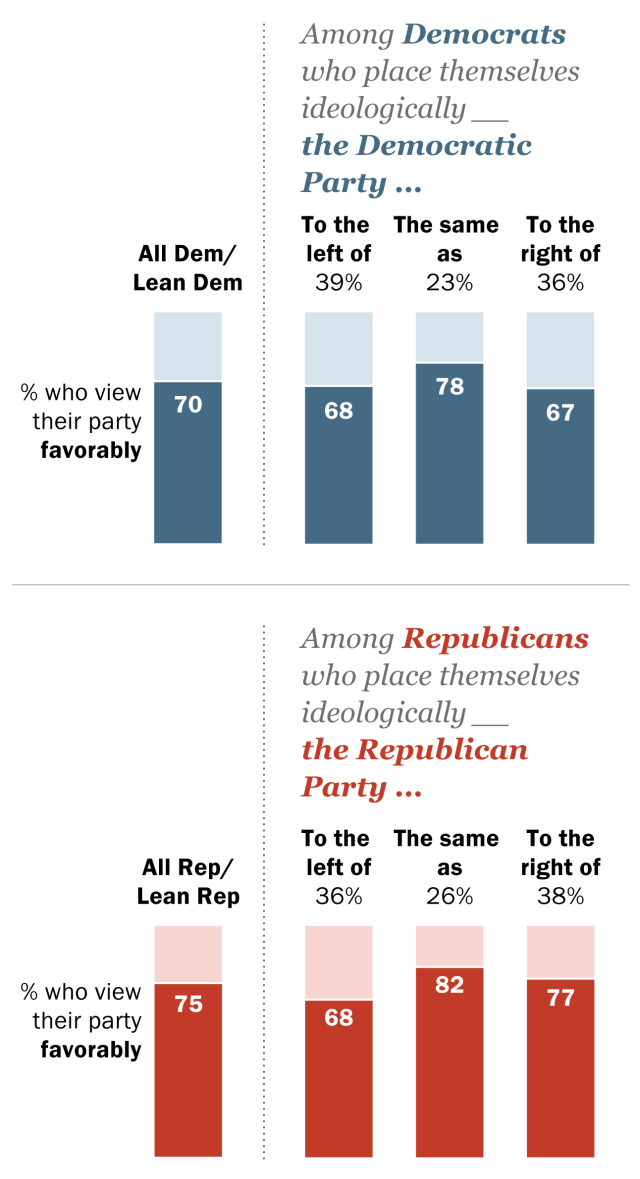
In both coalitions, those who rate their ideology the same as they rate that of their party express more favorable views of the party overall.
About eight-in-ten Democrats and Democratic leaners who give themselves and their party the same ideological rating (78%) view the Democratic Party favorably. Smaller shares of Democrats who see themselves as more liberal (68%) or more conservative (67%) view the party favorably.
Similarly, 82% of Republicans and leaners who rate their ideology and their party’s ideology the same have favorable views of the GOP. The party’s rating is nearly as positive among those who say they’re more conservative than it (77%). By comparison, Republicans who say they’re more liberal than the GOP (68%) view their party less favorably.
Where do Americans place the parties?
| Group | grouping | Themselves | The Republican Party | The Democratic Party |
|---|---|---|---|---|
| Total | total | 5.3 | 7.2 | 2.8 |
| Rep/Lean Rep | party | 7.1 | 6.9 | 1.8 |
| Dem/Lean Dem | party | 3.6 | 7.7 | 3.8 |
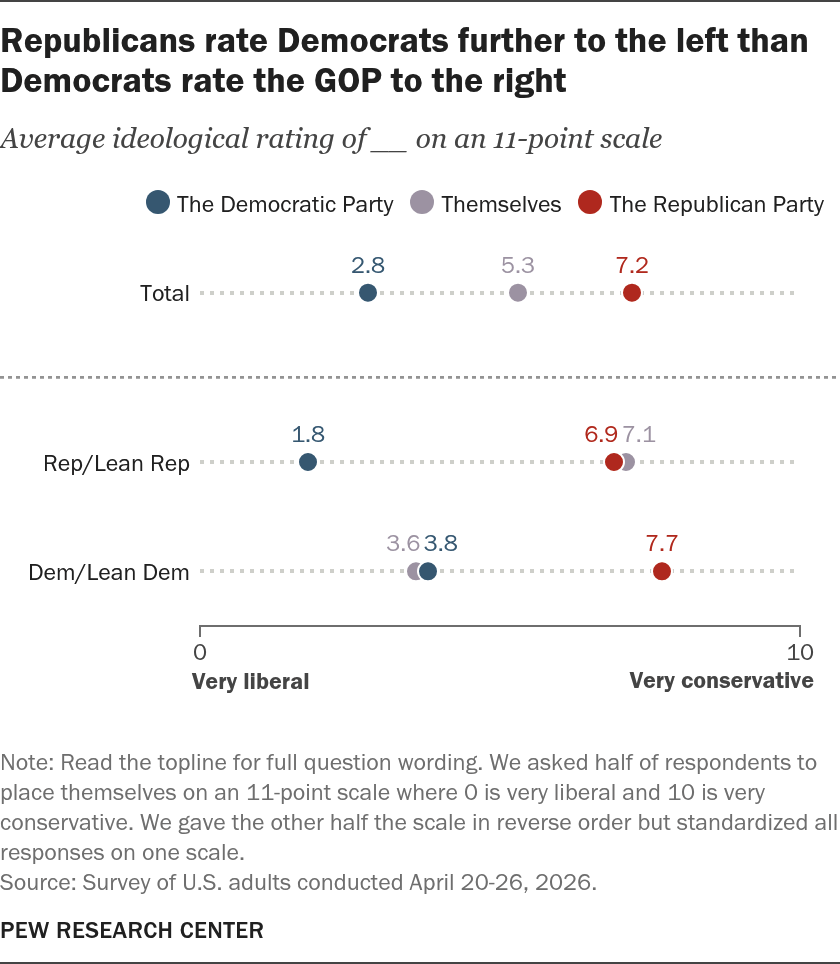
Democrats and Republicans alike (including those who lean to each party) generally place the Democratic Party left of center and the Republican Party right of center on the 11-point scale. But Democrats and Republicans rate the opposite party further from the center than they rate their own party:
- While Republicans give their party a 7.1 average rating, Democrats rate the GOP further to the right at 7.7.
- And while Democrats give their party a 3.8 rating, Republicans place it 2 full points further left (1.8).
When looking instead at the shares of people in each coalition who give each party the most liberal or conservative score:
- 14% of Republicans give the Republican Party the most conservative score, while Democrats are more than twice as likely (38%) to do the same for the GOP.
- 51% of Republicans give the Democratic Party the most liberal rating possible. Just 8% of Democrats do the same.
How views of the parties have changed
While Americans have long placed the two parties far apart ideologically, that distance is somewhat wider than it was a decade ago.
Americans’ ideological ratings of the Republican Party have shifted rightward, from an average of 6.9 in 2016 to 7.2 today. Their ratings of the Democratic Party have moved to the left by the same amount, from 3.1 to 2.8.
Note: Here are the 2026 survey questions we used for this analysis, the detailed responses and the survey methodology.