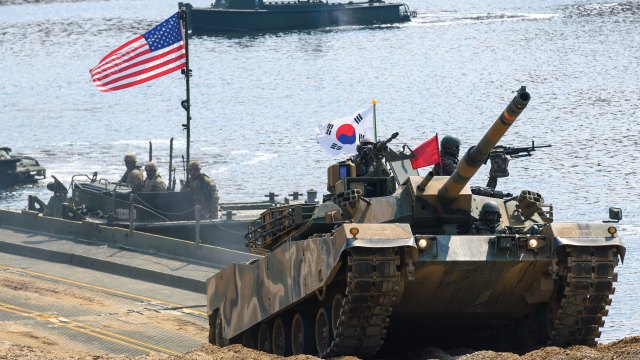
U.S. President Donald Trump recently ordered the Pentagon to scale back annual joint military exercises with South Korea. In response, South Korean President Lee Jae Myung reiterated his push for military independence from the United States.
U.S.-South Korean relations have been strained during Trump’s second term, following tense trade negotiations earlier this year.
Pew Research Center has surveyed the South Korean public consistently for over two decades. Here are five facts about how South Koreans view the U.S. and their bilateral relationship during the second Trump administration:
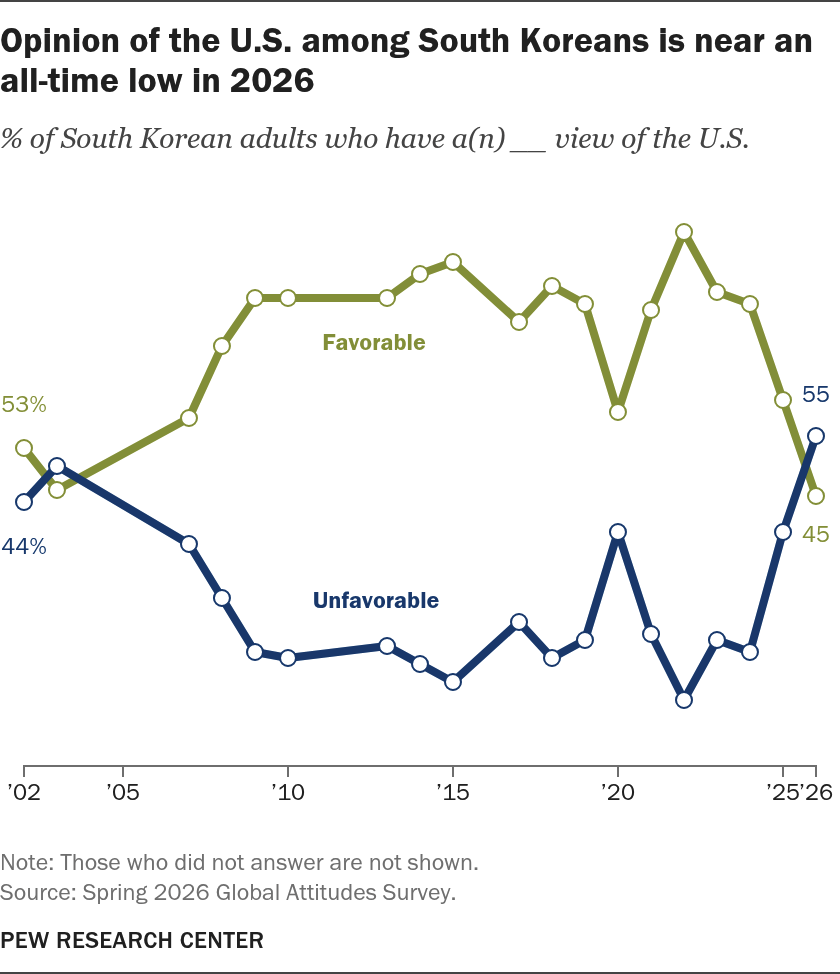
For the first time in over 20 years, a majority of South Koreans have an unfavorable opinion of the U.S. In our survey this past spring – before Trump’s call to scale back joint military exercises – 55% of South Koreans expressed an unfavorable view of the U.S., up from 39% last year. That included 18% with a very unfavorable view, up from 9% in 2025.
Fewer than half of South Koreans (45%) have a favorable view of the U.S. today, marking a 16-point drop from last year (61%) and a 35-point drop from 2018, the second year of Trump’s first term (80%).
| Date | Label | Favorable | Unfavorable |
|---|---|---|---|
| 2026 | Spring 2026 | 45 | 55 |
| 2025 | Spring 2025 | 61 | 39 |
| 2024 | Spring 2024 | 77 | 19 |
| 2023 | Spring 2023 | 79 | 21 |
| 2022 | Spring 2022 | 89 | 11 |
| 2021 | Spring 2021 | 76 | 22 |
| 2020 | Summer 2020 | 59 | 39 |
| 2019 | Spring 2019 | 77 | 21 |
| 2018 | Spring 2018 | 80 | 18 |
| 2017 | Spring 2017 | 74 | 24 |
| 2015 | Spring 2015 | 84 | 14 |
| 2014 | Spring 2014 | 82 | 17 |
| 2013 | Spring 2013 | 78 | 20 |
| 2010 | Spring 2010 | 78 | 18 |
| 2009 | Spring 2009 | 78 | 19 |
| 2008 | Spring 2008 | 70 | 28 |
| 2007 | Spring 2007 | 58 | 37 |
| 2003 | May 2003 | 46 | 50 |
| 2002 | Summer 2002 | 53 | 44 |
South Koreans are much less likely than a few years ago to view the U.S. as a reliable partner to their country.
While around six-in-ten South Korean adults (57%) consider the U.S. a reliable partner, that’s down from 83% in 2022, when we last asked this question during the Biden administration.
| Date | Label | A great deal/a fair amount | Not too much/not at all |
|---|---|---|---|
| 2026 | Spring 2026 | 21 | 78 |
| 2023 | Spring 2023 | 38 | 61 |
| 2021 | Spring 2021 | 31 | 68 |
| 2018 | Spring 2018 | 24 | 75 |
| 2013 | Spring 2013 | 35 | 63 |
| 2010 | Spring 2010 | 32 | 66 |
| 2009 | Spring 2009 | 35 | 63 |
| 2007 | Spring 2007 | 16 | 79 |
| 2003 | May 2003 | 22 | 76 |
| 2002 | Summer 2002 | 23 | 73 |
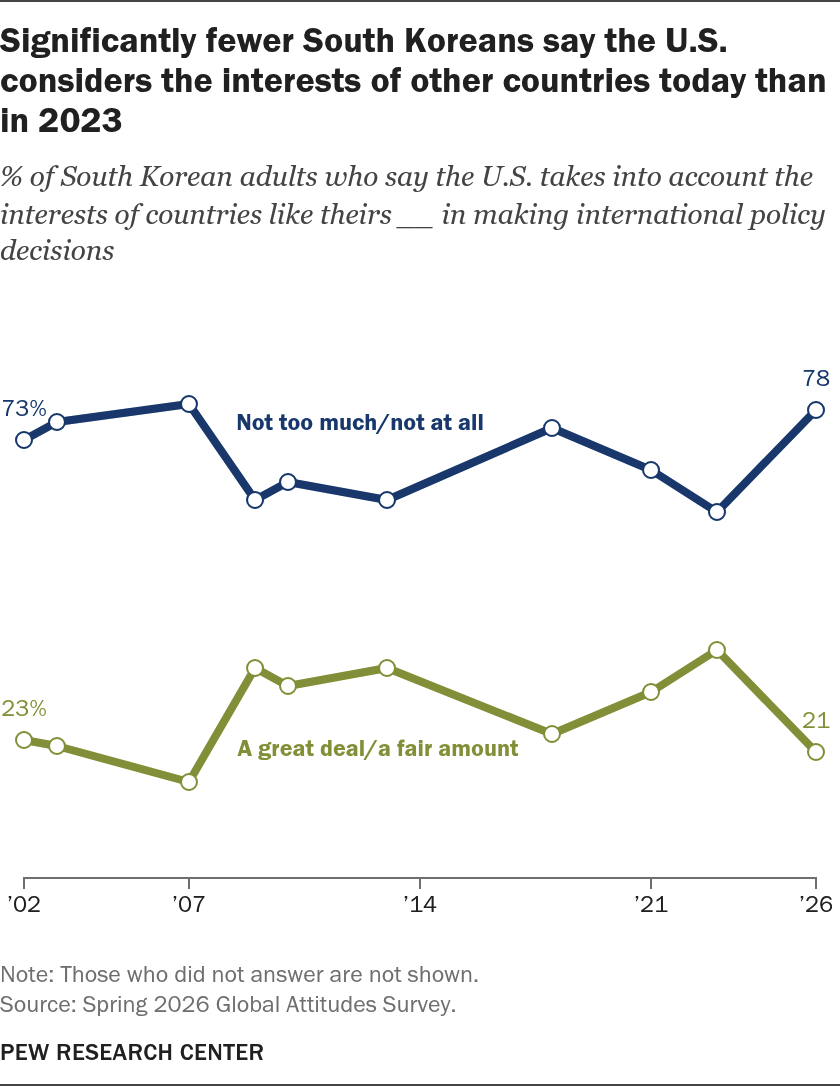
There has also been a decrease in the share of South Koreans who think the U.S. takes into account the interests of countries like their own when making international policy decisions. This year, 21% of South Koreans think the U.S. does this a great deal or a fair amount. That’s down from 38% in 2023, when we last asked.
The share of South Koreans who say the U.S. contributes a great deal or a fair amount to peace and stability around the world has also fallen, from 74% in 2023 to 47% this year.
A broad majority of South Koreans (85%) disapprove of the way Trump is dealing with tariffs, including 63% who strongly disapprove. Only 14% approve of the U.S. president’s handling of tariffs. Earlier this year, Trump threatened to raise tariffs on South Korean goods to 25% if the country’s legislature did not approve a proposed trade deal. Lawmakers later approved the deal.
Around three-quarters of South Koreans disapprove of the way Trump is dealing with Iran. That includes nearly half (47%) who strongly disapprove. Trump cited South Korea’s apparent reluctance to assist in the U.S. military conflict with Iran when he called for reducing joint military exercises.
Despite viewing the U.S. less favorably this year, South Koreans still overwhelmingly name the U.S. as their country’s most important ally. This share has decreased slightly since last year (84% vs. 89%). In 2025, South Koreans were more likely than people in all but one other of 24 surveyed countries – Israel – to name the U.S. as their most important ally. At the same time, South Koreans have consistently viewed North Korea as the greatest threat to their nation.
Only Japan and Germany host more U.S. troops than South Korea. As of March 2026, roughly 23,400 active-duty U.S. military personnel were stationed in South Korea, according to the Defense Manpower Data Center, a division of the U.S. Defense Department.
The size of the U.S. military force in South Korea has been fairly stable for more than a decade – around 25,000, give or take a few thousand. As recently as March 2014, however, more than 30,000 active-duty troops were stationed there.
The U.S. military presence in South Korea often is described as a “tripwire” intended to deter a potential North Korean invasion. In the event of such an invasion, the theory goes, the presence of American troops in the combat zone would guarantee a large-scale U.S. intervention.
Note: Here are the survey questions used for this analysis, along with responses, and the survey methodology.