
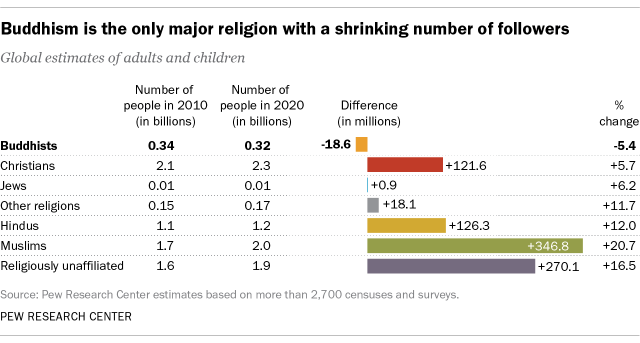
Buddhists are the world’s only major religious group whose population shrank between 2010 and 2020, according to a recent Pew Research Center analysis of religion in 201 countries and territories.
In 2010, an estimated 343 million people around the world identified as Buddhists. By 2020, that figure had fallen to 324 million. That’s a decline of roughly 5%.
During this period, the global population grew by 12%. The size of other religious groups we track at the global level also grew. As a result, Buddhists’ share of the global population dropped from 4.9% in 2010 to 4.1% in 2020.
But why were there fewer Buddhists in 2020 than in 2010?
- Buddhists globally are relatively old and tend to have few children. So there are a lot of adults nearing the end of their lives and fewer children to replace them.
- Many people who were raised as Buddhists in childhood no longer identify with Buddhism in adulthood, a process known as religious switching. Although some people also convert to Buddhism, more people are leaving than joining.
These dynamics are tied to geography. Nearly all Buddhists – 98% – live in the Asia-Pacific region, and around four-in-ten live in five East Asian places: China, Japan, South Korea, Taiwan and Hong Kong. In East Asia, the median age is higher than in other parts of the world, birth rates tend to be low, and many adults have left their childhood religions. Between 2010 and 2020, the total number of Buddhists in the five East Asian places fell by 32 million, or 22%.
Related: 5 facts about Buddhists in the United States
Aging population with low fertility
Buddhists are older, on average, and have fewer children than any other worldwide religious group we routinely study.
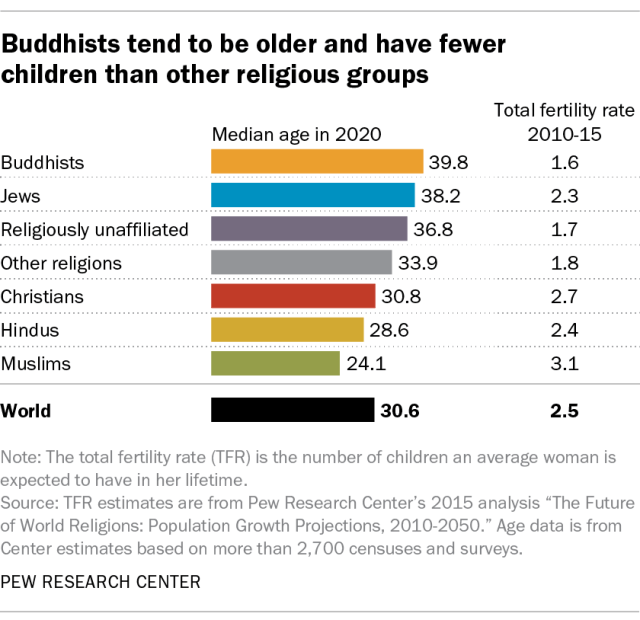
The median age of Buddhists around the world was roughly 40 as of 2020. That was nine years older than the median age of the overall global population (31). It was also older than the median age of Jews (38), Christians (31), Hindus (29) and Muslims (24).
Buddhists around the world were estimated to have 1.6 children per woman, according to Pew Research Center’s most recent estimates for 2010-2015.
That’s about one full child less than the average fertility level for women globally. It’s also well below the minimum of 2.1 children per woman that typically is needed for a population to stay the same size (without other factors like immigration or, in the case of religious groups, conversion). This number is also known as replacement-level fertility. Buddhists are the only religion in our analysis whose 2010-2015 global fertility rate was below replacement level.
Related: 5 facts about global fertility trends
When a group’s fertility rates stay low over time, its age structure changes. Think of it like a pyramid. Initially, there are a lot of young people at the bottom and fewer elderly people on top, but over time it changes to a brick or even an upside-down pyramid, with lots of aging people on top and relatively few children underneath. During this process, the population first grows slowly and, eventually, shrinks.
We see this dynamic occurring in East Asia, where people in general – not just Buddhists – are relatively old and have relatively few children. That is slowing population growth.
The combined populations of China, Japan, South Korea, Taiwan and Hong Kong grew by just 5% between 2010 and 2020. By contrast, the number of people living elsewhere in the Asia-Pacific region increased by 13%, and the rest of the world’s population expanded by 16% over the same decade.
Related: Buddhism’s Recent Decline in Asia
Religious switching
The decline of Buddhism also is a result of religious switching. We use that phrase to describe any change between the religious group in which a person says they were raised (in childhood) and their present religious identity (as an adult).
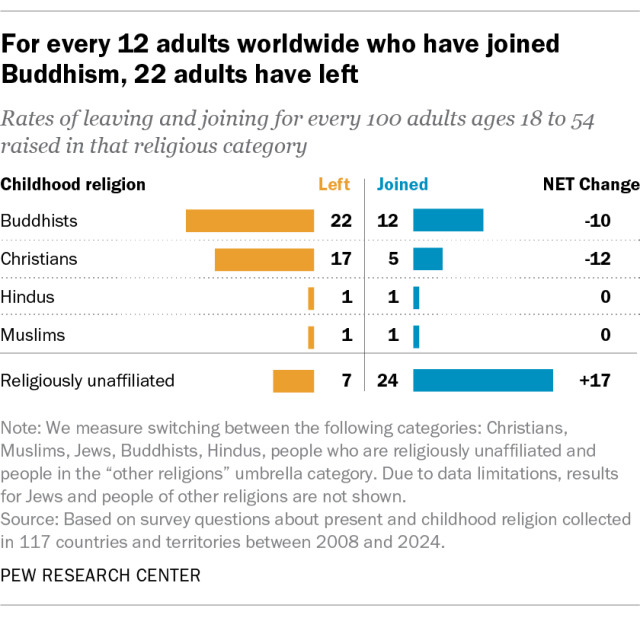
Globally, Buddhism has attracted many converts. For every 100 adults who were raised Buddhist, 12 adults have joined, according to a Center analysis of people ages 18 to 54. In proportion to its population, Buddhism gains more converts than Christianity, Hinduism or Islam do. (Due to data limitations, we don’t have comparable worldwide figures for Judaism or other religions.)
However, Buddhism also loses a higher share of its adherents than any other world religion we study. For every 100 adults who were raised Buddhist, 22 have left Buddhism and now identify with other religions or with no religion.
As a result of this switching in both directions, there is a net loss of 10 adherents for every 100 people raised Buddhist.
These switching dynamics are pronounced in East Asia and mostly absent in other parts of Asia. In Japan, roughly half of adults raised Buddhist have left the religion, while in South Korea, six-in-ten have done so, according to 2024 Center surveys. But in Thailand – a Southeast Asian country that has the world’s largest Buddhist population – nearly all people who say they were raised Buddhist still identify as Buddhist today.
Related: Globally, 1 in 10 adults under 55 have left their childhood religion