This is one of five detailed sections in a report on how Black Americans define and support their family networks. The report also includes an overview of key findings.
Families that give and receive emotional support can play a key role in emotional well-being, social connections and physical health. For Black Americans, family is often characterized by close relationships with nuclear, extended and non-relative family members.
To understand these relationships, we conducted a national survey of U.S. adults – including 4,271 Black adults – in June 2025 to ask what their family emotional support networks look like. Who do they receive emotional support from, who do they give it to and how do these relationships make them feel?
The survey finds that exchanging support with a spouse or partner is most common. But Black adults are more likely than other Americans to share emotional support with people researchers usually refer to as extended family, such as grandparents, cousins, and aunts or uncles. Generally speaking, giving emotional support to family is a mostly positive experience for Black Americans.
Who do Black adults seek emotional support from?
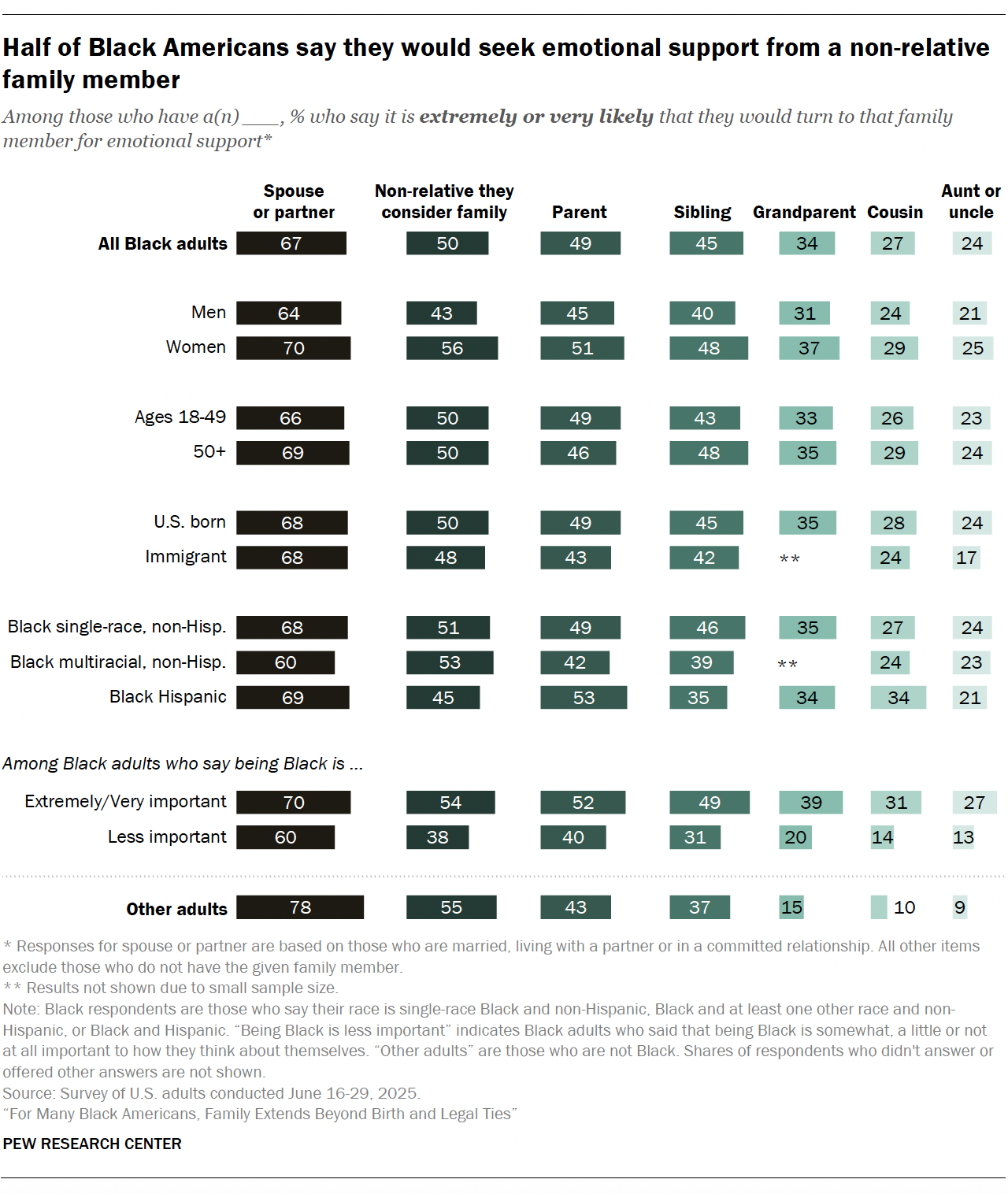
Two-thirds of Black adults say it is extremely or very likely that they would turn to their spouse or partner for emotional support. And about half would seek emotional support from a non-relative they consider family (50%), a parent (49%) or a sibling (45%).
Smaller shares say they would turn to extended family when seeking emotional support, although Black adults are more likely to do this than other Americans.
- 34% of Black adults say they are extremely or very likely to turn to a grandparent for emotional support, while 15% of other adults say they would do the same.
- 27% of Black adults say they would turn to a cousin for this support, compared with 10% of other adults.
- 24% of Black adults would turn to an aunt or uncle for emotional support, compared with 9% of other adults.
However, Black adults are less likely than other Americans to say they would turn to a spouse or partner (67% vs. 78%) or a non-relative they consider family (50% vs. 55%).
Differences by demographic group and views of Black identity
Black adults who say being Black is an important part of their personal identity are more likely than those who say Blackness is less important to seek emotional support from family. For example, 39% of those who say being Black is important to them say they would seek emotional support from a grandparent. That’s roughly double the share among those who see being Black as less important (20%).
Gender also plays a role: Black women are more likely than Black men to seek emotional support from nearly every family member included in the survey. (They’re about equally likely to seek support from grandparents.)
Who do Black adults give emotional support to?
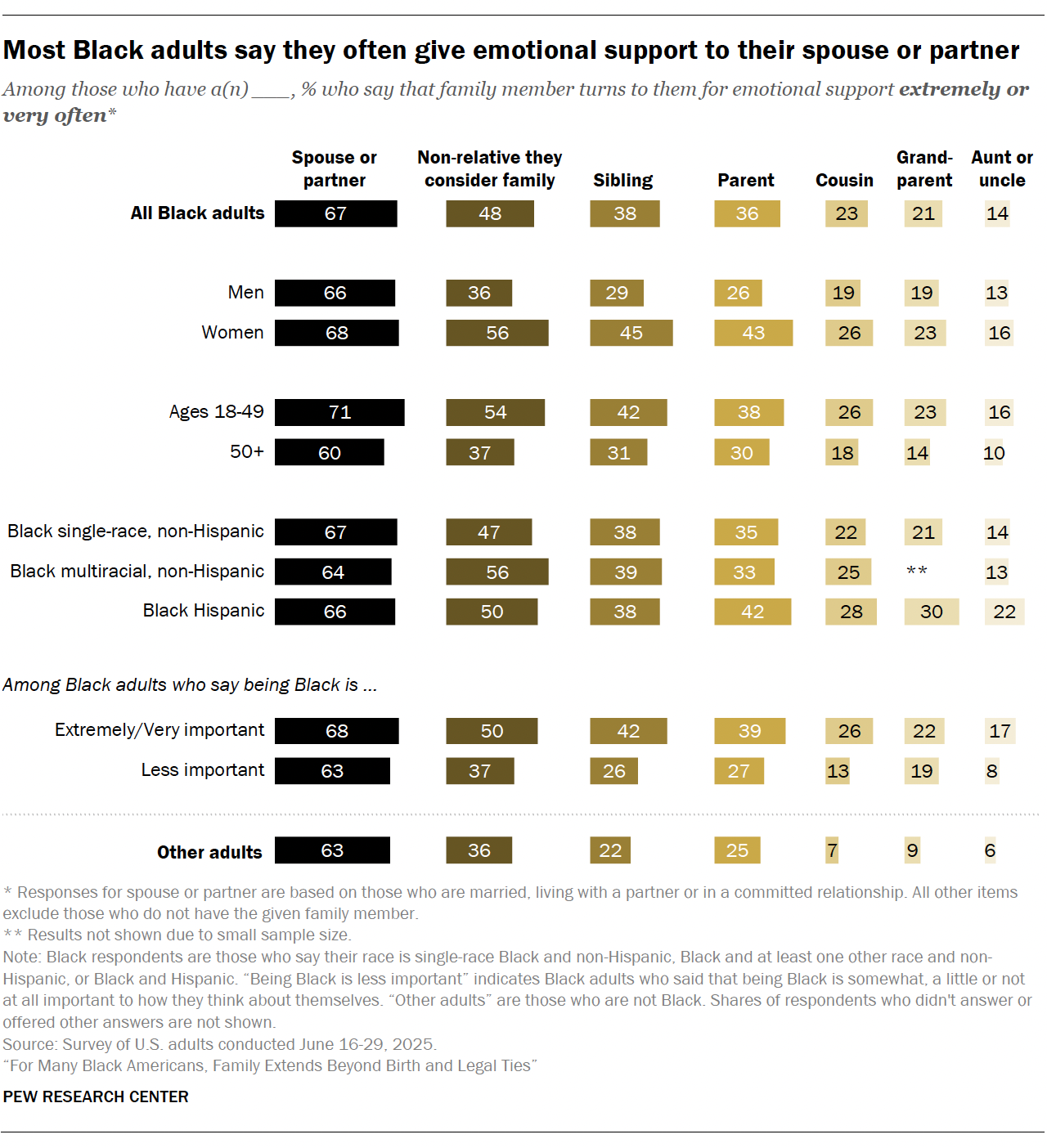
As is the case among other Americans, Black Americans most often give emotional support to the family members they are closest to. Two-thirds say they give support to their spouse or partner extremely or very often (67%) and about half say the same about a non-relative family member (48%).
Black adults also often provide emotional support to nuclear family members like a sibling (38%) or parent (36%). Smaller shares give support to extended family members like a cousin (23%), a grandparent (21%) or an aunt or uncle (14%).
Differences by demographic group and views of Black identity
How Black adults see their own Black identity is linked to the emotional support they provide to their family networks. Half of those who say being Black is important to them provide support to a non-relative family member extremely or very often, compared with 37% of those who say being Black is less important. There is a similar pattern when it comes to providing support to a sibling, parent, cousin, and aunt or uncle.
When comparing across demographic groups, younger Black adults – those under 50 – are more likely than older adults to provide emotional support to each of the family members we asked about.
In particular, younger Black women stand out. Women under 50 are the most likely to give emotional support to a non-relative family member (62%), sibling (50%), parent (45%) or cousin (29%).
How does giving emotional support make Black Americans feel?
Many Black adults describe providing emotional support as a positive part of their family life.
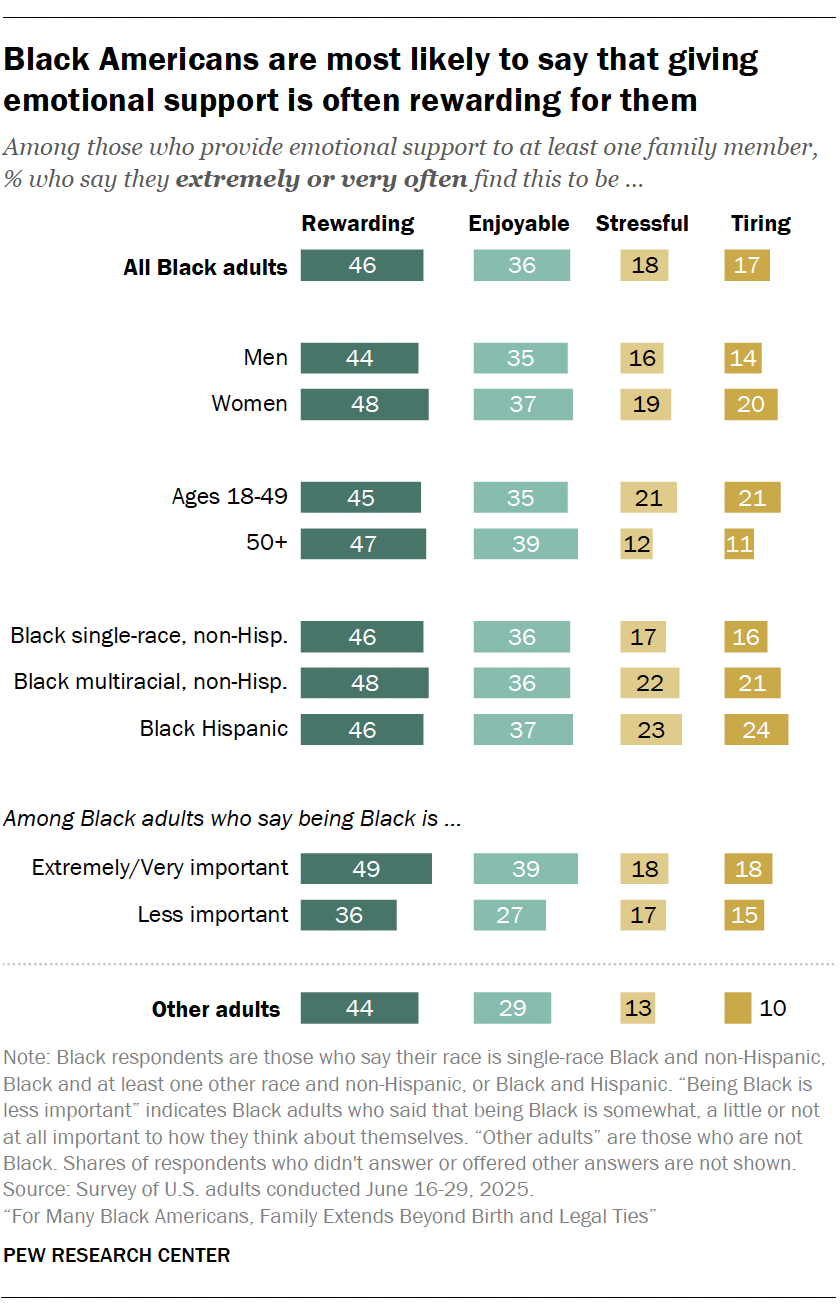
Among Black adults who provide support to at least one family member, 46% find it rewarding and 36% say it’s enjoyable.
Smaller shares say they find it stressful (18%) or tiring (17%).
Compared with other Americans, Black adults are slightly more likely to find these exchanges:
- Enjoyable (36% vs. 29%)
- Stressful (18% vs. 13%)
- Tiring (17% vs. 10%)
Similar shares of Black and non-Black adults say they find it rewarding (46% and 44%).
There are modest differences in how some Black people feel providing emotional support to family.
Black adults who say being Black is an extremely or very important part of their personal identity are more likely than those who say Blackness is less important to find it rewarding (49% vs. 36%) and enjoyable (39% vs. 27%). Similar shares find it stressful or tiring.
Black adults under 50 are more likely than older Black adults to find giving emotional support stressful (21% vs. 12%) or tiring (21% vs. 11%). Meanwhile, these two groups are equally likely to say the experience was rewarding or enjoyable.