This is one of five detailed sections in a report on how Black Americans define and support their family networks. The report also includes an overview of key findings.
Many Black Americans have deep connections to family, including people researchers usually refer to as extended family, such as cousins and grandparents. And most Black adults say they have a non-relative whom they consider part of their family.
But how do Black adults feel about Black Americans who are beyond their personal network? To understand these views, Pew Research Center conducted a survey including 4,271 Black Americans in June 2025.
A majority of Black adults say they generally consider other Black people in the U.S. to be their brothers or sisters, and most feel a larger sense of responsibility for other Black Americans.
Importantly, the survey finds that Black Americans’ views of their own racial identity is central to how they feel about other Black people.
These findings build on Pew Research Center’s past research on Black identity and the connections Black people feel to one another.
Most Black people say being Black is important to their sense of self
According to our June 2025 survey, 75% of Black adults say that being Black is extremely or very important to how they think about themselves. Another 25% say being Black is somewhat important, a little important or not at all important to their sense of self. Regardless of where they were born, education level, economic status or political affiliation, majorities of Black Americans say being Black is an important part of their identity. This is unchanged from when we asked this question in 2021.
A majority of Black Americans see other Black people as their brothers or sisters
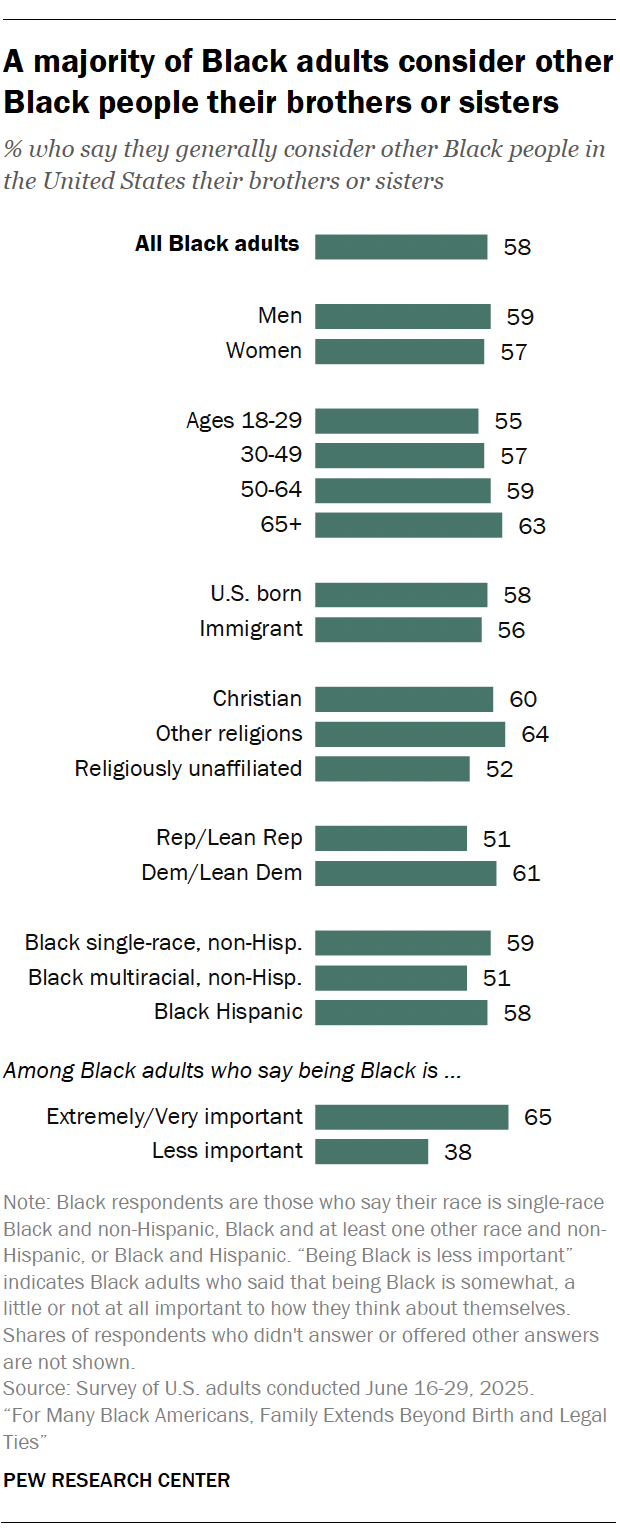
About six-in-ten Black adults (58%) say they generally view other Black people in the U.S. as their brothers or sisters.
This sense of overarching racial connection is closely tied to another question we asked in the survey, about how important Blackness is to respondents’ personal identity.
Among Black adults who say being Black is extremely or very important to them personally, 65% consider other Black people in the U.S. their brothers or sisters. Among respondents who see their Blackness as less important to their identity, 38% say the same.
There are modest differences by age, gender and other demographic traits. Still, in each group we analyzed, half of respondents or more say they consider other Black people to be their brothers or sisters. For example:
- Black adults ages 65 and older (63%) are slightly more likely than adults under 30 (55%) to say they consider other Black Americans to be their brothers or sisters.
- Democrats and Democratic-leaning independents (61%) are slightly more likely than Republicans and Republican leaners (51%) to feel this way.
- Christians (60%) and respondents who practice another religion (64%) are slightly more likely than people who are religiously unaffiliated (52%) to consider Black people to be their brothers or sisters.
Most Black Americans feel some responsibility to look out for one another
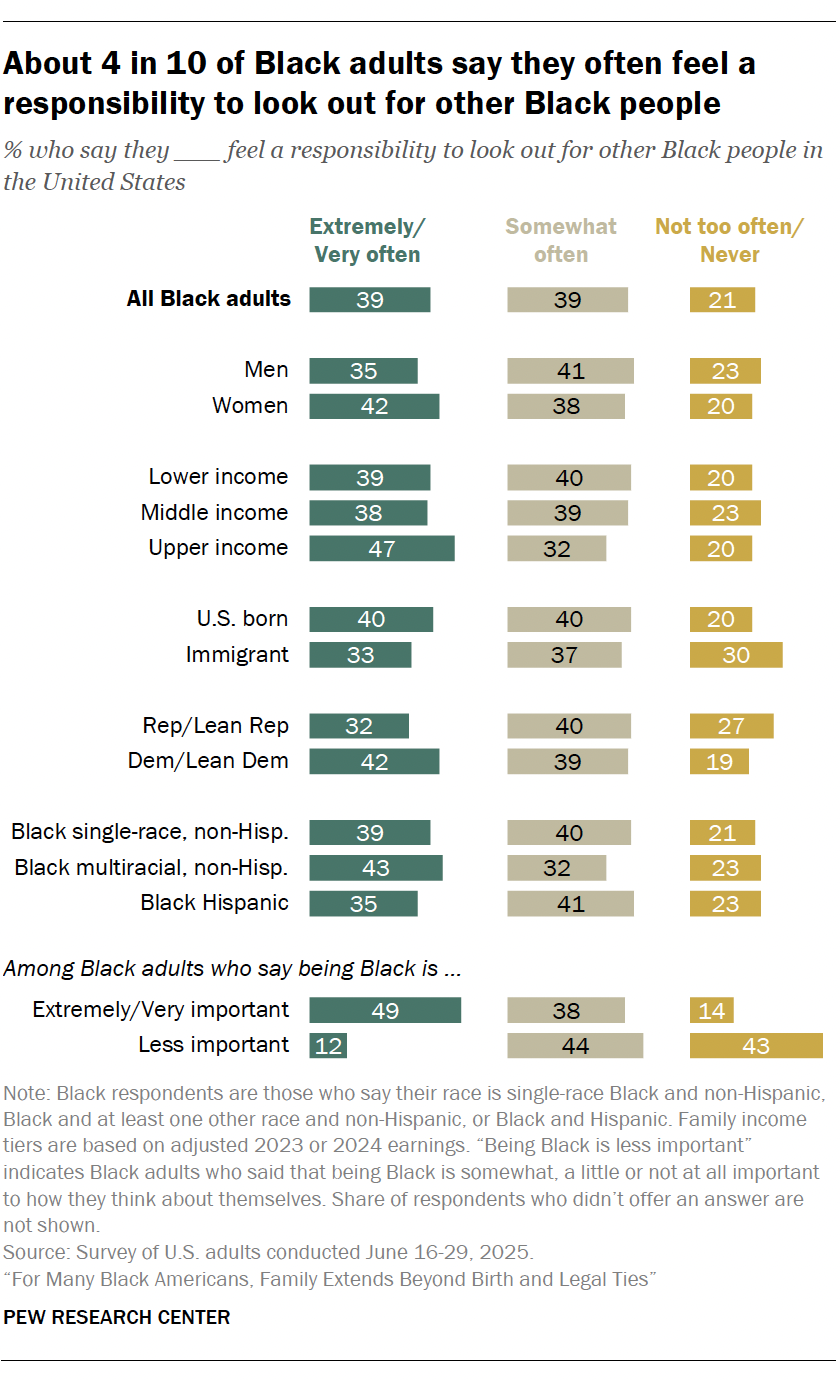
When asked if they feel a responsibility to look out for other Black people in the U.S., 39% of Black adults say they feel this way extremely or very often, and another 39% say they feel this somewhat often. Meanwhile, 21% say they don’t feel such a responsibility often or ever.
As with the previous question, Black Americans’ views are linked to how important their racial identity is to them personally.
- Among Black adults who say being Black is extremely or very important to their identity, 49% often feel a responsibility to look out for other Black people, while 14% don’t often or ever feel this.
- Conversely, 43% of those who say being Black is less important don’t often or ever feel this, while 12% do so extremely or very often.
The gaps are smaller among other demographic groups of Black Americans:
- 47% of upper-income adults say they feel a responsibility to look out for other Black people extremely or very often, compared with 39% of lower- and 38% of middle-income adults.
- 42% of Democrats say they often feel this responsibility, compared with 32% of Republicans.
- 42% of women often feel a responsibility to look out for other Black people, compared with 35% of men.
- 40% of adults born in the U.S. often feel this responsibility, compared with 33% of immigrants.