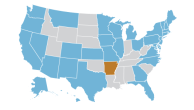
Nearly four years after the Supreme Court overturned Roe v. Wade, a majority of Americans continue to say abortion should be legal in all or most cases. Now, with a patchwork of differing state laws in effect, perceptions of abortion access vary by where people live.
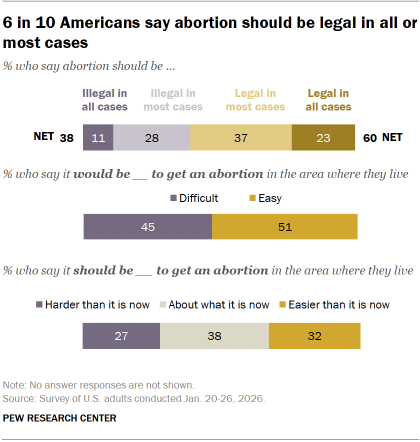
A 60% majority of U.S. adults say abortion should be legal in all or most cases. This share is down slightly from the last few years – when attention to the issue was heightened after the high court’s Dobbs decision.
About half (51%) say it would be easy to get an abortion in the area where they live, while slightly fewer (45%) say it would be difficult. In recent years, the public has become more likely to say obtaining an abortion in their area would be difficult.
Roughly a third (32%) say it should be easier to get an abortion where they live, 27% say it should be harder and 38% say it should be about what it is now.
Should abortion be legal or illegal?
Since 2024, there has been a slight decline in the share of Americans who say abortion should be legal in all or most cases. Still, public support for legal abortion remains far higher than it was in the 1990s and early 2000s.
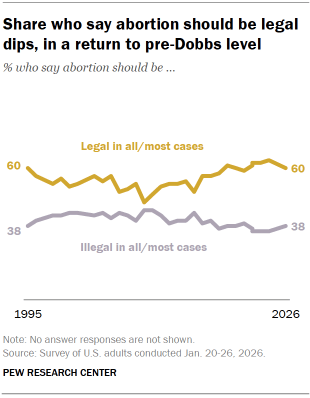
- Today, 60% say abortion should be legal in all or most cases, down from 63% in 2024
- This share is roughly on par with views held in March 2022, a few months before the Supreme Court’s Dobbs decision (61%).
Familiar partisan gap in views of abortion
The recent decline in support for legal abortion has come exclusively among Republicans and Republican-leaning independents.
- Today, 36% of Republicans say it should be legal. In 2024, 41% held this view.
- Democrats’ views have been more stable over this period. Since 2022, at least 84% of Democrats have said abortion should be legal in all or most cases.
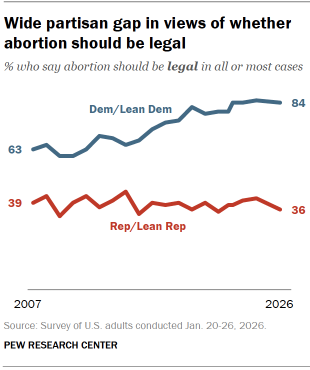
Still, the current partisan gap in views of abortion is far wider than a few decades ago. In 2007, there was a 24 percentage point gulf between the parties. That has widened to 48 points today.
Demographic differences
While majorities across most demographic and religious groups say abortion should be legal in all or most cases, there are exceptions. Roughly three-quarters of White evangelical Christians (74%) say it should be illegal in all or most cases. A majority of Republicans (63%) also hold this view.
There are also differences between men and women, younger and older adults, and people of different education levels and political ideologies.
For views on abortion by demographic group, read our fact sheet, “Public Opinion on Abortion.”
Perceptions that abortions are difficult to get are up modestly – and linked to geography
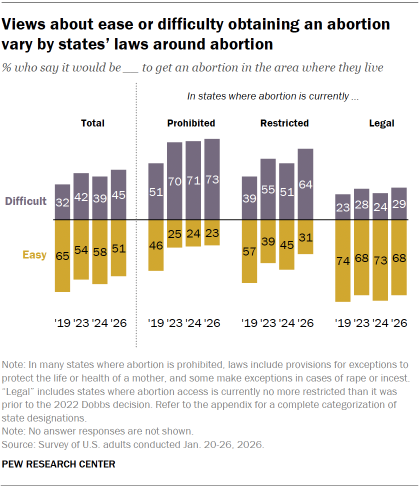
About half of Americans say it is easy to get an abortion in the area where they live (51%), while fewer say it is difficult (45%).
But in recent years, there has been a modest rise in perceptions that it is difficult to obtain an abortion.
In 2024, 39% of adults said it would be difficult for someone to get an abortion where they live. And in 2019 – before the Supreme Court overturned Roe v. Wade – 32% said this.
Restrictiveness of state law on abortion is associated with perceptions of how easy or difficult the procedure is to obtain.
Roughly three-quarters of adults who live in states where abortion is prohibited say it is difficult (73%).
In states where abortion is restricted by gestational limits – ranging from 6 weeks to 20 weeks – views are slightly more mixed. But on balance, more people say it is difficult than easy (64% vs. 31%).
And in states where abortion is legal at or beyond the framework previously set by Roe v. Wade – roughly 24 weeks – about two-thirds (68%) say abortion is easy to obtain in the area where they live.
These patterns hold among both Republicans and Democrats.
For information about state abortion policy designations, refer to the appendix.
Other key findings
Medication abortion
By about two-to-one, more U.S. adults say medication abortion should be legal (55%) than illegal (26%). However, the share saying medication abortion should be illegal has risen since 2024. Refer to “Majority of Americans say medication abortion should be legal.”
Considerations around abortion
About half of adults (52%) say that the statement, “The decision to have an abortion should belong solely to the pregnant woman” describes their views extremely or very well. And roughly four-in-ten (39%) say their views are best described by the statement, “Human life begins at conception, so an embryo is a person with rights.”
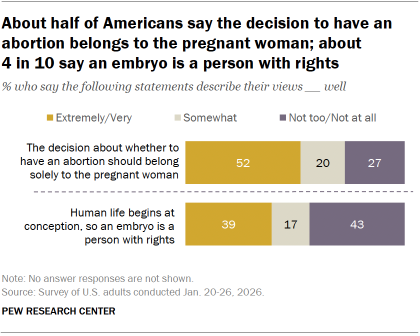
Notably, a third of Americans say both statements describe their views at least somewhat well.
Views by gender
In a shift from past surveys, there is now a modest gender gap in attitudes about abortion among Republicans. Still, partisanship continues to be a much bigger factor in these views than gender. For more, refer to “Do abortion attitudes differ by gender?”