A majority of U.S. teens say they use AI chatbots, including about three-in-ten who do so daily. But what are they using them for? And how do they think artificial intelligence (AI) will impact their lives?
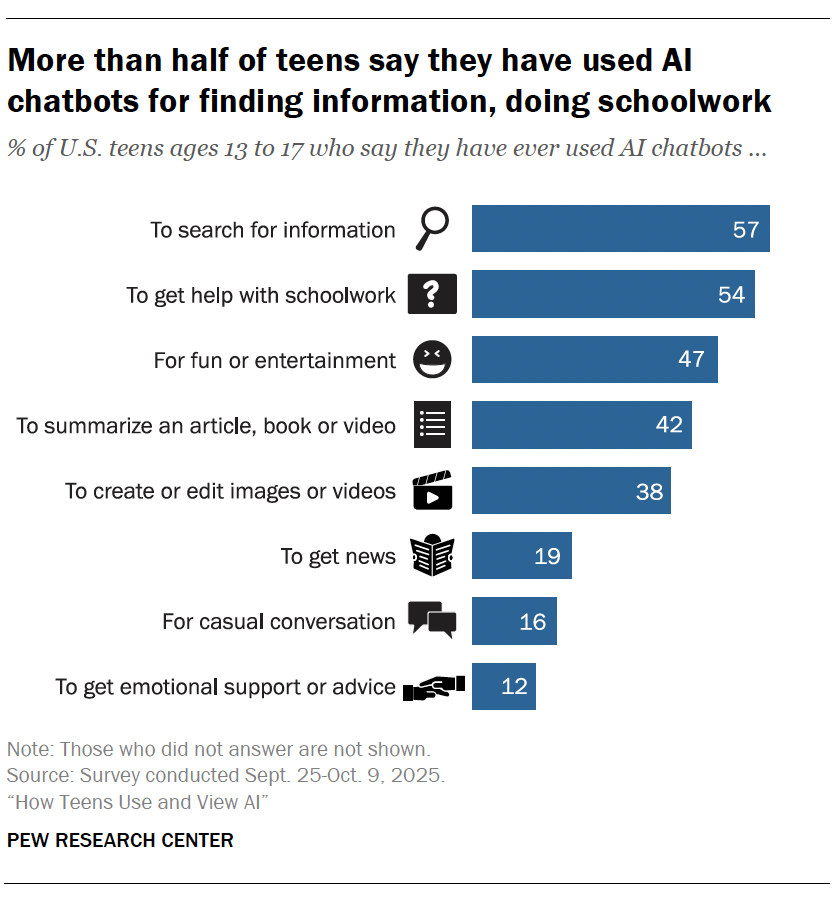
Teens turn to chatbots like ChatGPT, Copilot and Character.ai for a variety of things – but information seeking and schoolwork help top the list, while “for fun” is not far behind:
- More than half of teens say they have used chatbots to search for information (57%) or get help with schoolwork (54%).
- And 47% say they’ve done so for fun or entertainment.
About four-in-ten each report using chatbots to summarize articles, books or videos or create or edit images or videos. And about one-in-five say they use chatbots to get news, according to Pew Research Center’s survey of U.S. teens ages 13 to 17 conducted Sept. 25-Oct. 9, 2025.
Concerns about young people using chatbots for companionship have caught the attention of parents, advocates and lawmakers. Our survey finds some teens are using chatbots in more personal ways: 16% of teens say they have used chatbots to have casual conversations, and 12% say they’ve used these tools to get emotional support or advice. Still, majorities of teens report not doing these things.
Below, we walk through findings from the effort, including a deep dive into AI and schools, how teens see AI’s impact and AI literacy.
Teens’ experiences are far from one-size-fits-all. To learn about how experiences differ by race, ethnicity, gender and household income, go to “Demographic differences in how teens use and view AI.”
And to find out what parents are making of this, check out “What parents say about their teen’s AI use.” A key takeaway? While about half of parents say their teen uses chatbots, higher shares of teens themselves (64%) report using them.
Teens, schoolwork and AI
Helping with schoolwork ranks among the top reasons for teen chatbot use in our survey. As schools move quickly to craft AI policies, students are already tapping into these tools for assignments. To that end, we asked teens the following questions:
- How much of their schoolwork do chatbots help with?
- What tasks do they use it for?
- Do they find chatbots helpful for schoolwork?
- In their school, how common do they think cheating with AI is?
How much schoolwork is done with AI’s help
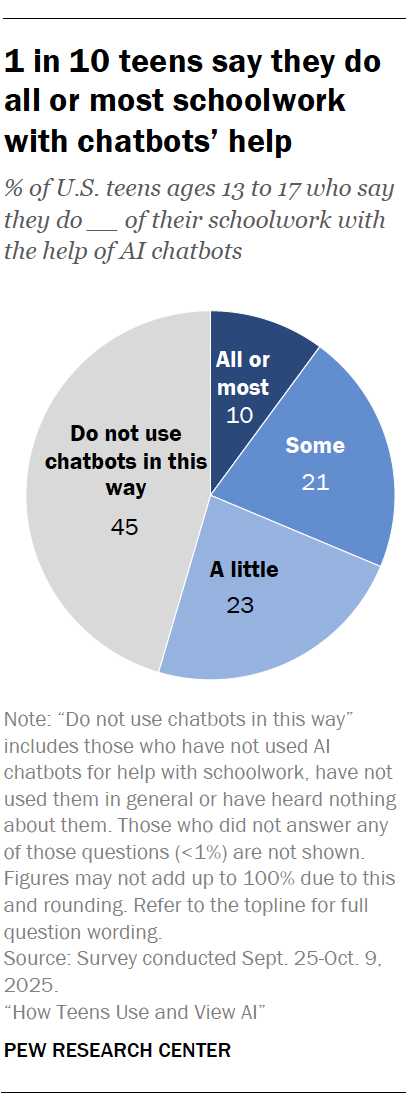
For a minority of teens, chatbots have become a go-to tool for much of their schoolwork. One-in-ten teens say they do all or most of their schoolwork with chatbots’ help.
Larger shares say they do some (21%) or a little (23%) of their schoolwork with the help of a chatbot. Another 45% haven’t used them in this way.
To see how these experiences differ by demographics, go to the sections on race and ethnicity and household income.
How teens use chatbots for schoolwork
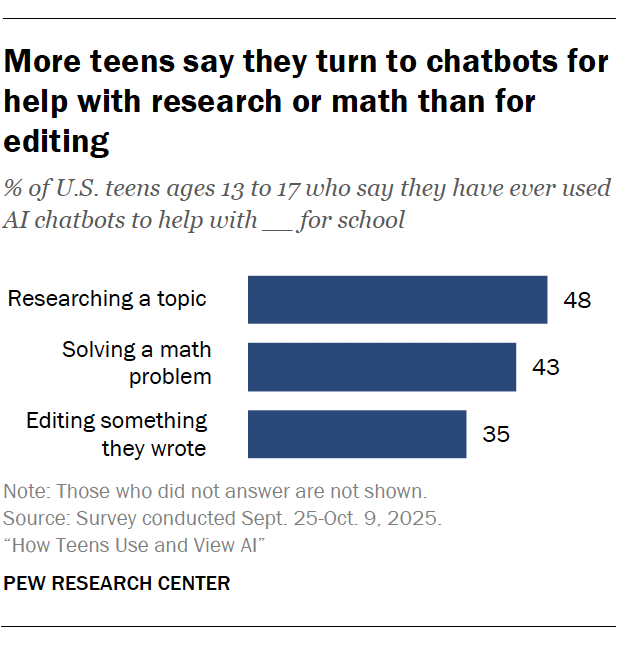
When it comes to how teens are using chatbots for school:
- About four-in-ten or more report having used them to get help researching a topic or solving math problems.
- By comparison, teens are less likely to turn to AI for help editing something they wrote. Still, 35% of teens say they have done this.
How helpful chatbots are
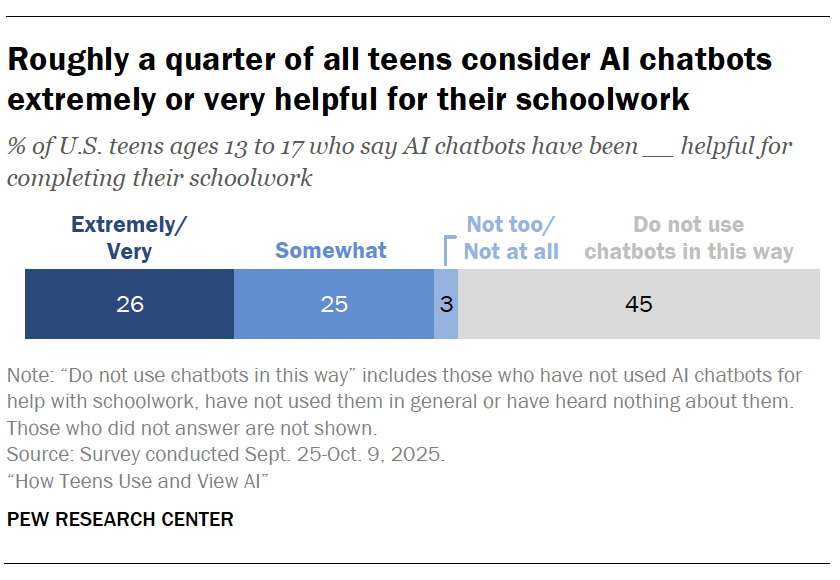
Teens are far more likely to say chatbots are helpful for schoolwork, rather than unhelpful.
In fact, about a quarter of all teens say chatbots have been extremely or very helpful for completing their schoolwork, and another 25% say they’ve been somewhat helpful.
Just 3% say these tools were of little to no help.
Schoolwork, cheating and chatbots
From what counts as cheating to trouble detecting it, the rise of AI in classrooms has posed a thorny issue for teachers. Our survey shows that many teens think cheating with AI has become a regular feature of student life.
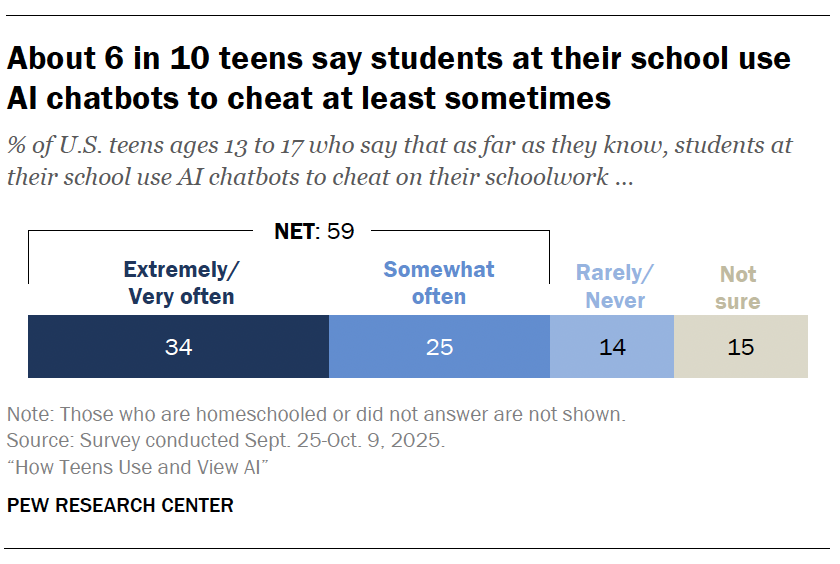
A majority of teens (59%) think using AI to cheat is a regular occurrence at their school – happening at least somewhat often. This includes about a third who say it happens extremely or very often.
Another 14% of teens say students at their school rarely or never cheat using AI chatbots.
Still, some teens are unsure if this happens (15%).
Teens who have ever used chatbots for schoolwork help are especially likely to think cheating is a regular occurrence. About three-quarters (76%) of this group say students at their school use chatbots to cheat at least sometimes.
How teens see AI’s impact
Along with understanding how teens are using chatbots, we also asked questions about their predictions for AI’s impact on them and society.
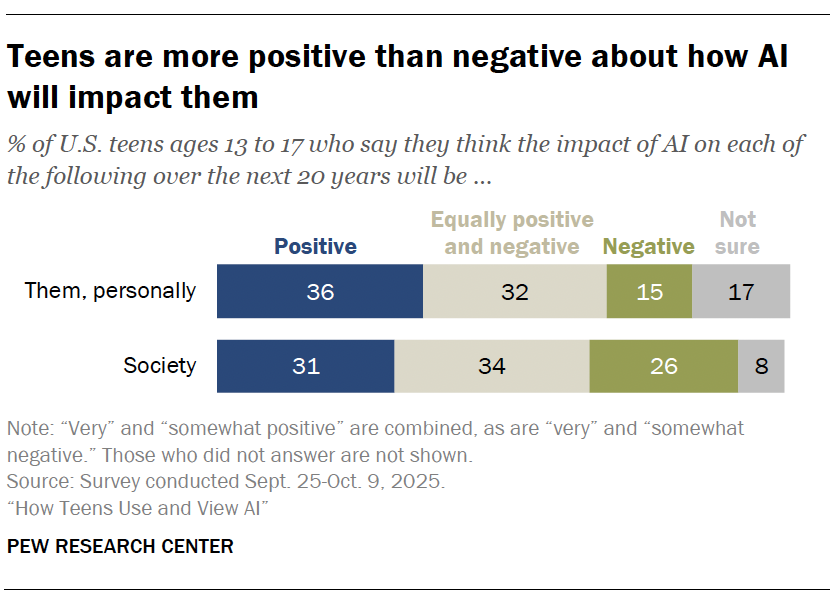
Teens tend to view the impact of AI on their own lives more positively than negatively. While 36% say it’ll have a positive impact on them personally over the next 20 years, far fewer (15%) say this effect will be negative.
Still, teens are more critical of its effect on society more broadly. While 15% of teens think AI will have a negative impact on them personally over the next 20 years, that share rises to 26% when that same question is framed around society.
There are also gaps – though more modest – when looking at the positive side of AI. Teens are somewhat more likely to say AI will have a positive impact on them than on society (36% vs. 31%).
Still, similar shares of teens expect AI to have an equally positive or negative effect on both them and society. And some remain uncertain: 8% say they are unsure about AI’s impact on society over the next 20 years, while 17% say the same about its personal impact.
In their own words: Why do teens think AI will be good or bad for society?
After asking teens whether they think AI will have a positive or negative effect on society over the next 20 years, we asked them to describe – in their own words – why they felt this way.
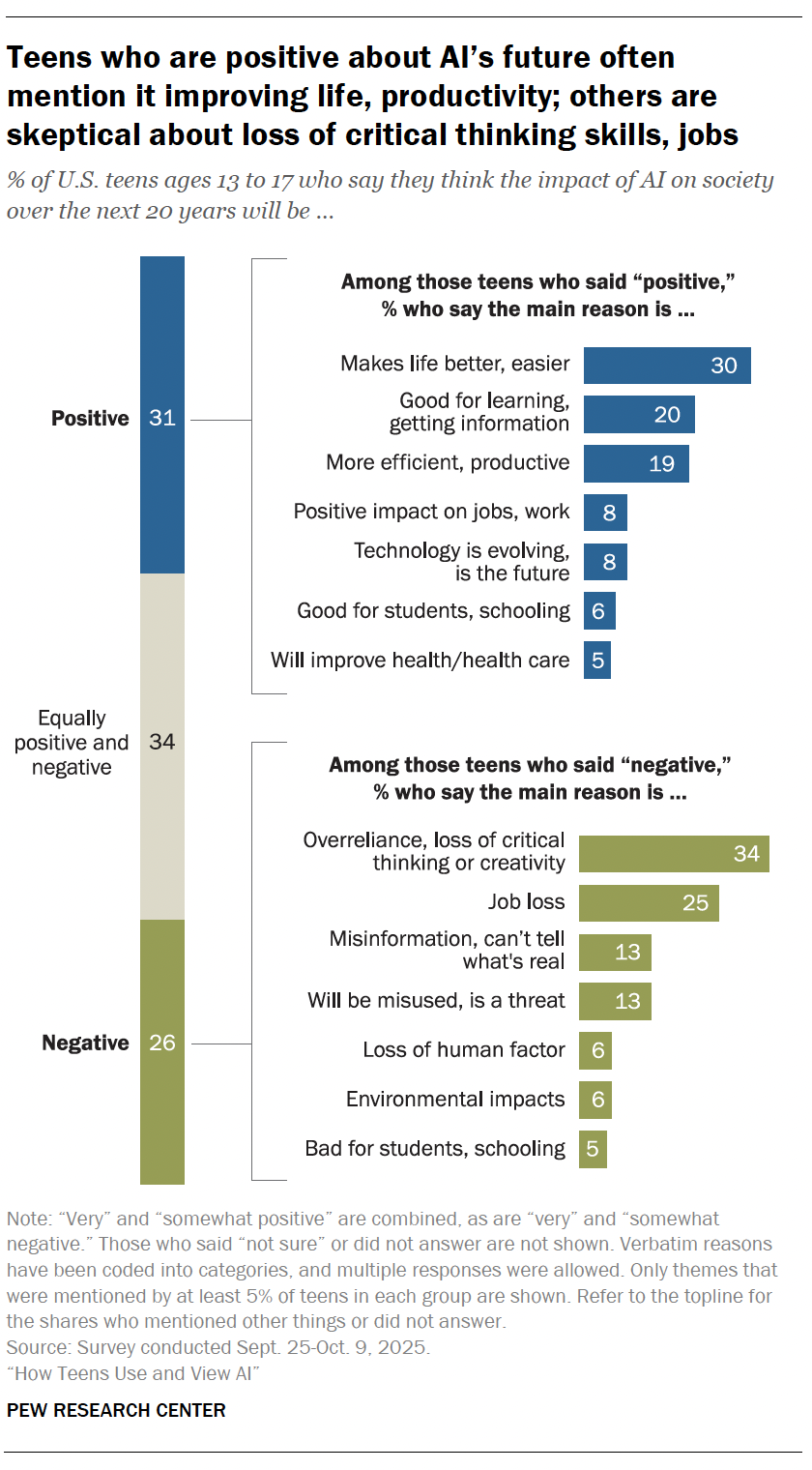
Three-in-ten teens who see AI positively impacting society think it’ll make life better or easier. About one-in-five each say it’ll be good for learning or information or make things more efficient.
Smaller shares of these teens mention that evolving technology is the future (8%), as well as AI improving work (8%), education (6%) or health and health care (5%).
Here are some quotes from teens about the positive impacts of AI, lightly edited for grammar and length:
Some of teens’ biggest worries on the negative side? Overreliance, and jobs.
Among those who think the impact will be negative, about a third (34%) mention overreliance, loss of critical thinking or creativity. A quarter talk about AI taking people’s jobs.
By comparison, about one-in-ten mention misinformation or it being hard to tell what’s real. An identical share say it’s that AI is a threat or ripe for misuse. Slightly fewer mention the “human factor,” environmental impacts or AI hurting students or schooling.
In teens’ own words:
Teens aren’t alone in their reasoning. Americans overall see efficiency as one of AI’s key benefits. And we’ve seen notable shares of the U.S. public concerned about job loss due to AI.
Views on AI’s ability to perform human tasks
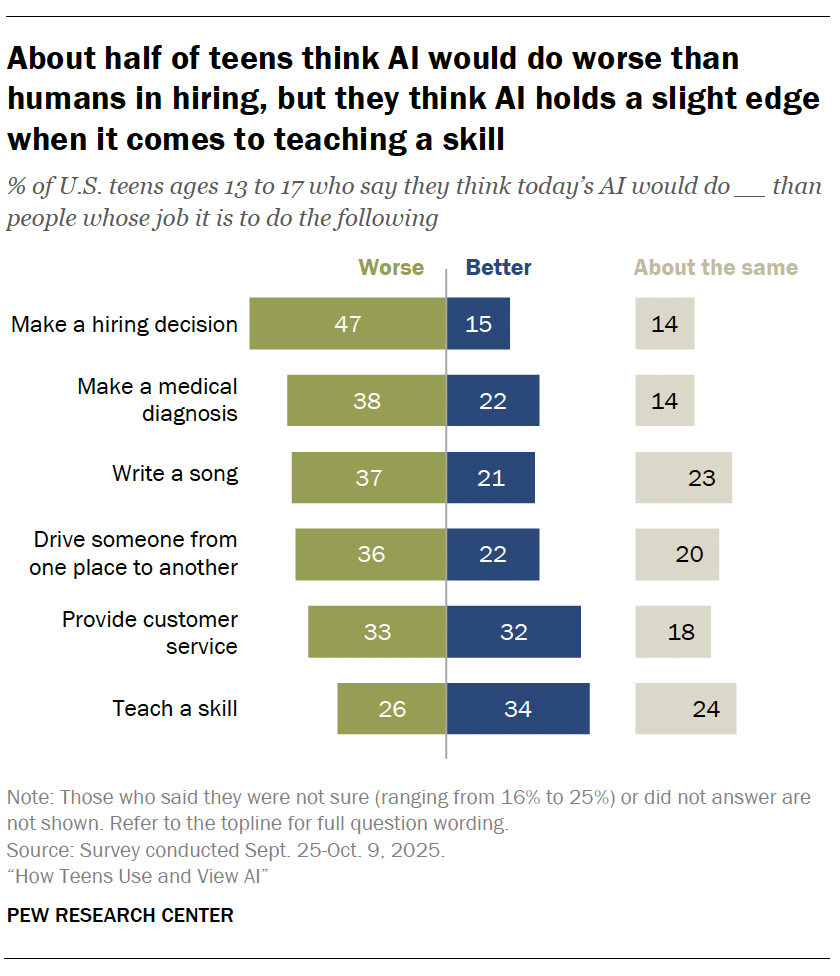
Teens – just like adults – generally think AI would lose to humans across a range of tasks. But they are most skeptical about hiring.
Roughly half say today’s AI would do worse than humans, rather than better, in making hiring decisions. Just 15% think AI would be better than people.
Teens are also more likely to think AI would do worse than humans at driving someone from one place to another, making a medical diagnosis or writing a song.
Their views are more divided when it comes to providing customer service, with about a third each saying AI will do a worse or better job.
Teaching a skill is the only item asked about where a larger share of teens thought AI would best humans. About a third say AI will do a better job than humans at teaching skills, while about a quarter say AI would do a worse job.
It is worth noting the level of uncertainty that young people feel about these questions. For example, about a quarter of teens say they’re unsure how AI would perform in cases like health care (25%) and employment (23%).
AI literacy: Confidence and awareness
AI literacy is on the minds of parents, educators and researchers. Experts are already calling this a crucial skill for teens – including as a way to combat misinformation.
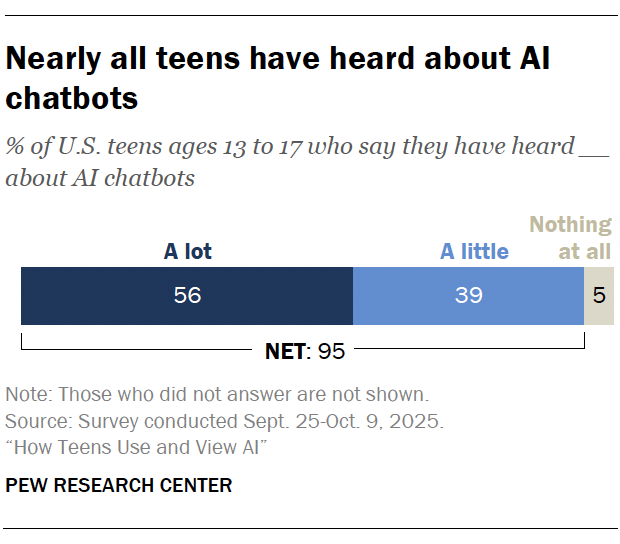
Teens are already quite familiar with AI chatbots. More than nine-in-ten say they have heard a lot (56%) or a little (39%) about them. Just 5% of teens say they’ve heard nothing at all.
Yet while awareness is high and use is becoming common, teens’ confidence in using chatbots varies.
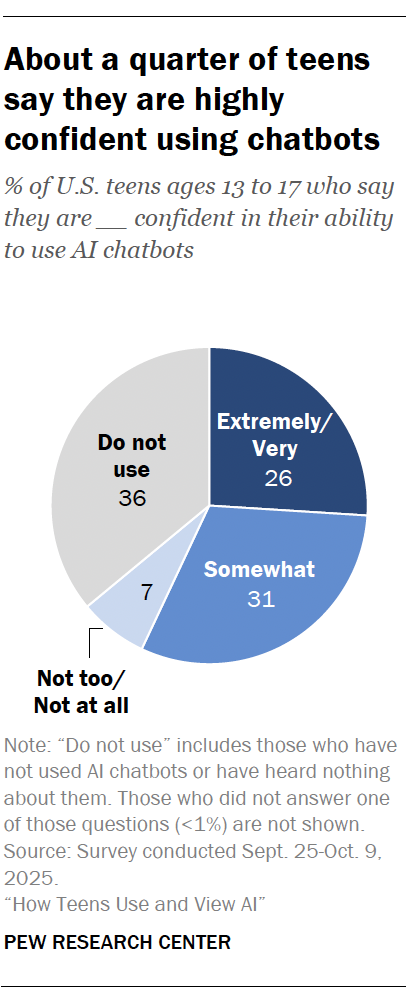
About a quarter of teens report being extremely or very confident in their ability to use chatbots. Roughly another three-in-ten say they’re somewhat confident.
And a small share of teens lack confidence in using these tools. About one-in-ten report having little to no confidence in their ability to use chatbots.