Artificial intelligence is part of many teens’ online lives today, with a majority saying they’ve used chatbots. One takeaway from our recent survey? How they use AI – and what they think about it – is far from one-size-fits-all.
We’ve long explored teens’ tech use by factors like race, ethnicity, income and gender – from what platforms they use to how often they go online. We’ve also seen differences in teens’ overall use of chatbots and in how U.S. adults view AI.
Jump to the sections below for findings from Pew Research Center’s survey of 1,458 U.S. teens ages 13 to 17, conducted Sept. 25-Oct. 9, 2025. We walk through differences by teens’:
To see how teens overall use and view AI, check out the main report.
Racial and ethnic differences in teens’ AI chatbot use
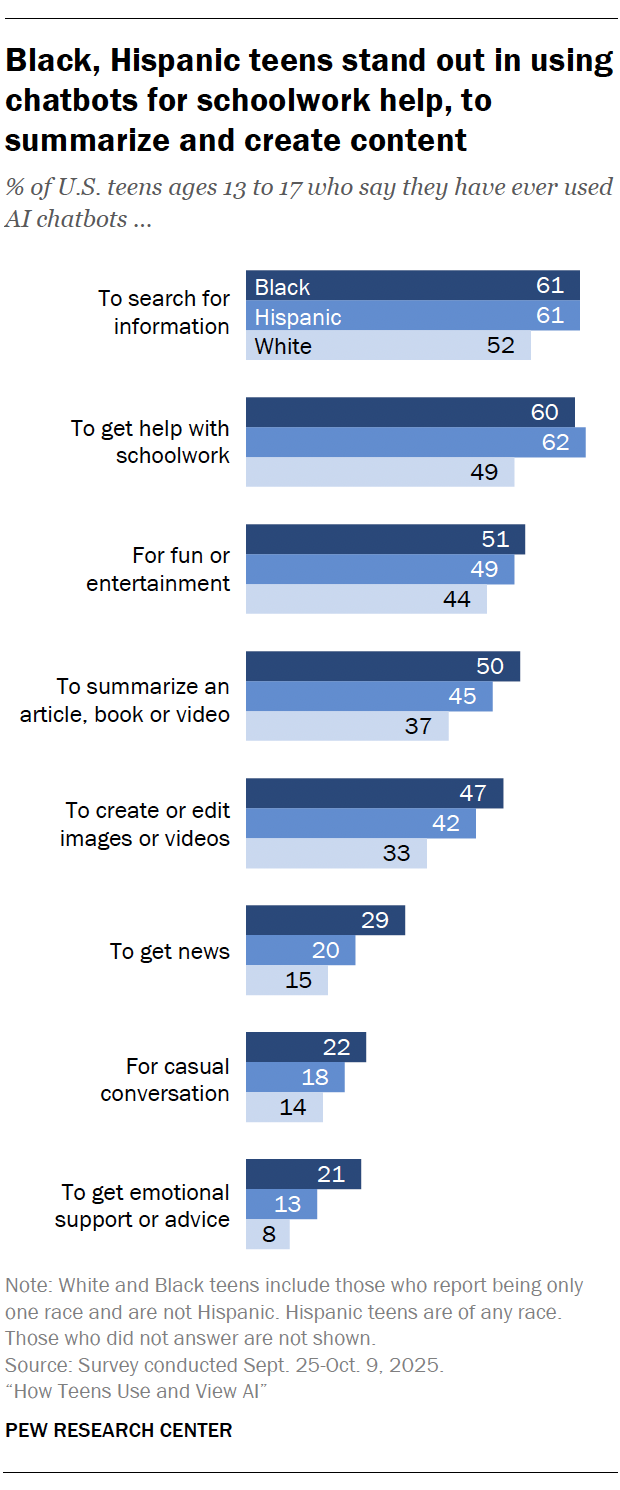
Black and Hispanic teens are more likely than White teens to say they use chatbots overall, according to our survey.1
But these differences aren’t limited to overall use. How teens are using these tools – whether for schoolwork or getting news – often varies by race and ethnicity.
Schoolwork: About six-in-ten Black or Hispanic teens say they’ve used chatbots to get help with schoolwork. That drops to roughly half of White teens.
Summarizing or creating content: Black and Hispanic teens are more likely than their White peers to say they have turned to chatbots to summarize articles, books, or videos, or to create or edit images.
Getting emotional support or advice: While 21% of Black teens say they have done this, those shares drop to about one-in-ten for their Hispanic or White peers.
Casual conversations: Black teens are also more likely than White teens to say they’ve used chatbots for casual conversation (22% vs. 14%). (Hispanic teens don’t differ from either group.)
Getting news: About three-in-ten Black teens say they have gotten news in this way. This is higher than for both Hispanic and White teens.
Using chatbots for fun is the only place we see no statistical differences by race and ethnicity.
How chatbots are used for schoolwork
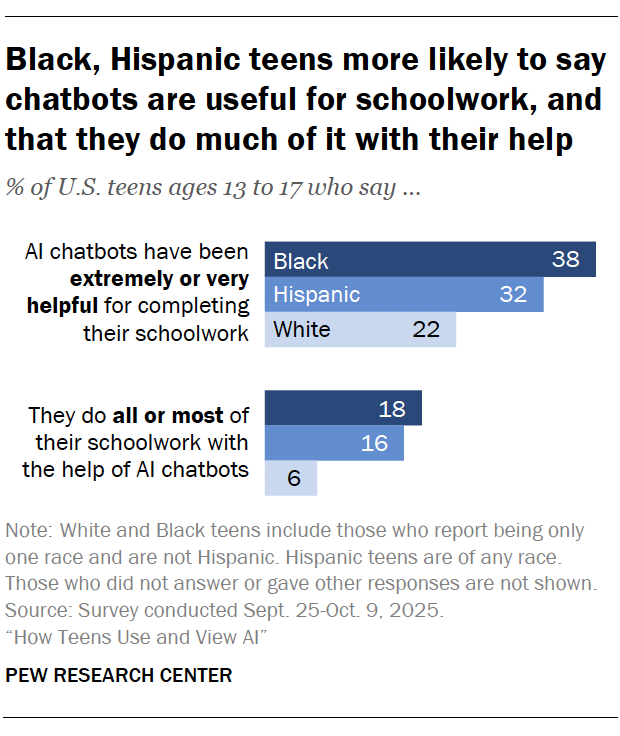
Educators are paying close attention to how chatbots are being used and debating what this could mean for academic outcomes. We find some teens are more likely to incorporate them into their assignments – or feel they benefit from them.
Specifically, Black and Hispanic teens are more likely to say chatbots have been helpful for their schoolwork – and more likely to use them frequently for this.
Roughly four-in-ten Black teens, and a statistically similar share of Hispanic teens, say chatbots have been extremely or very helpful for their schoolwork. Fewer White teens say the same.
At the same time, Black and Hispanic teens are more likely to say they do all or most of their schoolwork with chatbots’ help, versus their White peers.
Confidence using chatbots
Even outside of schoolwork, we find confidence in using chatbots varies by race and ethnicity.
About four-in-ten Black teens (37%) say they’re extremely or very confident, compared with roughly a quarter each of Hispanic (26%) or White (23%) teens.
Household income differences in using chatbots for schoolwork
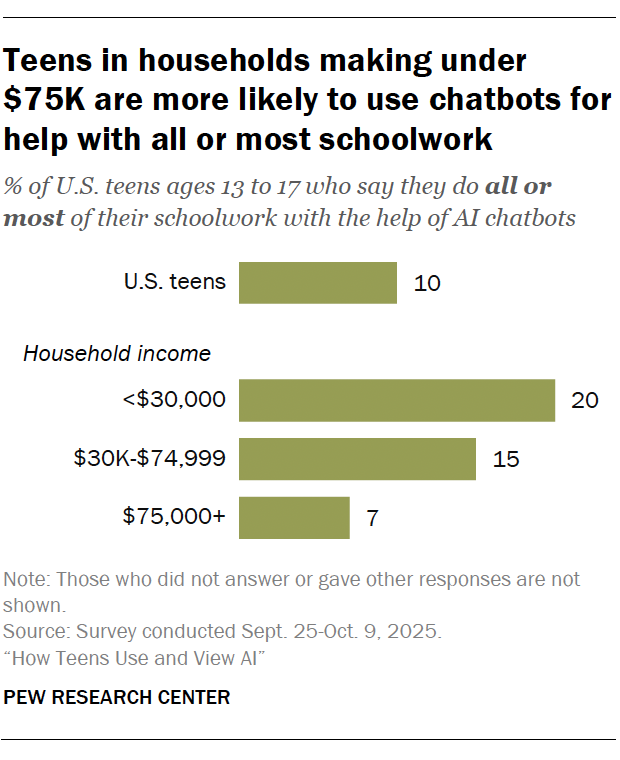
How much teens are using AI for schoolwork also varies by household income.
One-in-five teens living in households making less than $30,000 a year say they do all or most of their schoolwork with AI chatbots’ help.
A similar share of those in households making $30,000 to just under $75,000 annually say this. Fewer teens living in higher-earning households (7%) say the same.
Gender differences in views of AI
Teen boys and girls use chatbots at similar rates and generally for the same kinds of tasks.
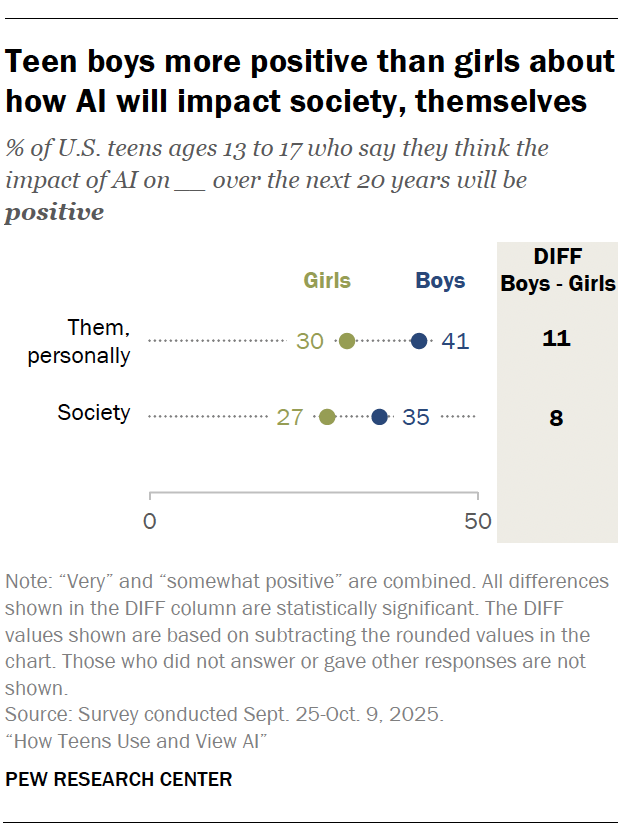
But there are some gender differences in teens’ outlook about AI – both for themselves and society, more broadly.
Boys are more likely than girls to think AI will have a positive impact on their own lives (41% vs. 30%) and on society (35% vs. 27%).
This is on par with findings among adults, where AI’s future impact is generally seen more positively among men than women.
Can AI do better than humans?
Teens also sometimes differ by gender when asked how AI would compare with humans on a variety of tasks.
Teen boys are more likely than teen girls to say AI would do a better job than people at:
- Providing customer service (36% vs. 27%)
- Driving someone from one place to another (27% vs. 19%)
- Teaching a skill (37% vs. 31%)
There are no gender differences when asked about AI making a medical diagnosis, writing a song or making a hiring decision.
For more on how teens overall feel about these questions, read the main report.