
People around the world are generally negative in their evaluations of U.S. foreign policy. In most countries, majorities say the United States does not promote peace and stability around the world and does not take other countries’ interests into account on matters of international policy. But Americans themselves are divided on these questions.
These findings come from a new Pew Research Center survey of 42,151 adults in 36 countries, conducted Feb. 8-May 13, 2026, and additional interviews with 3,507 U.S. adults conducted March 23-29, 2026. They are part of a larger report on views of the U.S. and its president.
Does the U.S. contribute to peace and stability around the world?
Across the 36 non-U.S. countries surveyed, a median of 35% of adults say the U.S. contributes to global peace and stability, while 63% say it does not. Some of the places with the lowest shares saying the U.S. contributes to stability are in Europe and Latin America. For example, around a quarter of people or fewer in France, Greece, Italy, Netherlands, Spain and Sweden think this is the case, as do 20% in Argentina.
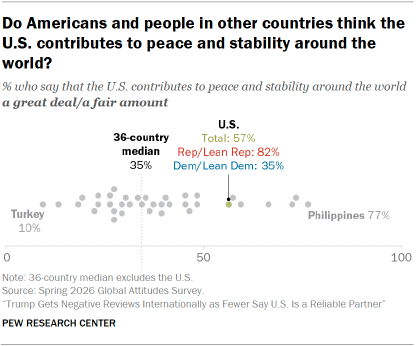
But in some nations, majorities say the U.S. does contribute to global peace and stability. For example, around seven-in-ten or more hold this view in Israel, Kenya, Nigeria and the Philippines.
In many countries, fewer now believe the U.S. contributes to stability than when we last asked in 2023. In Sweden, for example, the share saying it contributes in this way dropped from 64% in 2023 to 23% today.
What is a median?
In this analysis, median scores are used to help readers see overall patterns in the data. The median percentage is the middle number in a list of all percentages sorted from highest to lowest.
Americans are more likely than people in most other countries to say the U.S. contributes to peace and stability around the world – 57% hold this view. However, Republicans and Republican-leaning independents (82%) are much more likely than Democrats and Democratic leaners (35%) to express this view.
Does the U.S. take the interests of other countries into account?
In most of the 36 non-U.S. countries surveyed, relatively few people think the U.S. considers other nations’ interests when making foreign policy. Overall, a median of 32% say the U.S. takes the interests of countries like their own into account.
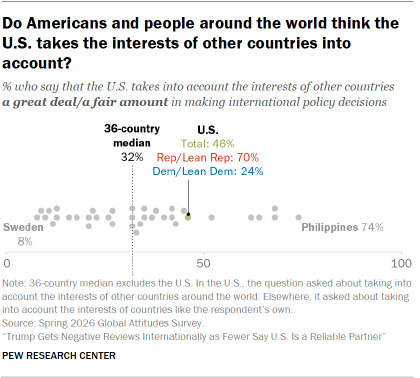
Once again, Europeans stand out as especially critical of U.S. foreign policy. Around one-in-ten in France, the Netherlands, Sweden and Spain say the U.S. accounts for the interests of countries like theirs. And in many countries, the share saying this has declined since 2023.
Americans are more likely than people in most other nations surveyed to say the U.S. does take other countries’ interests into account, but they are again divided by party. Overall, 46% think the U.S. takes other interests into account in its foreign policymaking, while 53% say it does not. But seven-in-ten Republicans say the U.S. does take these interests into account, compared with 24% of Democrats.
Related: Most Americans Now Say U.S. Foreign Policy Ignores the Interests of Other Countries
Does the U.S. government respect the personal freedoms of the American people?
In the 36 non-U.S. countries surveyed, a median of 39% of adults say the U.S. government respects the personal freedoms of its people, while 56% say that it does not.
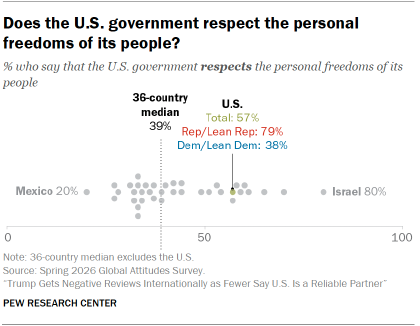
The shares saying the U.S. does respect the personal freedoms of its people tend to be higher in countries in sub-Saharan African and Asia-Pacific nations. For example, 70% of Nigerians hold this view, as do 61% of Japanese adults. Views are also very positive in Israel, where 80% say the U.S. government respects its people’s freedoms.
Fewer tend to express this opinion in Europe and Latin America. In Mexico, for example, 20% say the U.S. government respects its people’s freedoms, while 77% say it does not. And in nearly all of the countries where we also asked this question in 2021, at the start of the Biden administration, the share saying the U.S. respects its people’s freedoms has decreased by double digits.
A majority of Americans (57%) say the U.S. government respects its people’s freedoms, a higher share than in most of the other 36 countries surveyed. Around eight-in-ten Republicans (79%) hold this view, compared with around four-in-ten Democrats (38%).
Related: Multiple indicators show a decline in the health of America’s democracy in 2025


