Americans have grown more negative toward the possible environmental and economic effects of data centers since the beginning of the year. And a majority say they’d be uncomfortable if a new data center started operating in their area, according to a new Pew Research Center survey.

| Topic | Jan ’26 | Aug ’26 |
|---|---|---|
| The environment | 39 | 54 |
| Home energy costs | 38 | 50 |
| People’s quality of life nearby | 30 | 49 |
| Local jobs | 15 | 24 |
| Local tax revenue | 12 | 21 |
The survey comes as protests against new data center construction have spread, and as some state and local politicians have spoken out against data centers. Meanwhile, President Donald Trump has been a vocal supporter of data centers.
More than half of Americans (54%) now say data centers are mostly bad for the environment, up from 39% in January. Half say they are mostly bad for home energy costs, up from 38%. And 49% say they are mostly bad for people’s quality of life nearby, up from 30%. The new survey was conducted from July 20 to Aug. 9 among 10,548 U.S. adults.
Just 4% of Americans think data centers have a mostly good impact in each of these areas.
Views on how data centers impact local tax revenue and jobs are mixed. Similar shares (between 21% and 24%) say data centers are mostly good and mostly bad for these things.
Since January, there have been increases of 9 percentage points in the shares of Americans who say data centers are mostly bad for local jobs (from 15% to 24%) and local tax revenue (from 12% to 21%).
Many Americans are still unsure or unfamiliar with data centers altogether. Shares ranging from 18% to 32% say they are not sure how data centers impact the five things we asked about. And overall, 12% say they haven’t heard of data centers.
Jump to the following sections for more:
- Views of data centers have become more negative across groups
- Changing partisan views on data centers’ impact on local jobs and tax revenue
- A majority of Americans would be uncomfortable with a new local data center
- Awareness of data centers continues to grow
Views of data centers have become more negative across groups
Americans in a variety of demographic and partisan subgroups have become more negative in their views of data centers. Men and women alike, as well as adults across age groups and education levels, have become more likely since January to say data centers have a mostly bad impact on the things we asked about.
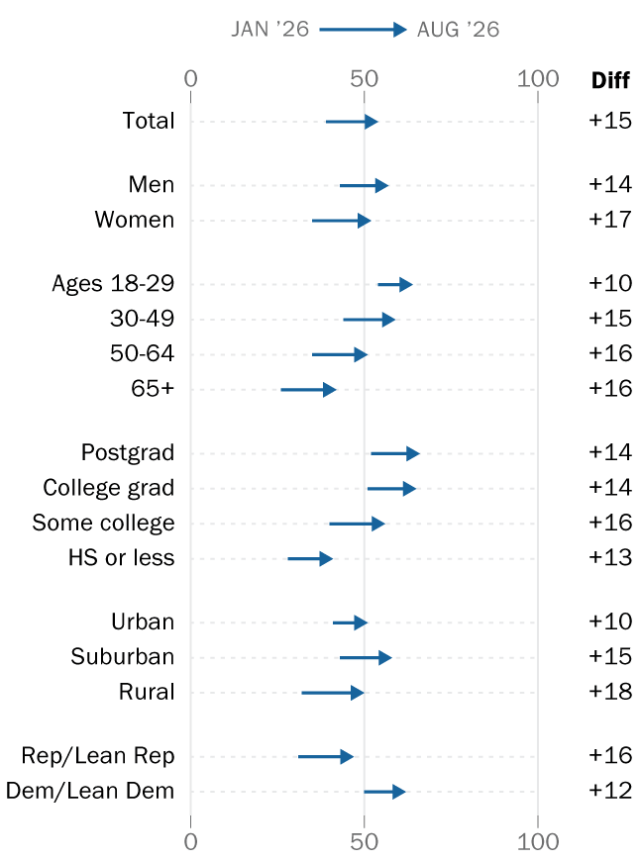
| Group | Jan ’26 | Aug ’26 | Diff |
|---|---|---|---|
| U.S. adults | 39 | 54 | +15 |
| Men | 43 | 57 | +14 |
| Women | 35 | 52 | +17 |
| 18-29 | 54 | 64 | +10 |
| 30-49 | 44 | 59 | +15 |
| 50-64 | 35 | 51 | +16 |
| 65+ | 26 | 42 | +16 |
| Postgrad | 52 | 66 | +14 |
| College grad | 51 | 65 | +14 |
| Some college | 40 | 56 | +16 |
| H.S. degree or less | 28 | 41 | +13 |
| Urban | 41 | 51 | +10 |
| Suburban | 43 | 58 | +15 |
| Rural | 32 | 50 | +18 |
| Rep/Lean Rep | 31 | 47 | +16 |
| Dem/Lean Dem | 50 | 62 | +12 |
For example, rural Americans have become more likely to say data centers are mostly bad for the environment (from 32% in January to 50% in August), home energy costs (32% to 46%) and the quality of people living nearby (28% to 45%). Most data centers currently being planned or under development will be in rural areas. Americans in urban and suburban areas have also become more likely to say data centers areas are mostly bad for these things.
As was the case earlier this year, Democrats and Democratic-leaning independents are more likely than Republicans and Republican leaners to view the impacts of data centers negatively. Still, Republicans’ views have also turned more negative: In the new survey, for example, 42% say the facilities are mostly bad for the quality of life of people nearby, up from 24% in January.
Republican elected officials have staked out varying positions on data centers. While Trump has consistently supported their construction in his second term, Texas Gov. Greg Abbott previously supported expansion but issued a statewide moratorium on new data centers in August.
Some Democrats, such as Pennsylvania Gov. Josh Shapiro and Illinois Gov. JB Pritzker, have also recently shifted their positions to support additional rules and oversight on data center construction and operation.
Changing partisan views about impact on local jobs and tax revenue
Among Democrats and Republicans alike, views on the effects of data centers on local jobs and tax revenue are somewhat more negative than they were at the start of the year. But many people in both partisan groups either say that they’re not sure or that the effects are neither good nor bad.
More Democrats now say the effects of data centers in these two areas are mostly bad than mostly good. Liberal Democrats have primarily driven this shift: For example, 34% of liberals now say data centers are mostly bad for local tax revenue, up from 19% in January.
More Republicans continue to say the effects of data centers on local jobs and tax revenue are mostly good than mostly bad. Still, Republicans are now 7 percentage points more likely than in January to say the effects in both areas are mostly bad.
A majority of Americans would be uncomfortable with a new local data center

| Extremely/ Very | Somewhat | Not too/Not at all | Have not heard of data centers | Grouping | |
|---|---|---|---|---|---|
| Total | 7 | 19 | 60 | 12 | total |
| Urban | 7 | 20 | 57 | 14 | urban |
| Suburban | 7 | 20 | 63 | 9 | urban |
| Rural | 6 | 18 | 60 | 14 | urban |
| Rep/Lean Rep | 10 | 24 | 54 | 11 | party |
| Conservative | 12 | 25 | 54 | 9 | party |
| Mod/Lib | 7 | 22 | 55 | 15 | party |
| Dem/Lean Dem | 4 | 16 | 68 | 10 | party |
| Cons/Mod | 6 | 22 | 58 | 14 | party |
| Liberal | 3 | 10 | 81 | 5 | party |
| Heard a lot | 11 | 16 | 73 | heard | |
| Heard a little | 6 | 26 | 66 | heard |
The new survey also finds that 60% of Americans say they would be not too or at all comfortable with a new data center operating in their area.
Much smaller shares say they would be somewhat comfortable (19%) or extremely or very comfortable (7%) with this.
Just over half of Republicans (54%) and about two-thirds of Democrats (68%) say they’d be not too or not at all comfortable with a new local data center. Liberal Democrats stand out, with 81% saying they’d be uncomfortable.
Majorities of urban, suburban and rural Americans say they would be not too or not at all comfortable with a new data center in their area.
Awareness of data centers continues to grow

| A lot | A little | Nothing at all | |
|---|---|---|---|
| Aug ’26 | 35 | 53 | 12 |
| Jan ’26 | 25 | 50 | 25 |
Americans are more aware of data centers than they were earlier in the year. The share of Americans who say they have heard or read a lot about them has increased from 25% in January to 35% today. About nine-in-ten adults (88%) have now heard at least a little about data centers.
As was the case in January, awareness of data centers is higher among men than women, and higher among people with at least a bachelor’s degree than those with less education.
Note: Here are the survey questions we used for this analysis, the detailed responses and the survey methodology.
Detailed tables
The detailed tables below provide additional information about how Americans’ views of data centers have shifted since the beginning of 2026.
| Mostly bad | Neither good nor bad | Mostly good | Not sure | Have not heard of data centers | |
|---|---|---|---|---|---|
| The environment | |||||
| Aug 2026 | 54 | 12 | 4 | 18 | 12 |
| Jan 2026 | 39 | 14 | 4 | 17 | 25 |
| Home energy costs | |||||
| Aug 2026 | 50 | 10 | 4 | 23 | 12 |
| Jan 2026 | 38 | 10 | 6 | 21 | 25 |
| People’s quality of life nearby | |||||
| Aug 2026 | 49 | 13 | 4 | 21 | 12 |
| Jan 2026 | 30 | 17 | 6 | 22 | 25 |
| Local jobs | |||||
| Aug 2026 | 24 | 19 | 22 | 23 | 12 |
| Jan 2026 | 15 | 17 | 25 | 17 | 25 |
| Local tax revenue | |||||
| Aug 2026 | 21 | 12 | 22 | 32 | 12 |
| Jan 2026 | 12 | 12 | 23 | 27 | 25 |
| The environment | Home energy costs | People’s quality of life nearby | Local jobs | Local tax revenue | ||||||
|---|---|---|---|---|---|---|---|---|---|---|
| Jan ’26 | Aug ’26 | Jan ’26 | Aug ’26 | Jan ’26 | Aug ’26 | Jan ’26 | Aug ’26 | Jan ’26 | Aug ’26 | |
| Total | 39 | 54 | 38 | 50 | 30 | 49 | 15 | 24 | 12 | 21 |
| Men | 43 | 57 | 46 | 56 | 33 | 51 | 16 | 25 | 14 | 23 |
| Women | 35 | 52 | 29 | 44 | 27 | 47 | 13 | 22 | 10 | 19 |
| Ages 18-29 | 54 | 64 | 45 | 61 | 42 | 59 | 23 | 37 | 19 | 35 |
| 30-49 | 44 | 59 | 41 | 53 | 34 | 53 | 18 | 28 | 14 | 25 |
| 50-64 | 35 | 51 | 36 | 47 | 27 | 46 | 10 | 19 | 10 | 15 |
| 65+ | 26 | 42 | 28 | 40 | 19 | 37 | 7 | 14 | 6 | 13 |
| Postgrad | 52 | 66 | 50 | 60 | 36 | 55 | 12 | 20 | 10 | 18 |
| HS or less | 28 | 41 | 25 | 39 | 21 | 37 | 13 | 21 | 11 | 20 |
| Some college | 40 | 56 | 38 | 52 | 32 | 51 | 17 | 27 | 14 | 23 |
| College grad | 51 | 65 | 50 | 60 | 40 | 59 | 16 | 26 | 13 | 23 |
| Urban | 41 | 51 | 38 | 48 | 33 | 46 | 18 | 25 | 15 | 22 |
| Suburban | 43 | 58 | 40 | 54 | 30 | 52 | 13 | 24 | 12 | 22 |
| Rural | 32 | 50 | 32 | 46 | 28 | 45 | 14 | 22 | 10 | 20 |
| Rep/Lean Rep | 31 | 47 | 33 | 44 | 24 | 42 | 12 | 19 | 10 | 17 |
| Dem/Lean Dem | 50 | 62 | 44 | 58 | 37 | 57 | 18 | 29 | 15 | 25 |
| Heard a lot about data centers | 63 | 73 | 67 | 72 | 51 | 68 | 26 | 35 | 23 | 32 |
| Heard a little about data centers | 48 | 54 | 42 | 47 | 35 | 47 | 16 | 22 | 13 | 19 |