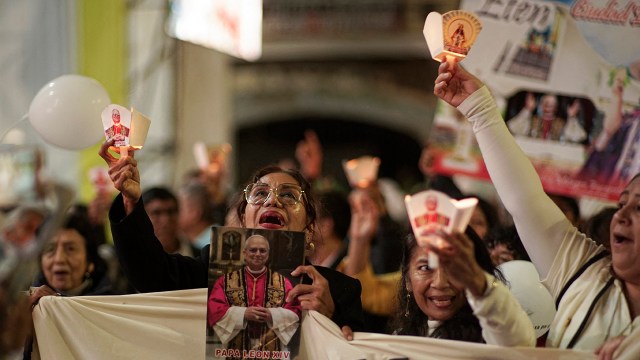
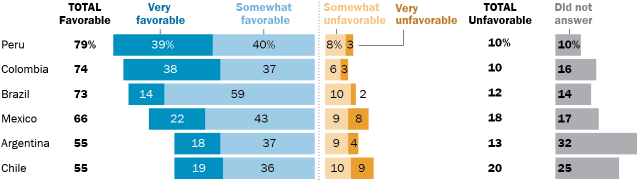
In all six Latin American countries we surveyed in 2026, a majority of Catholics express a favorable opinion of Pope Leo XIV. Some of the most positive views are in Peru, where 79% of Catholics look favorably on the pope, including 39% who have a very favorable opinion of him.
Although he is the first pope born in the United States, Leo has strong ties to Peru – where he lived for about two decades and became a bishop in 2014. He holds both Peruvian and U.S. citizenship.
In Argentina and Chile, opinions of Pope Leo are less positive, in part because he is less well known. Substantial shares of Catholics in both countries say they have not heard of Leo or don’t give an opinion on him.
| TOTAL Favorable | Very favorable | Somewhat favorable | Somewhat unfavorable | Very unfavorable | TOTAL Unfavorable | Did not answer | |
|---|---|---|---|---|---|---|---|
| Peru | 79% | 39% | 40% | 8% | 3% | 10% | 10% |
| Colombia | 74% | 38% | 37% | 6% | 3% | 10% | 16% |
| Brazil | 73% | 14% | 59% | 10% | 2% | 12% | 14% |
| Mexico | 66% | 22% | 43% | 9% | 8% | 18% | 17% |
| Argentina | 55% | 18% | 37% | 9% | 4% | 13% | 32% |
| Chile | 55% | 19% | 36% | 10% | 9% | 20% | 25% |
Some of the most negative ratings of Leo are among Catholics in Chile (20% unfavorable) and Mexico (18%).
The Latin American countries we surveyed are Argentina, Brazil, Chile, Colombia, Mexico and Peru. Together, they are home to roughly three-quarters of all Catholics in the region.
In these six countries, there do not tend to be large demographic differences in Catholics’ attitudes toward the pope. For example, Catholic men and women generally have similar opinions on Leo, as do younger and older Catholics.
Protestants and religiously unaffiliated adults in the region are much less likely than Catholics to say they view the pope favorably. However, many Protestants and religiously unaffiliated adults across Latin America say they have never heard of Pope Leo or didn’t answer the question. (For detailed responses by religious affiliation, refer to the topline.)
Comparing Catholics’ views of Pope Leo and Pope Francis
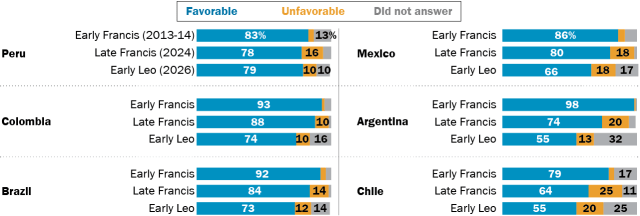
A year into Leo’s papacy, Latin American Catholics express much less favorable views of him than they did of Pope Francis early in his pontificate.
| Country | Papacy | Favorable | Unfavorable | Did not answer |
|---|---|---|---|---|
| Peru | Early Francis (2013-14) | 83% | 4% | 13% |
| Peru | Late Francis (2024) | 78% | 16% | 6% |
| Peru | Early Leo (2026) | 79% | 10% | 10% |
| Colombia | Early Francis | 93% | 2% | 5% |
| Colombia | Late Francis | 88% | 10% | 2% |
| Colombia | Early Leo | 74% | 10% | 16% |
| Brazil | Early Francis | 92% | 4% | 4% |
| Brazil | Late Francis | 84% | 14% | 2% |
| Brazil | Early Leo | 73% | 12% | 14% |
| Mexico | Early Francis | 86% | 5% | 9% |
| Mexico | Late Francis | 80% | 18% | 2% |
| Mexico | Early Leo | 66% | 18% | 17% |
| Argentina | Early Francis | 98% | 1% | 1% |
| Argentina | Late Francis | 74% | 20% | 5% |
| Argentina | Early Leo | 55% | 13% | 32% |
| Chile | Early Francis | 79% | 4% | 17% |
| Chile | Late Francis | 64% | 25% | 11% |
| Chile | Early Leo | 55% | 20% | 25% |
In 2013-14, 93% of Colombian Catholics held a favorable opinion of Francis, compared with 74% who hold a favorable view of Leo today. There has been a similar change in Mexico: 86% of Catholics viewed Francis favorably in 2013-14, compared with 66% who view Leo favorably now.
This lower favorability is partly because a larger share of Catholics in the latest survey do not give an opinion on Leo. However, there are also more unfavorable views of Leo today in these countries than of Francis in 2013-14.
Francis’ favorability ratings dropped between 2013-14 and 2024, but they were still higher in 2024 than they are for Leo today. The difference between 2024 and 2026 is largely because more people don’t give an opinion on Leo. The percentages with unfavorable views of Francis in 2024 are quite similar to the percentages with unfavorable views of Leo today.
Peru is an exception to this pattern. All three times we have asked Latin Americans about the pope, about eight-in-ten Peruvian Catholics have expressed a favorable view. However, the share of Peruvian Catholics with unfavorable views of Francis rose from 4% in 2013-14 to 16% in 2024, while 10% view Leo unfavorably in 2026.
Related: Most U.S. Catholics view Pope Leo favorably; many think Trump has been too critical of him
Note: Here is the question used for this analysis, along with responses, and the survey methodology.