
Betting on college basketball and other sports has increased sharply in the United States in recent years. With March Madness upon us, how do Americans’ views on gambling compare with those of people in other countries?
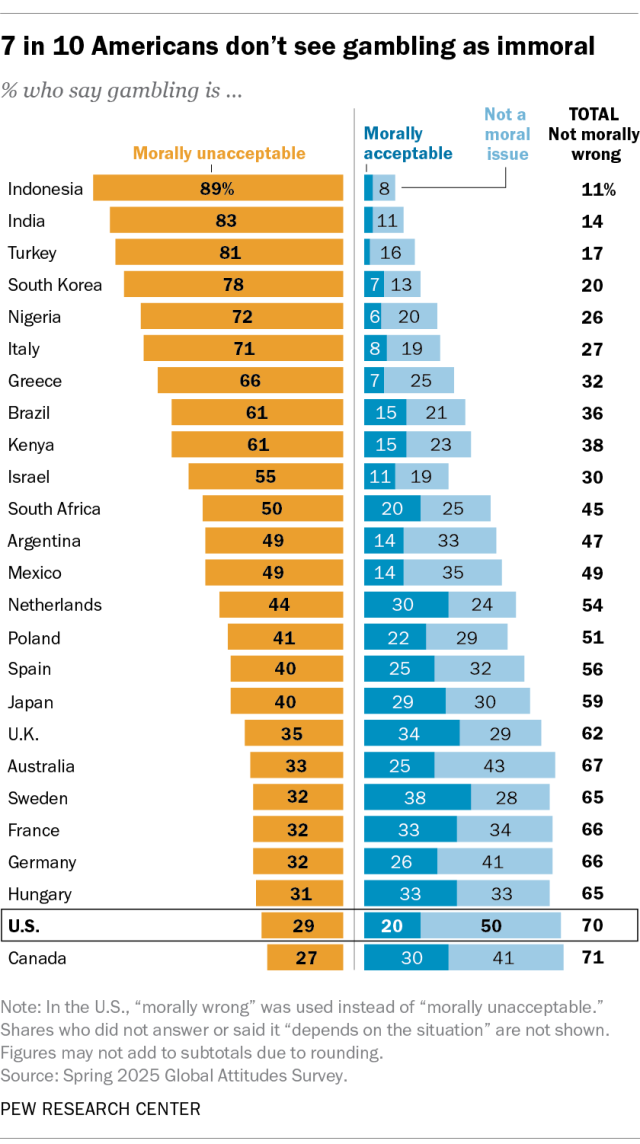
In a 2025 Pew Research Center survey of 25 countries, the U.S. stands out for having a relatively small share of adults (29%) who view gambling as morally wrong. In many other surveyed countries, about half of adults or more see gambling as immoral. This includes 89% in Indonesia, 83% in India, 71% in Italy and 61% in Brazil.
People taking the survey were given three options. They could say that gambling is morally acceptable, that it’s morally unacceptable or that it’s not a moral issue.
In the U.S., 20% of adults say gambling is morally acceptable. But half of Americans say gambling isn’t a moral issue. No other surveyed country has such a large share of people who take that position.
While relatively few Americans view gambling as immoral, the public has become slightly more likely to express that view over time. In 2013, when we first asked this question, 24% of U.S. adults said gambling is immoral.
About this research
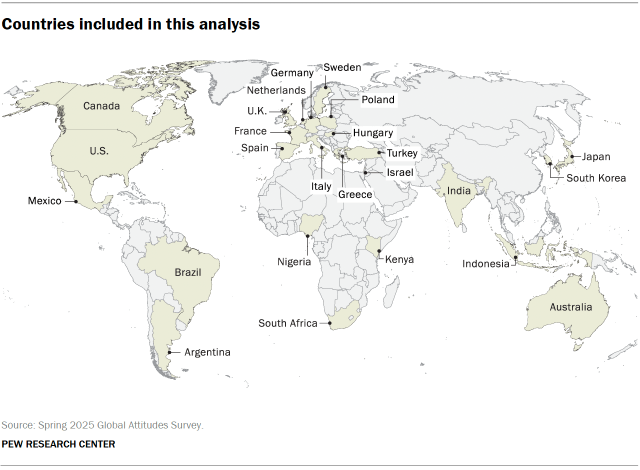
This analysis explores Americans’ views on the morality of gambling and compares their views with public opinion in 24 other countries.
Why did we do this?
Pew Research Center conducts high-quality research to inform the public, journalists and leaders. Studying religion and related topics, such as morality, has long been part of the Center’s research around the world. Learn more about Pew Research Center and our other research on religion.
How did we do this?
For data outside the United States, this analysis draws on nationally representative surveys of 28,333 adults conducted from Jan. 8 to April 26, 2025. We conducted these surveys:
- Over the phone in Canada, France, Germany, Greece, Hungary, Italy, Japan, the Netherlands, Poland, South Korea, Spain, Sweden and the United Kingdom
- Face-to-face in Argentina, Brazil, India, Indonesia, Israel, Kenya, Mexico, Nigeria, South Africa and Turkey
- Using a mixed-mode probability-based online panel in Australia
In the U.S., we surveyed 3,605 adults from March 24 to 30, 2025. Everyone who took part in the U.S. survey is a member of the Center’s American Trends Panel (ATP).
Here are the questions used for this analysis, along with responses, and the survey methodology.
Related: Americans increasingly see legal sports betting as a bad thing for society and sports
Demographic, religious differences in views of the morality of gambling
When asked about the morality of gambling, men and women in the U.S. are about equally likely to say it’s morally wrong.
Yet men are somewhat more likely than women to say gambling is morally acceptable. This is true across age groups. For example, 24% of men under 30 express this view, compared with 16% of women under 30. There’s a similar gender divide among Americans 65 and older (26% vs. 19%).
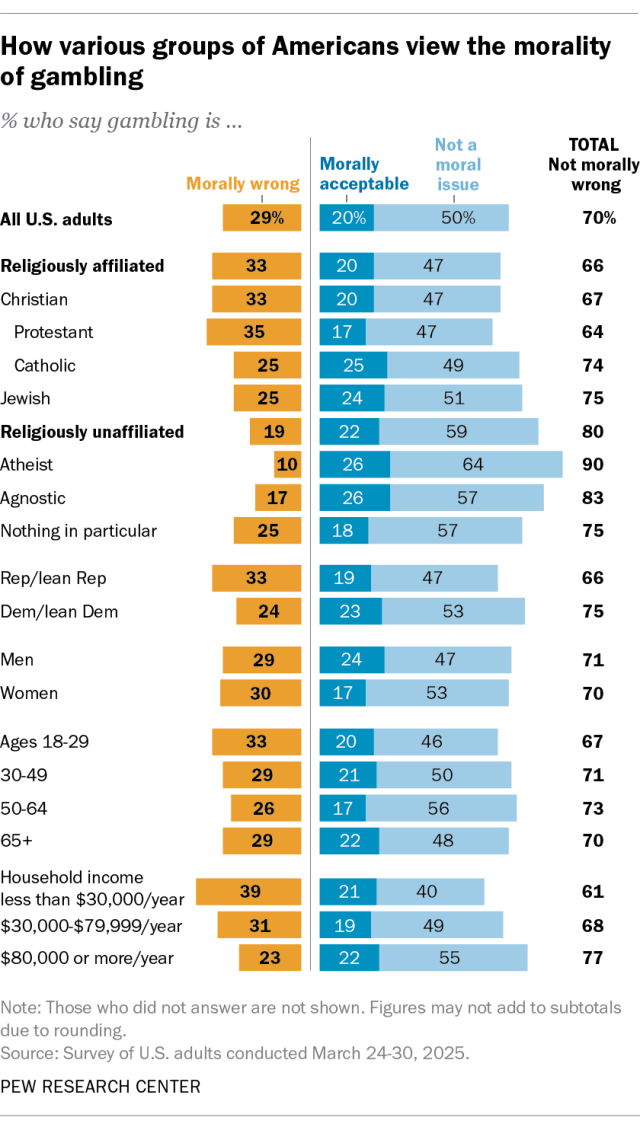
There are also some demographic differences in views of gambling as morally unacceptable:
- Asian (45%), Hispanic (38%) and Black Americans (37%) are much more likely than White Americans (23%) to express moral objections to gambling.
- Americans who report lower family incomes are more likely than Americans with higher incomes to say gambling is wrong.
Likewise, there are some religious differences in attitudes toward gambling:
- U.S. Christians (33%) are more likely than Jewish Americans and religiously unaffiliated adults (25% and 19%, respectively) to say gambling is morally wrong. The survey did not contain enough respondents in other non-Christian religions to report their answers separately.
- Americans who say they pray daily are more likely than those who pray less often to object to gambling on moral grounds (37% vs. 23%).
Note: Here are the questions used for this analysis, along with responses, and the survey methodology.