In this survey of six Latin American countries, we asked about a variety of religious and spiritual practices, such as whether respondents pray daily, attend worship services weekly or wear religious symbols.18
Half or fewer of adults in each country engage in the practices we asked about – with the exception of daily prayer, which is reported by majorities of adults in Brazil (76%), Colombia (71%) and Peru (58%).
In several countries, Protestants are more likely than Catholics to say they pray daily and attend worship services weekly. But Catholics are more likely than Protestants to wear or carry religious symbols and to light incense or candles for religious or spiritual purposes.19
Other findings from Pew Research Center’s 2024 survey of Argentina, Brazil, Chile, Colombia, Mexico and Peru include:
- Women are more likely than men in these six countries to pray and to attend religious services, reaffirming a pattern that researchers have often observed around the world.
- Based on the religious practices we asked about in these countries, Argentine and Chilean adults appear to be the least religious, on average.
Daily prayer
Praying at least once a day is most common in Brazil, Colombia and Peru. Fewer than half of adults in Mexico, Chile and Argentina report doing so.
Majorities of Protestants in nearly all places surveyed say they pray at least once a day. (The sample of Protestants in Mexico is too small for reliable analysis.)
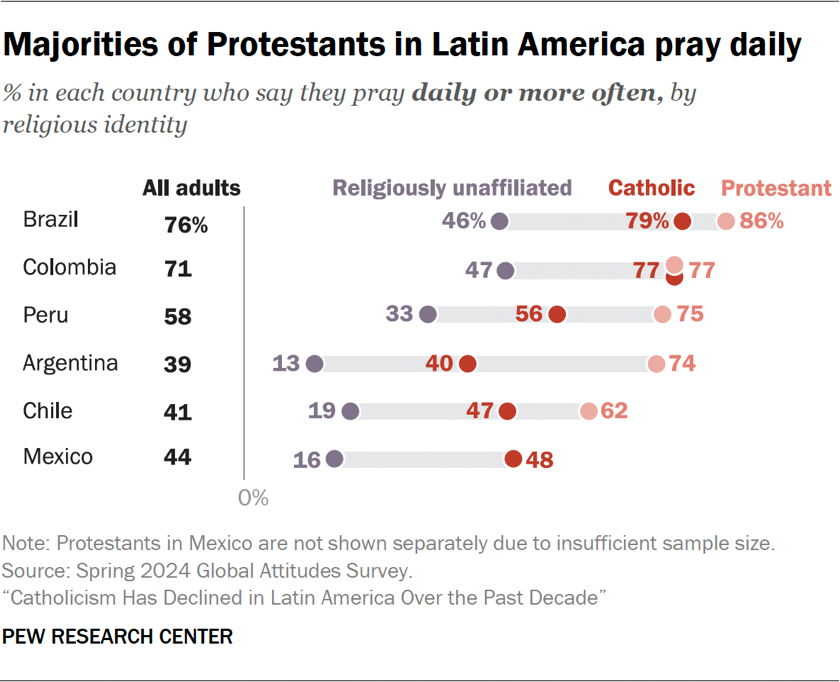
Yet only in Brazil, Colombia and Peru do majorities of Catholics pray daily. Our 2013-14 survey in Latin America also found that Protestants were more likely than Catholics to pray daily.20
Within the countries surveyed, religiously unaffiliated adults generally are much less likely than either Catholics or Protestants to pray daily.
However, there is a lot of variation in rates of prayer between religious groups in different countries. For example, “nones” in Brazil and Colombia are about as likely as Catholics in Chile and Mexico to pray at least once a day.
The oldest adults surveyed (ages 50 and older) are much more likely than the youngest adults (ages 18 to 34) to say they pray daily. For example, most of the oldest Chilean adults (57%) pray daily, compared with 21% of the youngest Chileans.
In all six countries, women are more likely than men to report that they pray daily.
(Refer to the detailed tables to see how this measure varies across demographic groups.)
Attending religious services
While about four-in-ten Brazilians (43%), Colombians (37%) and Mexicans (also 37%) say they attend religious services at least once a week, Argentines (19%) and Chileans (13%) are much less likely to do so.
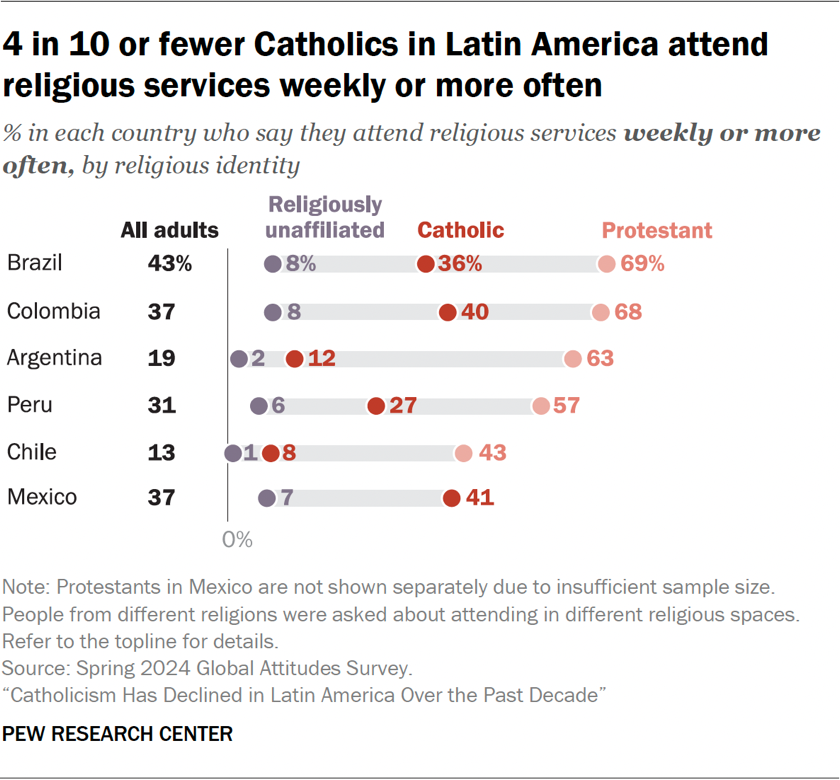
Looking within the countries that have a large enough sample of Protestants to analyze, Protestants are much more likely than Catholics to attend religious services weekly or more often. And Catholics, in turn, are more likely than religiously unaffiliated adults to be frequent churchgoers. In Peru, for instance, Protestants are around twice as likely as Catholics to go to church weekly (57% vs. 27%), while just 6% of religiously unaffiliated Peruvian adults say they attend that often.
This broad, regional pattern (Protestants attending church at higher rates than Catholics) was also found in our 2013-14 survey of the region. However, the recent survey’s results cannot be directly compared with specific percentages from the earlier survey due to changes in question wording.
In Brazil, Pentecostal Protestants are more likely than non-Pentecostal Protestants to attend church weekly (76% vs. 54%). (Brazil is the only surveyed country with samples large enough to compare Pentecostal Protestants with non-Pentecostal Protestants.)
In all but one of the six countries surveyed, women are more likely than men to attend religious services. For example, 44% of Mexican women say they attend religious services at least weekly, compared with 29% of Mexican men. (In Chile, the 4 percentage point gap between women and men is not statistically significant.)

(Refer to the detailed tables for more information about how this measure varies by frequency of prayer and across demographic groups.)
Lighting incense or candles
Among countries surveyed, lighting incense or candles is most common in Mexico, where around half of adults say they do this for spiritual or religious reasons.
Unlike with daily prayer and weekly service attendance, Protestants are much less likely than Catholics across the region to say they light candles for spiritual or religious reasons, and Protestants also are less likely than “nones” to follow this practice.
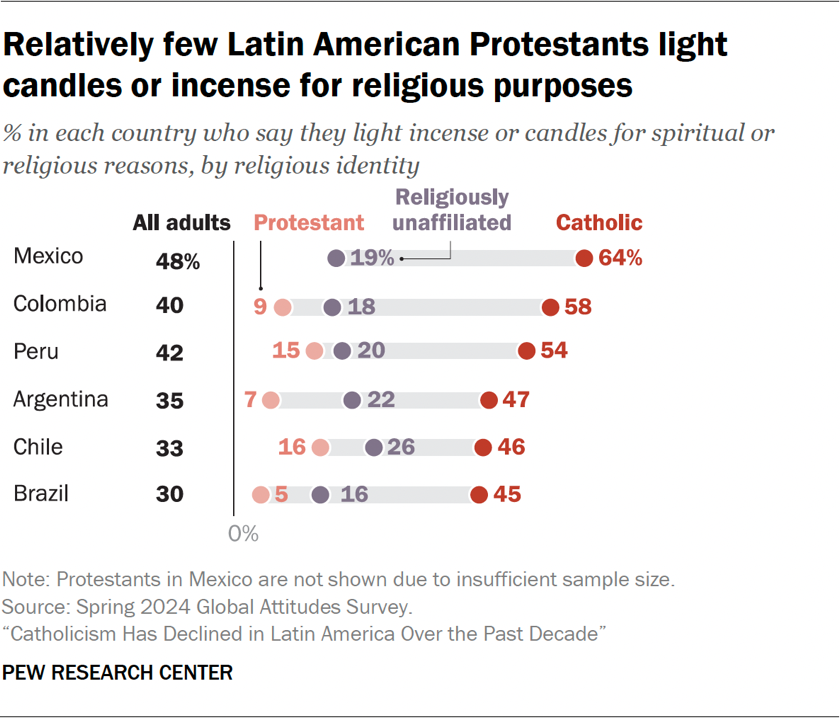
In Brazil, for example, 45% of Catholics light incense or candles for religious reasons, compared with 16% of “nones.” Meanwhile, only 5% of Protestants do this. Likewise, Argentine Catholics are more likely than “nones” to light candles or incense (47% vs. 22%), and both groups are more likely than Protestants in Argentina to do so (7%).
In Argentina, Chile and Mexico, women are more likely than men to light incense or candles for spiritual purposes. In the other countries, the gender differences are not statistically significant.
(Refer to the detailed tables for more information about how this measure varies by frequency of prayer and across demographic groups.)
Wearing religious symbols
Mexican (45%) and Colombian (43%) adults are more likely than others in the region to say they wear – or carry around – religious items or symbols.
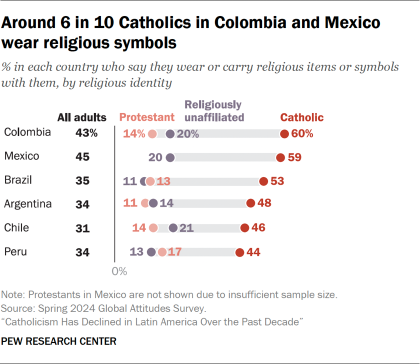
Catholics are much more likely than Protestants to wear or carry such items. But within most countries surveyed, roughly similar shares of Protestants and “nones” report doing this.
In Brazil, for example, about half of Catholics say they wear or carry religious symbols with them, compared with 13% of Protestants and 11% of “nones.”
(Refer to the detailed tables for more information about how this measure varies by frequency of prayer and across demographic groups.)