Religious Groups Differ Widely in Their 2026 Midterm Preferences
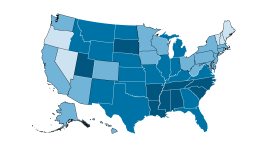
White evangelical Protestants and White Catholics favor Republicans in the midterms, while other religious groups split or lean Democratic.
Numbers, Facts and Trends Shaping Your World
Read our research on:

White evangelical Protestants and White Catholics favor Republicans in the midterms, while other religious groups split or lean Democratic.

Sent weekly on Wednesday
All
Publications
10:00 – 11:30 a.m. National Press Club Washington, D.C. Speakers: Doug Laycock, Counsel of Record for 32 Christian and Jewish clergy, urging the Court to affirm the 9th Circuit’s ruling Jay Alan Sekulow, Chief Counsel, American Center for Law and Justice; Counsel of Record for United States Senators and Congressmen and the Committee to Protect […]
Back to Religion and Public Schools Issue Page One Electorate Under God? A Dialogue on Religion and American Politics Executive Summary Event Transcript Event Transcript: Under God? A Discussion of the Constitutionality of the Pledge of Allegiance Issue Backgrounder: One Nation Under God? A Constitutional Question Background On June 26, 2002, a divided three-judge panel […]
10:00 – 11:30 a.m. Washington, D.C. Speakers Anthony Picarello, Vice President and General Counsel, the Becket Fund for Religious Liberty; filed amicus brief in Locke case on behalf of Joshua Davey Marc D. Stern, General Counsel, American Jewish Congress; filed amicus brief in Locke case on behalf of the state of Washington Ira “Chip” Lupu […]
On February 25, 2004, the United States Supreme Court announced its ruling in Locke v. Davey, holding that Washington State is allowed to deny scholarship funds to students studying devotional theology. Justice Rehnquist wrote for the majority: “The State of Washington established the Promise Scholarship Program to assist academically gifted students with postsecondary education expenses. […]
2003 Year-end Report
Introduction and Summary Opposition to gay marriage has increased since the summer and a narrow majority of Americans also oppose allowing gays and lesbians to enter legal agreements that fall short of marriage. Moreover, despite the overall rise in tolerance toward gays since the 1980s, many Americans remain highly critical of homosexuals and religious […]
Across 25 countries, Americans are the most likely to see the morality and ethics of people in their country as somewhat or very bad.
Singapore is the world’s most religiously diverse country overall as of 2020, while Yemen is the least diverse. But the U.S. ranks first among nations with very large populations, followed by Nigeria and Russia.
The Christian share of the population, after years of decline, has been relatively stable since 2019. And the religiously unaffiliated population, after rising rapidly for decades, has leveled off – at least temporarily.
The Global Religious Futures (GRF) project is jointly funded by The Pew Charitable Trusts and The John Templeton Foundation. Here are some big-picture findings from the GRF, together with context from other Pew Research Center studies.