Why Do Some Americans Leave Their Religion While Others Stay?
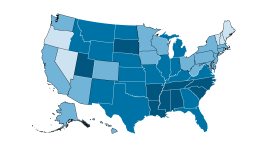
Many U.S. adults (35%) have moved on from the religion of their youth. Yet most Americans have not, including a majority – 56% – who still identify with their childhood religion.
All
Publications
12:00-2:00pm Council on Foreign Relations New York, New York The Pew Forum on Religion & Public Life and the Council on Foreign Relations co-hosted a luncheon roundtable on “Faith at War: Reports from the Islamic World” on May 4, 2005, at the Council on Foreign Relations in New York. With over one billion adherents, the […]
12:00-2:00pm Pew Research Center Washington, D.C. The Pew Forum on Religion & Public Life and the Council on Foreign Relations co-hosted a luncheon roundtable on “The Global Spread of Wahhabi Islam: How Great a Threat?” on May 3, 2005 at the Pew Research Center in Washington, D.C. The global spread of radical Islam, the threat […]
Pew Research Center Washington, D.C. On April 19, Cardinal Joseph Ratzinger of Germany became Benedict XVI, the 265th pontiff. Under the leadership of his predecessor, John Paul II, the Catholic Church gained remarkable global influence. From his role in the downfall of Communism to his ecumenical overtures to the Muslim world, John Paul II positioned […]
Los Angeles, California The Pew Forum on Religion & Public Life and the Pacific Council on International Policy co-hosted a meeting on “Islam and Democratization in the Middle East” on April 27, 2005, at the Pacific Council on International Policy in Los Angeles. The roundtable featured one of Egypt’s foremost human rights activists, Saad Eddin […]
10:00 a.m.-noon Pew Research Center Washington, D.C. Featured Speaker: John Podesta, President and CEO, Center for American Progress; former Chief of Staff to President William J. Clinton Moderator: Michael Cromartie, Vice President, Ethics & Public Policy Center With Additional Comments By: Luis Lugo, Director, Pew Forum on Religion & Public Life Andrew Kohut, Director, Pew […]
Pew Research Center Washington, D.C. The Pew Forum on Religion & Public Life and the Council on Foreign Relations co-hosted a luncheon roundtable entitled “Secular Europe and Religious America: Implications for Transatlantic Relations” on April 21, 2005 at the Pew Research Center in Washington, D.C. According to a 2002 Pew Global Attitudes survey, there are […]
Recent surveys by the Pew Forum on Religion & Public Life demonstrate that American evangelical Protestants have distinctive – and highly positive – attitudes towards the state of Israel. This group is important both because it constitutes a large share of the American population – about 26% – and because it provided President George W. […]
Pew Research Center Washington, D.C. Download the Pew Forum legal backgrounder Speakers: Nathan J. Diament, Director, Institute for Public Affairs, Union of Orthodox Jewish Congregations of America; Co-Editor, Tikkun Olam: Social Responsibility in Jewish Law and Thought Ira C. “Chip” Lupu, F. Elwood and Eleanor Davis Professor of Law, The George Washington University Law School […]
12:00-2:00pm Council on Foreign Relations Washington, D.C. The Pew Forum on Religion & Public Life and the Council on Foreign Relations co-hosted a luncheon roundtable entitled Religious Fault Lines in West Africa on March 15, 2005 at the Council on Foreign Relations in Washington. In recent history, West Africa has been prone to episodes of […]
Many religious “nones,” which include atheists and agnostics, in 22 countries hold religious or spiritual beliefs, such as in an afterlife or something beyond the natural world.
Nearly half of U.S. adults are connected to Catholicism. Read about going to Mass, Communion, confession and more.
After years of decline, the U.S. Christian share now shows signs of leveling off. The new Religious Landscape Study explores trends in identity, beliefs and practices.
The Global Religious Futures (GRF) project is jointly funded by The Pew Charitable Trusts and The John Templeton Foundation. Here are some big-picture findings from the GRF, together with context from other Pew Research Center studies.