Religious Groups Differ Widely in Their 2026 Midterm Preferences
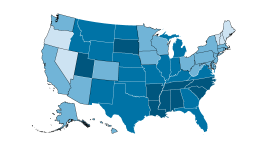
White evangelical Protestants and White Catholics favor Republicans in the midterms, while other religious groups split or lean Democratic.
Numbers, Facts and Trends Shaping Your World
Read our research on:

White evangelical Protestants and White Catholics favor Republicans in the midterms, while other religious groups split or lean Democratic.

Sent weekly on Wednesday
All
Publications
Center for Strategic & International Studies Washington, D.C. During the past year, Chinese President Hu Jintao and the leadership of the Communist Party of China have emphasized “building a harmonious society” in the face of escalating social and economic challenges resulting from China’s rapid economic growth. The Pew Forum on Religion & Public Life co-hosted […]
Almost 150 years after Charles Darwin published his groundbreaking theory on the origins of life, Americans are still fighting over evolution. If anything, the controversy is growing in both size and intensity. Recent polls indicate that challenges to Darwinian evolution have substantial support among the American people. According to a July 2005 survey sponsored by […]
National Press Club Washington, D.C. In late September 2005, Kitzmiller, et al. v. Dover Area School District et al. went to trial in federal district court in Pennsylvania. The plaintiffs challenged the decision of the Dover School Board requiring that public schools teach that intelligent design is an alternative theory to evolution. The plaintiffs alleged […]
Religion A Strength And Weakness For Both Parties Navigate this Report Executive Summary Contrasting Party Images: The Political Parties and Religion Evolution & Creationism Religion & Politics Promoting Democracy Support for Israel Religion & Mideast Views Faith-Based Aid Gays in the Military Other Issues Executive Summary Both major political parties have a problem with their […]
On June 27, 2005, the Supreme Court issued sharply divided decisions in two cases involving constitutional challenges to government-sponsored displays of the Ten Commandments. In McCreary County v. American Civil Liberties Union of Kentucky (03-1693), a 5-4 majority held that two Kentucky counties had “predominantly religious” purposes in posting the Ten Commandments in their courthouses, […]
Summary of Findings The July 7 terrorist bombings in London drew considerable public attention and raised fears of another attack in the United States, but these concerns do not translate into less favorable opinions of either Muslim-Americans or Islam. And compared with 2003, fewer now say that Islam is more likely than other religions to […]
The July 7 terrorist bombings in London drew considerable public attention and raised fears of another attack in the United States, but these concerns do not translate into less favorable opinions of either Muslim-Americans or Islam. And compared with 2003, fewer now say that Islam is more likely than other religions to encourage violence. The […]
Across 25 countries, Americans are the most likely to see the morality and ethics of people in their country as somewhat or very bad.
Singapore is the world’s most religiously diverse country overall as of 2020, while Yemen is the least diverse. But the U.S. ranks first among nations with very large populations, followed by Nigeria and Russia.
The Christian share of the population, after years of decline, has been relatively stable since 2019. And the religiously unaffiliated population, after rising rapidly for decades, has leveled off – at least temporarily.
The Global Religious Futures (GRF) project is jointly funded by The Pew Charitable Trusts and The John Templeton Foundation. Here are some big-picture findings from the GRF, together with context from other Pew Research Center studies.