Religious Groups Differ Widely in Their 2026 Midterm Preferences
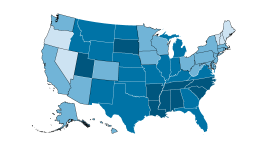
White evangelical Protestants and White Catholics favor Republicans in the midterms, while other religious groups split or lean Democratic.
Numbers, Facts and Trends Shaping Your World
Read our research on:

White evangelical Protestants and White Catholics favor Republicans in the midterms, while other religious groups split or lean Democratic.

Sent weekly on Wednesday
All
Publications
The Pew Forum on Religion & Public Life today released the results of a 10-country survey of pentecostal and charismatic Christians, two large and fast-growing groups whose socially conservative views are impacting religion and politics worldwide.
Executive Summary By all accounts, pentecostalism and related charismatic movements represent one of the fastest-growing segments of global Christianity. According to the World Christian Database, at least a quarter of the world’s 2 billion Christians are thought to be members of these lively, highly personal faiths, which emphasize such spiritually renewing “gifts of the Holy […]
Washington, D.C. Pope Benedict XVI is scheduled to visit Turkey on Nov. 28-30, a trip that has already attracted exceptionally close attention because of the pope’s remarks about Islam during a September speech in Regensburg, Germany. More than 50 Islamic nations have demanded an apology for the speech, which aroused anger in the Islamic world […]
Pew Research Center Washington, D.C. In his recent article in Foreign Affairs, Walter Russell Mead argues that as U.S. evangelicals exert increasing political influence, they are becoming a powerful force in foreign affairs. In recent years, evangelicals have voted overwhelmingly Republican, helping to put conservatives at the helm of U.S. foreign policy, while focusing their […]
Introduction and Summary The relationship between religion and politics is a controversial one. While the public remains more supportive of religion’s role in public life than in the 1960s, Americans are uneasy with the approaches offered by both liberals and conservatives. Fully 69% of Americans say that liberals have gone too far in keeping religion […]
Navigate this Report Introduction and Summary Section I – Religion and Public Life Section II – Religion and Politics Section III – Religion and Science Section IV – Religious Beliefs About the Survey Introduction and Summary The relationship between religion and politics is a controversial one. While the public remains more supportive of religion’s role […]
Bethesda, Maryland A native of Pakistan who served as his country’s high commissioner to Great Britain, Akbar Ahmed offers the unique perspective of an anthropologist who has lived in and studied both Islamic and Western cultures. The BBC has described him as “the world’s leading authority on contemporary Islam.” He is the principal investigator for […]
Martha’s Vineyard, Massachusetts A reviewer of political scientist Samuel P. Huntington’s first book compared him unfavorably to Mussolini. A reviewer of his 19th and latest book dubbed him “Patrick Buchanan with footnotes.” But those reactions were mild compared with the controversy over the international political paradigm advanced in Huntington’s most influential book, The Clash of […]
Across 25 countries, Americans are the most likely to see the morality and ethics of people in their country as somewhat or very bad.
Singapore is the world’s most religiously diverse country overall as of 2020, while Yemen is the least diverse. But the U.S. ranks first among nations with very large populations, followed by Nigeria and Russia.
The Christian share of the population, after years of decline, has been relatively stable since 2019. And the religiously unaffiliated population, after rising rapidly for decades, has leveled off – at least temporarily.
The Global Religious Futures (GRF) project is jointly funded by The Pew Charitable Trusts and The John Templeton Foundation. Here are some big-picture findings from the GRF, together with context from other Pew Research Center studies.