Religious Groups Differ Widely in Their 2026 Midterm Preferences
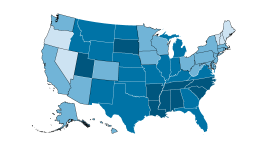
White evangelical Protestants and White Catholics favor Republicans in the midterms, while other religious groups split or lean Democratic.
Numbers, Facts and Trends Shaping Your World
Read our research on:

White evangelical Protestants and White Catholics favor Republicans in the midterms, while other religious groups split or lean Democratic.

Sent weekly on Wednesday
All
Publications
Santorum won narrow victories in both the Alabama and Mississippi Republican primaries, but exit polling shows there was no clear winner among white born-again/evangelical voters in either state.
This study focuses on the religious affiliation of international migrants, examining patterns of migration among seven major groups: Christians, Muslims, Hindus, Buddhists, Jews, adherents of other religions and the religiously unaffiliated.
This study focuses on the religious affiliation of international migrants, examining patterns of migration among seven major groups: Christians, Muslims, Hindus, Buddhists, Jews, adherents of other religions and the religiously unaffiliated.
This study focuses on the religious affiliation of international migrants, examining patterns of migration among seven major groups: Christians, Muslims, Hindus, Buddhists, Jews, adherents of other religions and the religiously unaffiliated.
Exit polls from Super Tuesday primaries show that Mitt Romney continues to struggle among evangelicals, and Rick Santorum is yet to win among Catholics in any state where exit polling was conducted.
Data from exit or entrance polling in the seven states where it has been conducted for GOP primaries and caucuses show that Mitt Romney’s fortunes among white born-again/evangelical voters have fluctuated from state to state. He has received less support from evangelicals than from non-evangelicals in every contest for which data are available.
Pope Benedict XVI will travel to Latin America March 23-28 for a much-anticipated visit to Mexico and Cuba. An infographic based on data from a 2011 demographic study by the Pew Research Center’s Forum on Religion & Public Life explores information on Catholics in Latin America, with a particular focus on the Catholic population in Mexico and Cuba.
Mitt Romney won the Arizona primary by a large margin and secured a narrow victory in the Michigan primary. In both states, his support among born-again/evangelical voters was weaker than among non-evangelicals, continuing the pattern from previous primaries and caucuses in other states.
Recent comments by presidential candidate Rick Santorum have brought renewed attention to the role of religion in politics. In both 2010 and 2008, narrow majorities said that churches and other houses of worship should keep out of political matters rather than express their views on social and political questions, according to polls by the Pew […]
Across 25 countries, Americans are the most likely to see the morality and ethics of people in their country as somewhat or very bad.
Singapore is the world’s most religiously diverse country overall as of 2020, while Yemen is the least diverse. But the U.S. ranks first among nations with very large populations, followed by Nigeria and Russia.
The Christian share of the population, after years of decline, has been relatively stable since 2019. And the religiously unaffiliated population, after rising rapidly for decades, has leveled off – at least temporarily.
The Global Religious Futures (GRF) project is jointly funded by The Pew Charitable Trusts and The John Templeton Foundation. Here are some big-picture findings from the GRF, together with context from other Pew Research Center studies.