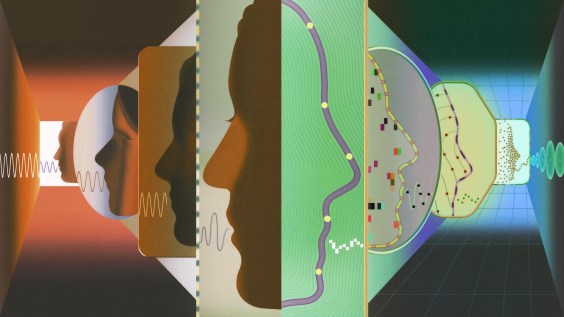
Can AI Stand In for Human Survey-Takers? Not Really
Synthetic surveys using digital twins do a poor job estimating the public mood and are especially error-prone for some subgroups, including Republicans and Black adults.
Numbers, Facts and Trends Shaping Your World
Read our research on:

Synthetic surveys using digital twins do a poor job estimating the public mood and are especially error-prone for some subgroups, including Republicans and Black adults.

The latest on survey methods, data science and more, delivered quarterly.
All
Publications
As America turns 250, explore how demographics, work, family and economics have shifted since 1976, based on 50 years of Census data.
Ever wonder how we collect our data? Today, most polls are conducted online. But, most pollsters reject the idea that “one size fits all” when it comes to polling, so we still use phone calls or mail to reach people.
In this post, we’ll highlight a few of our favorite visuals from 2025 and walk through how we made them and what makes them successful.
We’re in an era where the people most likely to respond to a poll are also the most likely to vote Democratic for president. Pew Research Center’s head methodologist Courtney Kennedy explains how pollsters are tackling this challenge to make samples as representative as possible.
How the U.S. government measures race has changed substantially since censuses began in 1790. Today, Americans differ on whether the government should ask about race.
Racial categories, which have been on every U.S. census, have changed from decade to decade, reflecting the politics and science of the times.
In this Q&A, we speak with Senior Demographer Jeffrey S. Passel about how the Center estimates the number of unauthorized immigrants in the U.S.
In 2020, Pew Research Center launched a new project called the National Public Opinion Reference Survey (NPORS). NPORS is an annual, cross-sectional survey of U.S. adults. Respondents can answer either by paper or online, and they are selected using address-based sampling from the United States Postal Service’s computerized delivery sequence file.
While survey research in the United States is a year-round undertaking, the public’s focus on polling is never more intense than during the run-up to a presidential election.
Pew Research Center conducted a study to compare the accuracy of six online surveys of U.S. adults – three from probability-based panels and three from opt-in sources. On average, the absolute error on opt-in samples was about twice that of probability-based panels.
Members of the American Trends Panel can now take our surveys online or over the phone with an interviewer.
A new study found that 61% of national pollsters used different methods in 2022 than in 2016. And last year, 17% of pollsters used multiple methods to sample or interview people – up from 2% in 2016.


