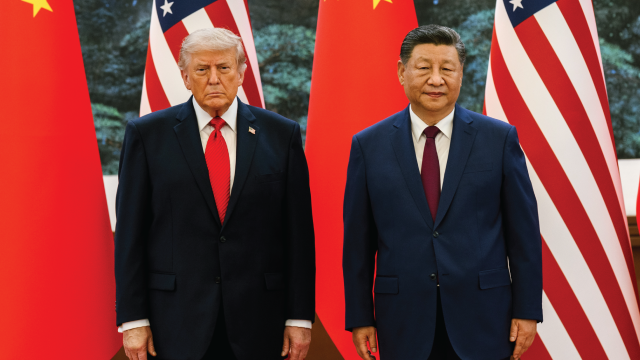
U.S. President Donald Trump meets with Chinese President Xi Jinping in Beijing on May 14. (White House via X/Anadolu via Getty Images)
Chinese President Xi Jinping and U.S. President Donald Trump will meet this week in Washington. The meeting comes as Americans’ feelings about China have warmed in recent years, even though they remain cold overall.
In a Pew Research Center survey conducted from Sept. 14 to 20, 2026, we asked Americans to rate China (and several other countries) on a “feeling thermometer” ranging from zero to 100, where:
Zero means they feel as cold and negative as possible.
50 means they don’t feel particularly positive or negative.
100 means they feel as warm and positive as possible.
About this research
This Pew Research Center analysis looks at how Americans feel about China and how their views have changed since 2016.
Why did we do this?
Pew Research Center does research to help the public, media and decision-makers understand important topics. This research builds on more than two decades of work tracking what Americans and people around the world think about China.
This analysis includes findings from a survey of 5,193 U.S. adults conducted from Sept. 14 to 20, 2026. Everyone who took part in this survey is a member of the Center’s American Trends Panel. We asked each respondent to rate four of 18 possible countries on the “feeling thermometer.” The results shown here are from the 1,168 U.S. adults who rated China.
Pew Research Center typically measures favorability – including of China – using a four-point scale, asking people if they have a very favorable, somewhat favorable, somewhat unfavorable or very unfavorable view of different countries. Readers (and survey respondents) can easily grasp what favorable and unfavorable mean and the simplicity of the measure makes analysis and reporting straightforward.
Still, the measure shown here – which asks people to rate a country on a “feeling thermometer” ranging from zero (“as cold and negative as possible”) to 100 (“as warm and positive as possible”) – also has some advantages. With 101 scale points, respondents can offer a precise rating. Researchers also have more variation they can use for analysis, and the ability to look easily at both frequencies (the share that says 0, the share that says 0 to 24, etc.) or at mean or median ratings. This approach also offers a neutral midpoint at 50 – something that carries both advantages and disadvantages, depending on researchers’ analytical goals. (For more, read “What different survey modes and question types can tell us about Americans’ views of China.”)
Regardless of which measure is used to gauge Americans’ views of China, the story is consistent:
Views of China are more negative than positive
Views have improved somewhat in recent years
Democrats have more positive (or warmer) views of China than Republicans do
Younger people have more positive views of China than older people do
Today, Americans give China an average rating of 37 on the feeling thermometer, up from 28 in 2021.
Warm views of China increasingly common among Americans, though cold views are still more common
% who have a __ view of China
Note: Those who did not answer are not shown. On a scale of 0-100, where zero is “as cold and negative as possible” and 100 is “as warm and positive as possible,” ratings of 0-49 are cold, ratings of 50 are neutral and ratings of 51-100 are warm. “Average rating” is the mean.
Source: Survey of U.S. adults conducted Sept. 14-20, 2026.
PEW RESEARCH CENTER
Share this chart
Warm views of China increasingly common among Americans, though cold views are still more common
Note: Those who did not answer are not shown. On a scale of 0-100, where zero is “as cold and negative as possible” and 100 is “as warm and positive as possible,” ratings of 0-49 are cold, ratings of 50 are neutral and ratings of 51-100 are warm. “Average rating” is the mean.
Source: Survey of U.S. adults conducted Sept. 14-20, 2026.
PEW RESEARCH CENTER
We can see a few other shifts over this period:
The share of U.S. adults with a warm view of China (a thermometer rating of 51 to 100) has increased from 11% in 2021 to 19% today.
The share with a neutral view (a rating of exactly 50) has increased from 20% to 27%.
The share with a cold view (a rating of zero to 49) has fallen from 68% to 54%.
The share with a very cold view (zero to 24) has decreased from 47% to 34%.
Democrats and Democratic-leaning independents have significantly warmer views of China than Republicans and Republican-leaning independents do (average thermometer rating of 43 vs. 29).
Americans feel more cold than warm toward China
% who have a __ view of China
Note: Those who did not answer are not shown. On a scale of 0-100, where zero is “as cold and negative as possible” and 100 is “as warm and positive as possible,” ratings of 0-24 are very cold, ratings of 25-49 are somewhat cold, ratings of 50 are neutral, ratings of 51-75 are somewhat warm and ratings of 76-100 are very warm.
Source: Survey of U.S. adults conducted Sept. 14-20, 2026.
Note: Those who did not answer are not shown. On a scale of 0-100, where zero is “as cold and negative as possible” and 100 is “as warm and positive as possible,” ratings of 0-24 are very cold, ratings of 25-49 are somewhat cold, ratings of 50 are neutral, ratings of 51-75 are somewhat warm and ratings of 76-100 are very warm.
Source: Survey of U.S. adults conducted Sept. 14-20, 2026.
PEW RESEARCH CENTER
About a quarter of Democrats (26%) view China warmly, compared with 10% of Republicans. Conversely, a 68% majority of Republicans have cold views of China, compared with 44% of Democrats.
Democrats are now more likely to have a warm view of China (26% today vs. 15% in 2021).
Republicans have both warmed toward China (10% today vs. 5% in 2021) and are more likely to have a neutral view (22% vs. 15%).
The share of Republicans who give China a zero rating on the feeling thermometer has fallen from 37% in 2021 to 19% today.
How do ratings of China differ by age?
Younger Americans rate China more warmly than their older counterparts do. Adults under age 50 give China an average rating of 42 on the feeling thermometer, compared with older Americans’ average of 31.
This marks an uptick in ratings among both younger and older adults since 2021, similar to the shift among Americans overall. The difference in average ratings by age has consistently been around 10 points for the last decade.
Notably, while younger people have warmer views of China than older people do, adults under 50 are still about twice as likely to give China a cold rating than a warm one (47% vs. 24%; another 27% are neutral).