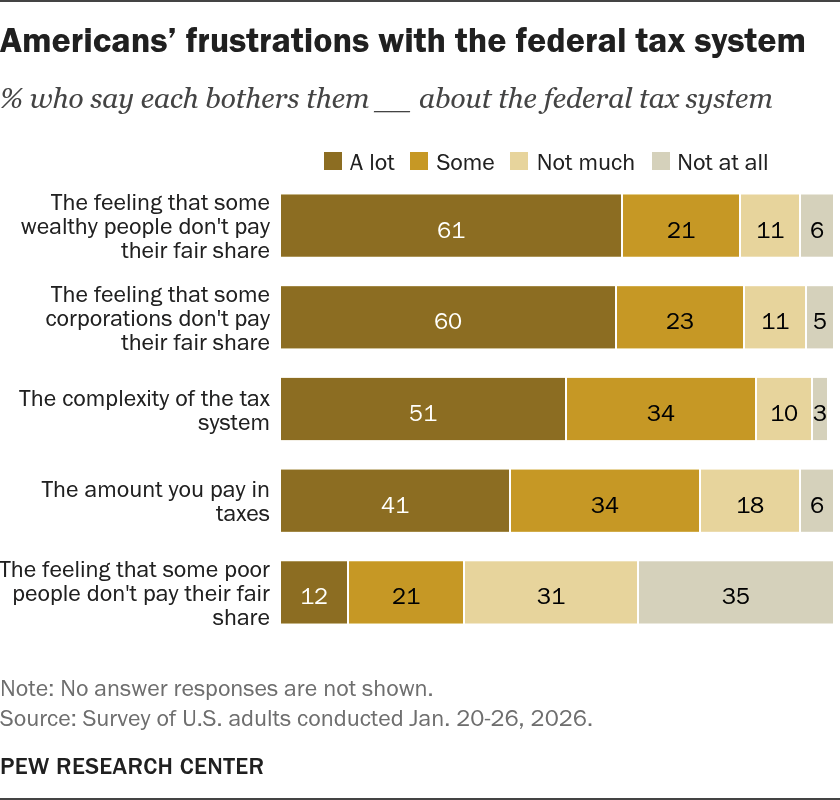
With the annual IRS filing deadline approaching, majorities of Americans continue to be bothered by the feeling that some wealthy people and corporations do not pay their fair share in federal taxes.
| A lot | Some | Not much | Not at all | |
|---|---|---|---|---|
| The feeling that some wealthy people don’t pay their fair share | 61% | 21% | 11% | 6% |
| The feeling that some corporations don’t pay their fair share | 60% | 23% | 11% | 5% |
| The complexity of the tax system | 51% | 34% | 10% | 3% |
| The amount you pay in taxes | 41% | 34% | 18% | 6% |
| The feeling that some poor people don’t pay their fair share | 12% | 21% | 31% | 35% |
Roughly six-in-ten adults now say the feeling that some wealthy people (61%) and corporations (60%) don’t pay their fair share bothers them a lot. These percentages are largely unchanged in recent years.
A Pew Research Center survey, conducted Jan. 20-26 among 8,512 U.S. adults, also finds that:
- 51% of Americans say the complexity of the federal tax system bothers them a lot. That’s roughly on par with past years.
- 41% are bothered a lot by the amount they personally pay in taxes. That share has grown steadily over the last several years.
- Only 12% say a sense that lower-income people don’t pay their fair share bothers them a lot.
Partisans’ top frustrations with the tax system differ
Republicans and Democrats, including those who lean toward each party, diverge in their frustrations with the federal tax system.

| Total | Rep/Lean Rep | Dem/Lean Dem | |
|---|---|---|---|
| The feeling that some wealthy people don’t pay their fair share | 61% | 41% | 81% |
| The feeling that some corporations don’t pay their fair share | 60% | 42% | 79% |
| The complexity of the tax system | 51% | 53% | 52% |
| The amount you pay in taxes | 41% | 47% | 36% |
| The feeling that some poor people don’t pay their fair share | 12% | 16% | 8% |
Democrats are more likely than Republicans to say certain things about the tax system bother them a lot:
- The feeling that some wealthy people don’t pay their fair share (81% of Democrats vs. 41% of Republicans)
- The feeling that some corporations don’t pay their share (79% vs. 42%)
By contrast, Republicans are modestly more likely than Democrats to say other things bother them a lot:
- The amount they personally pay in taxes (47% of Republicans say this vs. 36% of Democrats)
- The feeling that some poor people don’t pay their fair share (16% vs. 8%)
About half of both Republicans (53%) and Democrats (52%) say the complexity of the tax system bothers them a lot.
6 in 10 Americans now say they pay more than their fair share in taxes

| Year | Group | More than fair share | About the right amount | Less than fair share |
|---|---|---|---|---|
| ’19 | Total | 51% | 40% | 8% |
| ’21 | Total | 49% | 44% | 6% |
| ’23 | Total | 56% | 34% | 8% |
| ’26 | Total | 60% | 33% | 5% |
| ’19 | Among Rep/Lean Rep | 56% | 38% | 6% |
| ’21 | Among Rep/Lean Rep | 59% | 35% | 5% |
| ’23 | Among Rep/Lean Rep | 63% | 28% | 9% |
| ’26 | Among Rep/Lean Rep | 66% | 29% | 4% |
| ’19 | Among Dem/Lean Dem | 46% | 43% | 10% |
| ’21 | Among Dem/Lean Dem | 41% | 50% | 8% |
| ’23 | Among Dem/Lean Dem | 50% | 42% | 8% |
| ’26 | Among Dem/Lean Dem | 56% | 38% | 6% |
Today, 60% of Americans say that the amount they pay in taxes is “more than their fair share” given what they get from the federal government. That’s up from 56% in 2023 and roughly half in 2019 and 2021.
Another 33% now say they pay about the right amount in taxes, while 5% say they pay less than their fair share.
As in past years, Republicans (66%) are more likely than Democrats (56%) to say they pay more than their fair share. But these percentages have increased in both parties over the last several years.
How demographic groups see the amount they pay in taxes
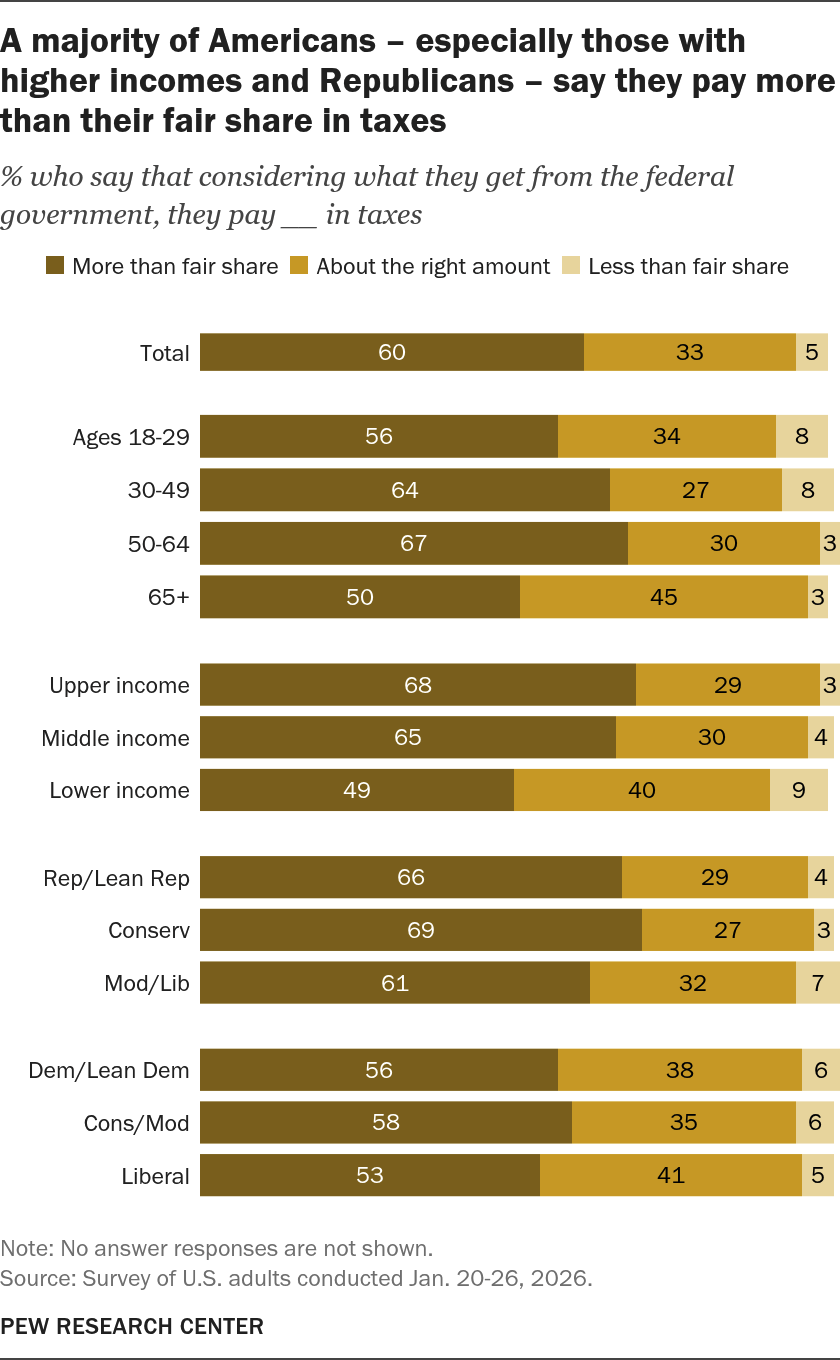
Americans from upper- and middle-income households, conservative Republicans, and those ages 30 to 64 are especially likely to say they pay more than their fair share in federal taxes.
| Population | group | More than fair share | About the right amount | Less than fair share |
|---|---|---|---|---|
| Total | total | 60% | 33% | 5% |
| Ages 18-29 | age | 56% | 34% | 8% |
| 30-49 | age | 64% | 27% | 8% |
| 50-64 | age | 67% | 30% | 3% |
| 65+ | age | 50% | 45% | 3% |
| Upper income | income | 68% | 29% | 3% |
| Middle income | income | 65% | 30% | 4% |
| Lower income | income | 49% | 40% | 9% |
| Rep/Lean Rep | rep | 66% | 29% | 4% |
| Conserv | rep | 69% | 27% | 3% |
| Mod/Lib | rep | 61% | 32% | 7% |
| Dem/Lean Dem | dem | 56% | 38% | 6% |
| Cons/Mod | dem | 58% | 35% | 6% |
| Liberal | dem | 53% | 41% | 5% |
Age
About two-thirds of adults ages 30 to 64 (65%) say their personal tax burden is unfairly high. Smaller shares of those ages 18 to 29 and those 65 and older say the same.
Income
Upper-income (68%) and middle-income (65%) Americans are more likely than those with lower incomes (49%) to feel their tax burden is unfair, given what they receive from the federal government. (Refer to the methodology for details on how household income tiers are determined.)
Ideology
Conservative Republicans are particularly likely to say their tax contributions are unfairly high.
About seven-in-ten conservative Republicans (69%) say they pay an unfair amount, compared with 61% of moderate and liberal Republicans, 58% of conservative and moderate Democrats, and 53% of liberal Democrats.
Income by party

| Rep/Lean Rep | Total | Dem/Lean Dem | |
|---|---|---|---|
| Total | 66% | 60% | 56% |
| Upper income | 79% | 68% | 57% |
| Middle income | 70% | 65% | 60% |
| Lower income | 51% | 49% | 49% |
There are wide differences by income among Republicans on this question, but smaller differences for Democrats. About eight-in-ten upper-income Republicans (79%) say they pay more than their fair share, while 70% of middle-income and 51% of lower-income Republicans say the same.
By comparison, 57% of upper-income Democrats and 60% of middle-income Democrats say they pay more than their fair share. About half of lower-income Democrats say this (49%).
As a result, there is a wide partisan gap in these views for upper-income Americans but no partisan gap among lower-income Americans.
Note: This is an update of a post originally published April 30, 2021. Here are our survey questions, detailed responses and methodology.