
Pew Knight Initiative
The Pew-Knight Initiative supports new research on how Americans absorb civic information, form beliefs and identities, and engage in their communities.
Pew Research Center is a nonpartisan, nonadvocacy fact tank that informs the public about the issues, attitudes and trends shaping the world. Knight Foundation is a social investor committed to supporting informed and engaged communities. Learn more >
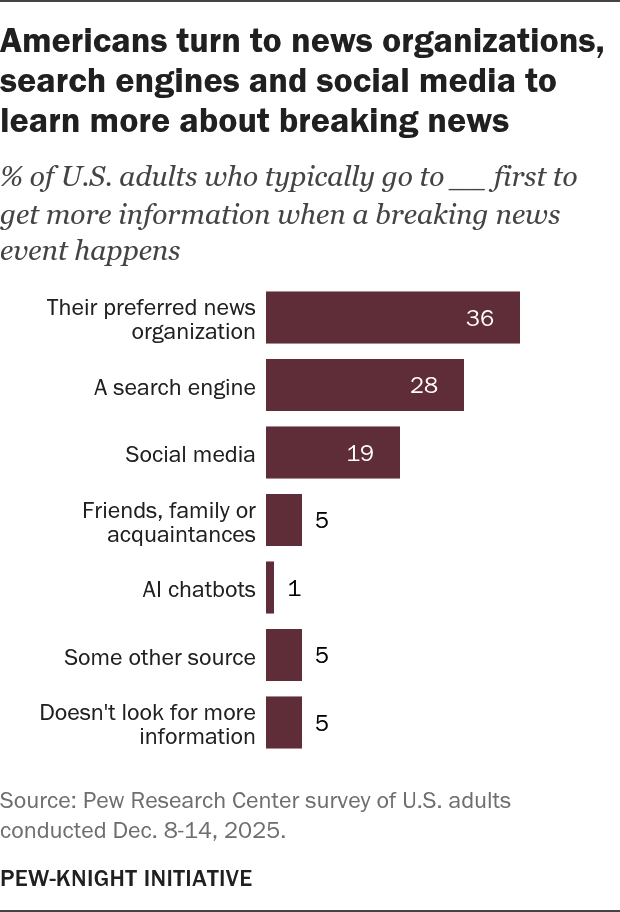
When Americans look to learn more about a breaking news event, they turn to a variety of sources. This mirrors the fragmented way that people get news and information more broadly these days.
| U.S. adults | |
|---|---|
| Their preferred news organization | 36% |
| A search engine | 28% |
| Social media | 19% |
| Friends, family or acquaintances | 5% |
| AI chatbots | 1% |
| Some other source | 5% |
| Doesn’t look for more information | 5% |
When a breaking news event happens, 36% of U.S. adults say they typically turn first to their preferred news organization to get more information, according to a 2025 Pew Research Center survey from the Pew-Knight Initiative. Another 28% look to search engines like Google or Bing, and 19% make social media their first destination. A smaller share (5%) usually asks friends, family or acquaintances for more information.
In a similar question from 2018, a slim majority of Americans (54%) said they turned to their preferred news organization when they wanted to learn more about a breaking news event. The shares of U.S. adults who said they turned first to search engines (15%) and social media (9%) were both lower than they are today. Similar shares in both survey years said they turn to people in their lives.
Reflecting the evolving news environment, some other response options in the two surveys were not the same. We included an option for news aggregation websites or apps (such as Google News, Apple News or Flipboard) in 2018 but not 2025. In 2025, we added three response options: AI chatbots (such as ChatGPT or Gemini), “Some other source” and “I don’t look for more information.”
Relatively few Americans selected these options: 1% said they go first to AI chatbots for more information about breaking news, while 5% each consult another source or say they don’t look for more information.
The small share who look to AI chatbots for more information about breaking news reflects the fact that relatively few Americans say they use AI chatbots for news in general. However, those who turn to search engines for this information still might see AI-generated summaries.
Age differences
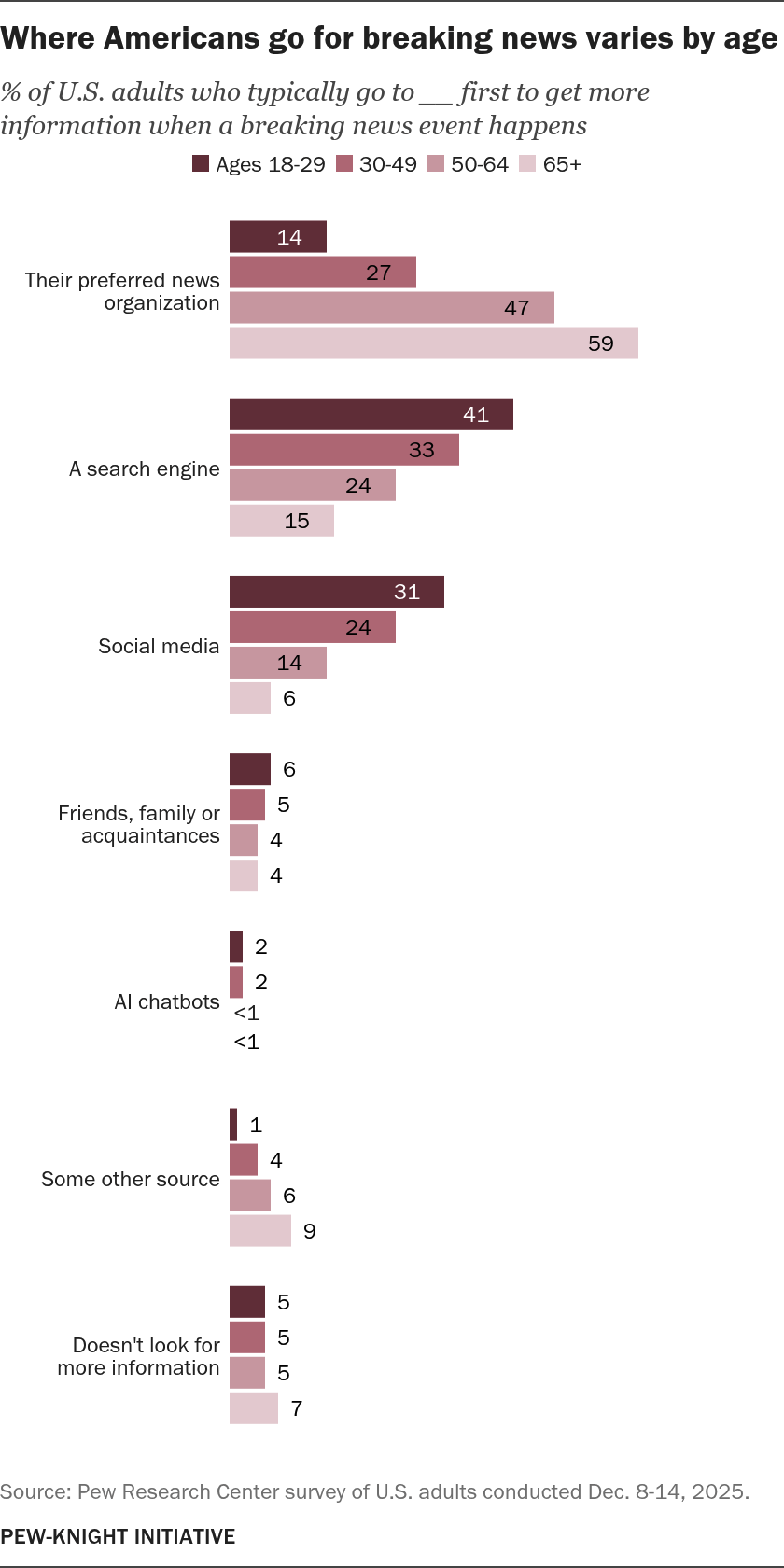
Where Americans turn first to get more information about breaking news events varies widely by age.
| Ages 18-29 | 30-49 | 50-64 | 65+ | |
|---|---|---|---|---|
| Their preferred news organization | 14% | 27% | 47% | 59% |
| A search engine | 41% | 33% | 24% | 15% |
| Social media | 31% | 24% | 14% | 6% |
| Friends, family or acquaintances | 6% | 5% | 4% | 4% |
| AI chatbots | 2% | 2% | <1% | <1% |
| Some other source | 1% | 4% | 6% | 9% |
| Doesn’t look for more information | 5% | 5% | 5% | 7% |
Based on the 2025 survey, Americans ages 65 and older are around four times as likely as adults ages 18 to 29 to say they turn to their preferred news organization for this (59% vs. 14%).
By contrast, younger adults are more likely to say they turn to search engines and social media for breaking news. For example, 31% of adults under 30 say they turn to social media first to get more information about breaking news events. Just 6% of Americans 65 and older say the same.
This aligns with a previous Center study showing that the share of younger adults who get news from social media is much higher than the share of older adults who do so. Among adults ages 18 to 29, 76% say they get news from social media at least sometimes, compared with 28% of adults ages 65 and older.
Younger adults are also more likely than older Americans to trust the information they get from social media. And adults ages 18 to 29 are now about equally likely to trust information they get from social media and from national news organizations.
Note: Here are our survey questions, the detailed responses and the methodology.