About six-in-ten Americans (59%) say any U.S. voter should have the option to vote early or absentee without having to document a reason, according to a recent Pew Research Center survey.

| Group | Only if they have a documented reason for not voting in person on Election Day | Without having to document a reason | Group type |
|---|---|---|---|
| Total | 40 | 59 | total |
| Rep/Lean Rep | 66 | 34 | subgroup |
| Dem/Lean Dem | 18 | 81 | subgroup |
But there are wide partisan divides on this question:
- 81% of Democrats and Democratic-leaning independents say early or absentee voting should be available to voters without the need to provide a reason.
- By comparison, 66% of Republicans and GOP leaners say these voting methods should only be available to those who have a documented reason for not voting in person on Election Day.
Both early and absentee voting are far more common today than in prior decades. In the 2024 presidential election, only around a third of voters cast their ballots in person on Election Day.
About this research
This Pew Research Center analysis looks at Americans’ views of early voting and whether they think elections would be less secure if it were easier to register and vote.
Why did we do this?
Pew Research Center does research to help the public, media and decision-makers understand important topics. We have studied Americans’ views of the voting for decades.
Learn more about Pew Research Center and our politics research.
How did we do this?
Most of the data for this analysis comes from a Center survey of 5,103 U.S. adults conducted April 20-26, 2026. Everyone who took this survey is part of the Center’s American Trends Panel. The survey reflects the views of all U.S. adults. Here are the 2026 survey questions we used for this analysis, the detailed responses and the survey methodology.
This analysis also uses data from a Center survey conducted May 13-19, 2024. Here are the 2024 survey questions, along with responses, and the survey methodology.
Categorizing state voting laws
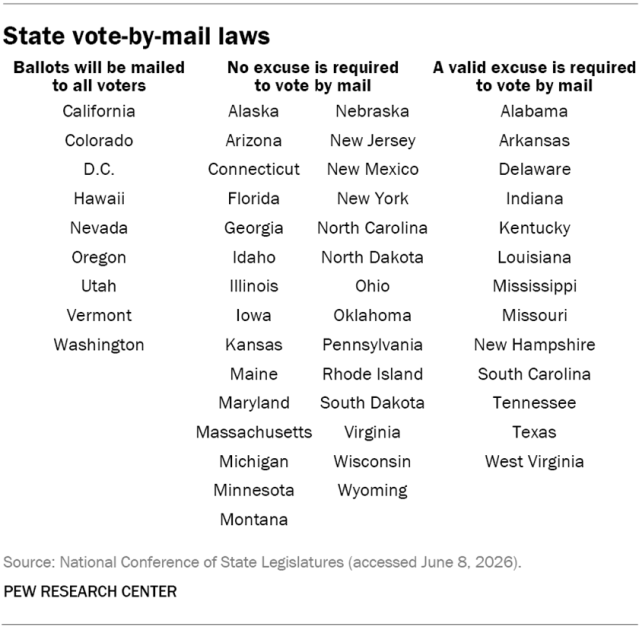
To categorize states by their voting laws, we relied on data from the National Conference of State Legislatures. We accessed this data on June 8, 2026, and it was last updated on June 3, 2026.
How views have changed in recent years

| Date | Total | Rep/Lean Rep | Dem/Lean Dem |
|---|---|---|---|
| 2026-04-26 | 59 | 34 | 81 |
| 2024-05-19 | 60 | 37 | 82 |
| 2021-04-11 | 63 | 38 | 84 |
| 2020-06-22 | 65 | 44 | 83 |
| 2018-10-07 | 71 | 57 | 83 |
Americans are now less likely to support no-excuse early or absentee voting than they were before the 2020 election – the result of shifting views among Republicans.
In 2018, when we first asked this question, a 57% majority of Republicans said that any voter should be able to vote early or absentee without having to give a reason. Today, 34% of Republicans say this.
In contrast, Democrats’ views are essentially unchanged over the past eight years. Since 2018, about eight-in-ten Democrats have said no-excuse early or absentee voting should be available to any voter.
How views of no-excuse early and absentee voting differ by state
Americans who live in states where mail-in ballots will automatically be sent to every voter this November are more likely to have a favorable view of no-excuse early or absentee voting than those who live in states where voters have to request an absentee ballot.

| Group | Total | Rep/Lean Rep | Dem/Lean Dem | group type |
|---|---|---|---|---|
| Total | 59 | 34 | 81 | total |
| Ballots will be mailed to all voters | 67 | 40 | 85 | subgroup |
| No excuse is required to vote by mail | 59 | 33 | 83 | subgroup |
| A valid excuse is required to vote by mail | 53 | 33 | 75 | subgroup |
- 67% of Americans in states with universal mail-in ballot access say voters should have the option to vote early or absentee without needing to provide a reason.
- This share drops to 59% among people living in states where ballots are not automatically mailed, but where any voter can request a mail-in ballot without an excuse.
- 53% of adults in states that require a valid excuse to vote by mail say no-excuse early or absentee voting should be available to all voters.
These patterns persist within both parties, even as Democrats are substantially more likely than Republicans across the different groups of states to back no-excuse early and absentee voting.
Republicans living in states where every voter receives a mail-in ballot are somewhat more likely than those in other states to favor no-excuse early or absentee voting (40% vs. 33%).
Overwhelming shares of Democrats across these different groups of states favor no-excuse absentee voting. But those in states where an excuse is required are somewhat less likely to say this than those in states where no excuse is required to vote absentee (75% vs. 83%).
How views of voting access differ across demographic and political groups
There are some differences in views of no-excuse early or absentee voting by race and ethnicity, age, and education.

Note: White, Black and Asian adults include those who report being only one race and are not Hispanic. Hispanics are of any race. No answer responses are not shown.
| Group | Only if they have a documented reason for not voting in person on Election Day | Without having to document a reason | Group type |
|---|---|---|---|
| Total | 40 | 59 | total |
| White | 45 | 55 | race |
| Hispanic | 36 | 62 | race |
| Black | 23 | 76 | race |
| Asian* | 36 | 63 | race |
| Ages 18-29 | 37 | 62 | age |
| 30-49 | 39 | 60 | age |
| 50-64 | 44 | 55 | age |
| 65+ | 42 | 58 | age |
| Postgrad | 32 | 67 | education |
| College grad | 34 | 66 | education |
| Some college | 43 | 57 | education |
| HS or less | 46 | 53 | education |
| Rep/Lean Rep | 66 | 34 | party rep |
| Conserv | 72 | 27 | party rep |
| Mod/Lib | 55 | 44 | party rep |
| Dem/Lean Dem | 18 | 81 | party dem |
| Cons/Mod | 24 | 75 | party dem |
| Liberal | 10 | 90 | party dem |
Note: White, Black and Asian adults include those who report being only one race and are not Hispanic. Hispanics are of any race. No answer responses are not shown.
Race and ethnicity
Roughly three-quarters of Black adults (76%) say any voter should have the option to vote early or absentee without an excuse. Smaller majorities of White (55%), Asian (63%) and Hispanic (62%) adults say the same.
Age
Adults under 50 are modestly more likely than those ages 50 and older to support no-excuse early or absentee voting (61% vs. 56%).
Education
Two-thirds of Americans with a bachelor’s degree or more education favor no-excuse early or absentee voting. This compares with 57% among those who have some college experience but no four-year degree, and 53% among those with a high school degree or less education.
Party and ideology
In both parties, views differ by ideology:
- Liberal Democrats are 15 percentage points more likely than conservative and moderate Democrats to back no-excuse early or absentee voting (90% vs. 75%).
- Moderate and liberal Republicans are 17 points more likely than conservative Republicans to support this (44% vs. 27%).
Would making it easier to vote affect election security?
In 2024, we also asked Americans whether elections would be less secure if the rules were changed to make it easier to register and vote. About six-in-ten Americans (58%) said elections would not be less secure, while 40% said they would.

Note: White, Black and Asian adults include those who report being only one race and are not Hispanic. Hispanics are of any race. No answer responses are not shown.
| Group | It would not make elections any less secure if election rules were changed to make it easier to register and vote | If election rules were changed to make it easier to register and vote, that would also make elections less secure | Group type |
|---|---|---|---|
| Total | 58 | 40 | total |
| White | 55 | 44 | race |
| Hispanic | 56 | 41 | race |
| Black | 74 | 24 | race |
| Asian* | 62 | 37 | race |
| Ages 18-29 | 62 | 37 | age |
| 30-49 | 60 | 38 | age |
| 50-64 | 55 | 43 | age |
| 65+ | 55 | 44 | age |
| Postgrad | 66 | 33 | education |
| College grad | 63 | 37 | education |
| Some college | 55 | 43 | education |
| HS or less | 54 | 44 | education |
| Rep/Lean Rep | 35 | 63 | party rep |
| Conserv | 30 | 69 | party rep |
| Mod/Lib | 45 | 54 | party rep |
| Dem/Lean Dem | 79 | 20 | party dem |
| Cons/Mod | 70 | 29 | party dem |
| Liberal | 91 | 9 | party dem |
Note: White, Black and Asian adults include those who report being only one race and are not Hispanic. Hispanics are of any race. No answer responses are not shown.
There were some demographic and ideological differences on this question as well.
Race and ethnicity
About three-quarters of Black adults (74%) said that changing the rules in this way would not make elections less secure. That compared with 62% of Asian adults, 56% of Hispanic adults and 55% of White adults.
Age
Adults under 50 were modestly more likely than those ages 50 and older to say that changing these election rules would not make elections less secure (61% vs. 55%).
Education
Americans with at least a four-year college degree were more likely than those without a degree to say this (64% vs. 54%).
Party and ideology
Around nine-in-ten liberal Democrats (91%) said that changing the rules to make it easier to vote would not make elections less secure. A smaller majority of conservative and moderate Democrats (70%) said the same.
By contrast, 69% of conservative Republicans and 54% of moderate and liberal Republicans said elections would be less secure if the rules were changed.
Note: This is an update of a post originally published on July 9, 2024. Here are the 2026 survey questions we used for this analysis, the detailed responses and the survey methodology. Here are the 2024 survey questions we used for this analysis, along with responses, and the survey methodology.