
Key takeaways:
- Although Americans say many aspects of health – such as getting enough sleep and managing stress – are really important, far fewer say they’re doing a good job at them.
- Americans face many challenges in taking care of their health, with the price of health care and stress management topping the list.
- Americans say the biggest motivators for taking care of health are preventing future health issues and being able to go about daily life.
- Health experiences differ vastly by income levels. Adults with lower incomes are more likely than those with upper incomes to rate their health worse and report facing challenges when taking care of their health.
Do Americans’ health priorities align with their actions? A new Pew Research Center survey finds big differences between how much importance Americans place on health behaviors – like sleeping enough, managing stress or eating healthy – and how well they say they are actually doing them. For majorities of U.S. adults, health care costs, stress, and not having enough time or motivation get in the way of taking care of their health.
This analysis looks at Americans’ challenges and motivations when it comes to maintaining their health. It builds on our previous research on Americans’ health attitudes and behaviors. These findings are based on a survey conducted Oct. 20-26, 2025, among 5,111 U.S. adults.
Click through for findings on the following topics of Americans’ personal health:
- What’s important to maintaining health and how well are Americans doing at it?
- What are the challenges Americans have when it comes to taking care of their health?
- How much effort are Americans putting into taking care of their health and why?
- How income shapes health experiences
Related: Roughly a third of young adults have negative views of their mental health
What’s important to maintaining health and how well are Americans doing at it?
We asked U.S. adults to rate the importance they place on six health-related behaviors: getting enough sleep, managing stress, eating healthy, having good relationships, exercising and getting an annual physical.
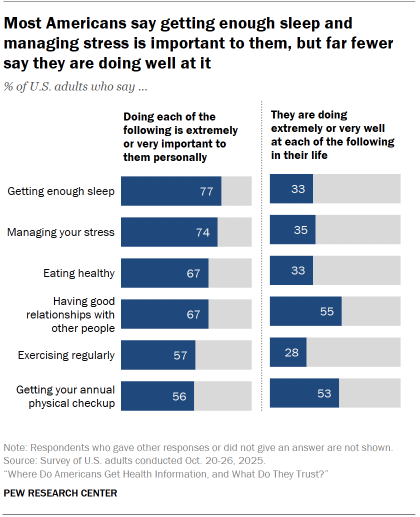
Majorities of Americans say doing each of the six health behaviors is extremely or very important to them personally. For example, about three-quarters of Americans say getting enough sleep and managing stress is highly important to them.
However, despite placing high importance on these healthy behaviors, many Americans express difficulty with them.
Large shares say sleep, managing stress and healthy eating are highly important. But there are large gaps – 34 to 44 percentage points – between the share who say they are highly important and those who say they are doing extremely or very well at them. For example, 77% say getting enough sleep is highly important – but only 33% do really well at getting enough.
There is also a sizable difference between the shares who highly value exercising regularly and those who say they do well at it. A majority (57%) of Americans highly value exercise but the share who say they are doing great at exercising regularly is 28%.
Getting an annual physical exam is the only behavior we don’t see a gap: 56% say it is highly important to them, and 53% report they do extremely or very well at it.
What are the challenges Americans have when it comes to taking care of their health?
It’s clear that many Americans value having a healthy lifestyle, but many face challenges in doing so.
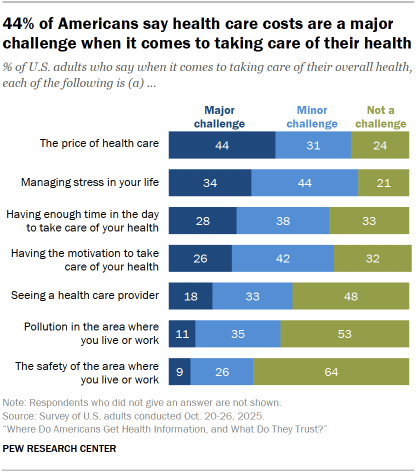
Of the seven potential barriers we asked about, the largest share say the price of health care is a major challenge: 44% say this. The cost of health care also is at the top of Americans’ overall economic concerns.
About a third say managing stress is a major challenge, and roughly three-in-ten say the same about having the time and motivation.
Overall, 67% of U.S. adults say at least one of these items is a major challenge for them, while 33% say none of these items are a major challenge for them.
How much effort are Americans putting into taking care of their health and why?
All this is not to say that Americans aren’t putting any effort in: Just 7% say they put no effort into their physical health, and 15% say that about their mental health.
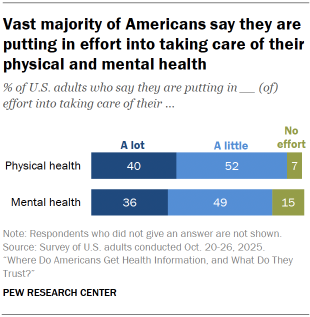
In fact, substantial shares say they are putting a lot of effort into taking care of their physical (40%) and mental health (36%).
Americans across racial and ethnic groups give similar ratings of their mental health, yet Black adults are more likely than other groups to say they put a lot of effort into taking care of their mental health. Over half (54%) of Black adults say they are putting a lot of effort into taking care of their mental health, compared with 32% of White, 38% of Hispanic and 29% of Asian adults. Black adults are also slightly more likely than these groups to say they are putting in a lot of effort into their physical health.
Reasons for putting in effort into taking care of their health
There are many reasons why someone would want to put effort into their health, from following medical advice to looking good. But the most common motivations are practical: lowering their risk of developing health problems (78% say this is a major reason) and to do the things they need to do in their daily lives (70%).
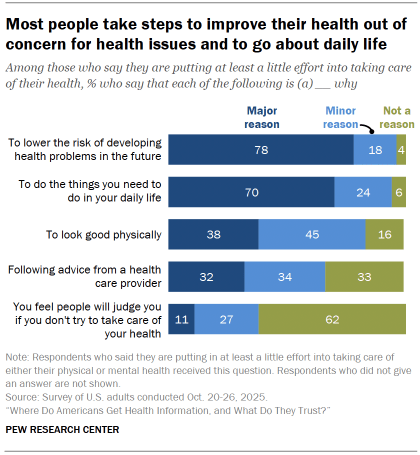
Far smaller shares point to other reasons. About four-in-ten (38%) say looking good physically is a major reason, and 32% say the same for following advice from a health care provider. Few (11%) say that concern about other people judging them is a major reason.
How income shapes health experiences
Research has shown that people with higher incomes often have better health in part due to better living conditions, greater access to nutritious food and lower barriers to health care.
This connection between income and health comes through in this survey: higher-income Americans rate their physical and mental health better than those with lower incomes.
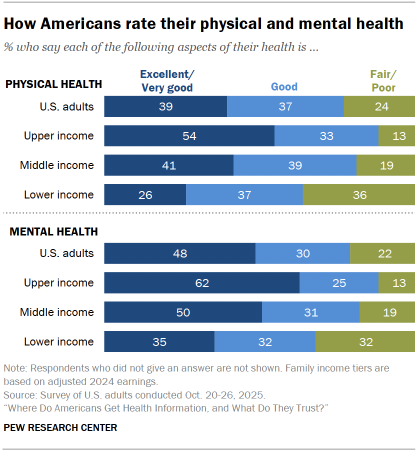
Over half (54%) of those with upper incomes rate their physical health as excellent or very good, compared with 26% of those in the lowest income tier. Adults with lower incomes are more likely to rate their physical health as just fair or poor (36%).
This pattern largely repeats for mental health. There is a 27 percentage point gap between adults with upper incomes compared with those with lower incomes on rating their mental health highly (62% vs. 35%).
Upper-income adults are also more likely to say they are doing extremely or very well at all six specific health behaviors surveyed. For example, 44% of adults with upper incomes say they are great at exercising regularly, compared with 28% of those with middle incomes and 20% of those with lower incomes. Refer to the appendix for more details and breaks.
Income and health challenges
Adults with lower incomes are more likely to report facing challenges when it comes to taking care of their health than adults with higher incomes.
Income gaps appear across all seven health challenges, but the largest gaps are on access to health care – both in price and provider availability. Over half (54%) of adults in the lowest income tier say the price of health care is a major challenge for them, compared with 28% among upper-income adults. Similarly, there is a 21-point gap between adults in the upper- and lower-income tiers who say seeing a health care provider is a major challenge (28% vs. 7%). Nearly all upper-income adults (97%) have health insurance, but coverage drops to 82% of those with lower incomes.
Local environments can also play an important role in health outcomes. While few across income tiers say pollution and safety in their areas are major challenges for them, those with lower incomes are much more likely than those with upper incomes to say these are at least minor challenges for them (49% vs. 20% on safety, 57% vs. 37% on pollution).


