About this research
This Pew Research Center analysis explores how adults in 25 countries rate the morality of other people in their country. It also describes how many people around the world consider different behaviors (such as drinking alcohol, gambling and having affairs) to be morally wrong.
Why did we do this?
Pew Research Center conducts high-quality research to inform the public, journalists and leaders. Studying religion and related topics, such as morality, has long been part of the Center’s research around the world. Learn more about Pew Research Center and our other research on religion.
How did we do this?
For data outside the United States, this analysis draws on nationally representative surveys of 28,333 adults conducted from Jan. 8 to April 26, 2025. All surveys were conducted over the phone with adults in Canada, France, Germany, Greece, Hungary, Italy, Japan, the Netherlands, Poland, South Korea, Spain, Sweden and the United Kingdom. Surveys were conducted face-to-face in Argentina, Brazil, India, Indonesia, Israel, Kenya, Mexico, Nigeria, South Africa and Turkey. In Australia, we used a mixed-mode probability-based online panel.
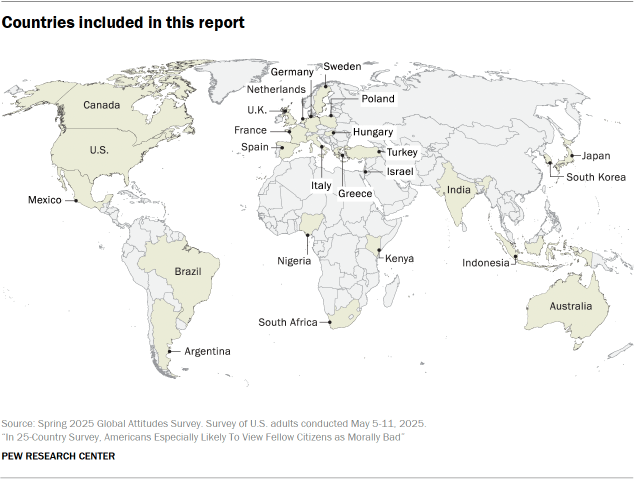
In the U.S., we surveyed 3,605 adults from March 24 to 30, 2025. Everyone who took part in this survey is a member of the Center’s American Trends Panel (ATP). This report also includes some findings from a separate ATP survey of 8,937 U.S. adults conducted from May 5 to 11, 2025.
Here are the questions used for this analysis, along with responses, and the survey methodology.
Americans are more likely than people in other countries surveyed in 2025 to question the morality of their fellow countrymen, according to Pew Research Center surveys in 25 countries.
We asked people around the world to rate the morality and ethics of others in their country.
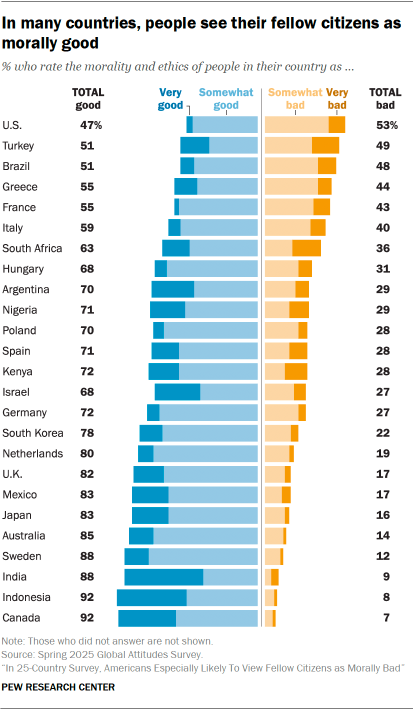
In nearly all countries surveyed, more people say that others in their country have somewhat or very good morals than say their compatriots display somewhat or very bad levels of morality.
The United States is the only place we surveyed where more adults (ages 18 and older) describe the morality and ethics of others living in the country as bad (53%) than as good (47%).
Because we have never asked this question before, we don’t know whether a majority of Americans have long held a skeptical view of the ethics of fellow Americans, or if it’s something new – and if so, what’s driving it. But partisan politics appear to play a role.
Democrats and independents who lean toward the Democratic Party are much more likely than Republicans and Republican leaners to rate fellow Americans as morally and ethically bad (60% vs. 46%). And previous research has shown that rising numbers of both Republicans and Democrats say people in the other party are immoral.
However, this partisan pattern is not unique to the U.S. In more than half of the countries surveyed, people who don’t support the governing party are particularly likely to view their fellow citizens as immoral.
Another possibility could be that Americans are more moralistic, in general, than people in other countries – that is, they’re more inclined to judge various behaviors to be immoral or sinful. But the results of other survey questions don’t support the idea that the U.S. public is especially judgmental.
We asked people in 25 countries whether nine different behaviors – including having an abortion and drinking alcohol – are morally unacceptable, morally acceptable or not a moral issue. On most of the nine behaviors, the U.S. is somewhere in the middle of the pack: It’s neither the country where the highest percentage of adults view each behavior as morally wrong, nor is it the country where the highest percentage say the same behavior is morally acceptable or not a moral issue.
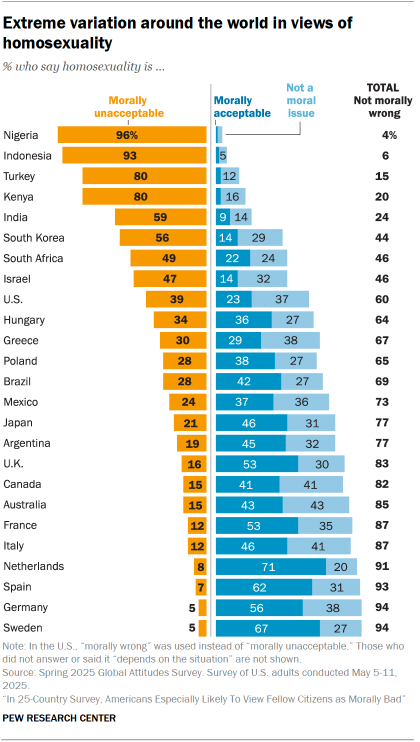
For example, 39% of U.S. adults say homosexuality is morally wrong – far more than take that position in Germany or Sweden (5% each) but far fewer than in Indonesia (93%) or Nigeria (96%).
Still, the U.S. is among the countries whose inhabitants are most likely to condemn extramarital affairs as immoral. Nine-in-ten Americans say that married people having an affair is morally wrong, similar to the share of people in Indonesia and Turkey (92% each) who take the same position. Adults in Germany (55%) and France (53%) are among the least likely to say that having an affair outside of marriage is morally unacceptable.
U.S. adults are also among the most accepting of a couple of behaviors: using marijuana and gambling. Just 23% of Americans say using marijuana is morally unacceptable, and 29% say the same about gambling. In most other countries surveyed, upward of 40% of adults consider gambling and using marijuana to be morally wrong.
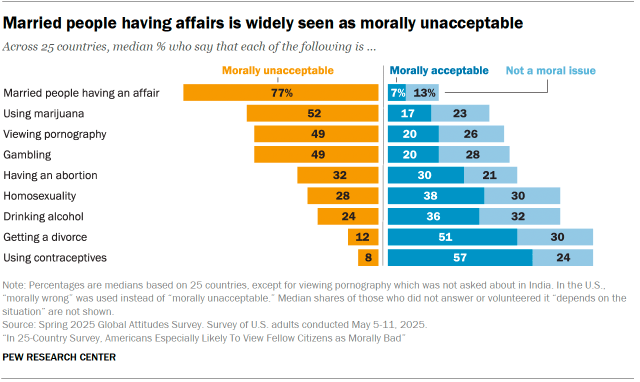
Of the nine behaviors we asked about, extramarital affairs drew the strongest overall disapproval. Across the 25 countries, a median of 77% of adults say that married people having an affair is morally unacceptable. At least half of adults in every country surveyed take this view.
What is a median?
In this analysis, median scores are used to help readers see overall patterns in the data. The median percentage is the middle number in a list of all percentages sorted from highest to lowest.
At the other end of the spectrum, using contraception and getting a divorce are the most widely accepted of the nine behaviors. In nearly all 25 countries, two-thirds or more of adults say these behaviors are either morally acceptable or not a moral issue.
Jump to a summary table showing how many adults in each country say each of the nine behaviors is morally unacceptable.
We find much less international consensus on some issues, such as having an abortion. In the Latin American and African countries surveyed, half or more of adults say abortions are morally unacceptable. But in most European countries included in the survey, the vast majority of adults view abortions as either morally acceptable or not a moral issue.
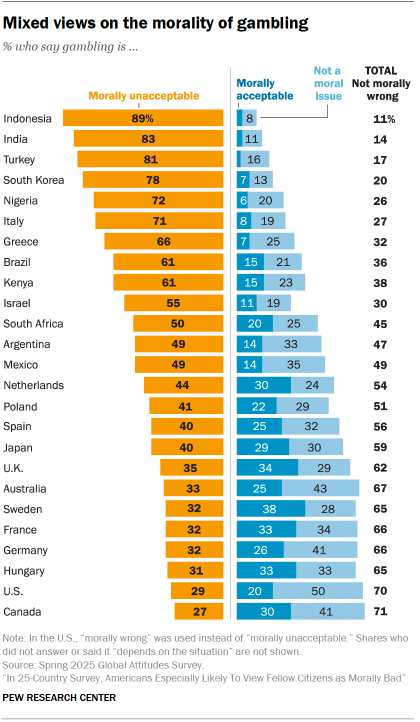
Another topic on which views differ widely around the world is gambling. In 10 countries, a majority says gambling is morally wrong, including 89% in Indonesia and 71% in Italy. Meanwhile, in another 10 countries, a majority says gambling is morally acceptable or not a moral issue. In Australia, for instance, two-thirds of adults do not express moral qualms about gambling: 25% say gambling is morally acceptable, and 43% do not see gambling as a moral issue.
This study presents new findings from Pew Research Center surveys of more than 30,000 people in 25 countries conducted Jan. 8-May 11, 2025. It also explores:
- How attitudes toward morality have changed over the last decade
- Differences in opinion by gender
- Differences in opinion across religious groups
- Differences by education and age
For more information on how the data was collected in each country, read the methodology.
How have views on morality changed over time?
Pew Research Center also asked about the morality of several of these behaviors in 2013.1
A total of 22 countries were surveyed in both years. In the interim, moral disapproval of some behaviors generally has fallen, though not universally.
For example, views on divorce have softened internationally since 2013. In half of the countries surveyed both times, adults are less likely today than they were in 2013 to say that getting a divorce is morally wrong.
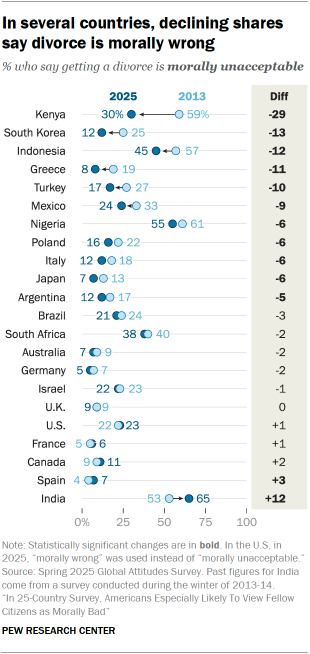
Kenya has experienced the largest change. In 2013, 59% of Kenyan adults said divorce was wrong, compared with 30% in 2025. And several other countries, including Indonesia and Mexico, have experienced about a 10 percentage point drop in the share saying divorce is morally unacceptable.
India stands out in the opposite direction. The share of Indian adults who say divorce is morally wrong increased from 53% a decade ago to 65% in 2025 – largely driven by an increase among Indian women.
The only other country surveyed where a majority of adults today say divorce is wrong is Nigeria. Yet this slim majority (55%) represents a slight decline from the share of Nigerians who took the same position in 2013 (61%).
In addition, people in several countries are less likely today than they were in 2013 to say that homosexuality is morally unacceptable, and the same goes for having an abortion.
Opinions about the morality of using contraceptives, extramarital affairs, drinking alcohol and gambling show more mixed results across the decade or so between surveys. For instance, only a few countries have had significant changes in the shares who say drinking alcohol is morally wrong (some increasing and others decreasing). Yet in 13 of the 22 countries, adults today are more likely than they were in 2013 to say drinking alcohol is morally acceptable.
For 2013 figures on the morality of drinking alcohol and other behaviors, explore our interactive feature. For the full 2025 results, consult this report’s topline.
How do women and men differ in their views of morality?
Around the world, women appear to be more likely than men to say that some behaviors are morally unacceptable. For example, in nearly all countries surveyed, women are more likely than men to say that viewing pornography is wrong.
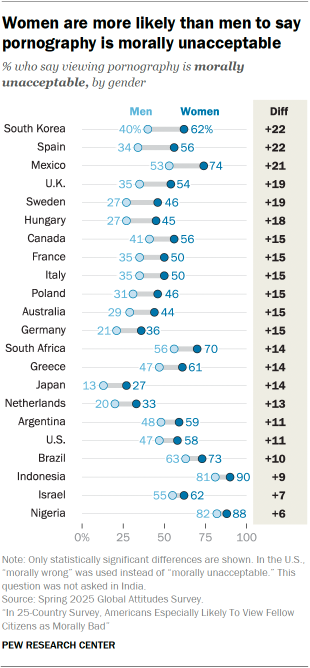
Some of the widest gender differences are in South Korea and Spain, where women are 22 points more likely than men to say that viewing pornography is morally unacceptable. In both countries, a majority of women express this opinion, compared with a minority of men.
In the U.S., 58% of women say viewing pornography is wrong, while 47% of men say the same.
Across the countries surveyed, women tend to be more likely than men to say the following behaviors are morally unacceptable:
- Gambling
- Drinking alcohol
- Using marijuana
Men’s and women’s views on the morality of homosexuality
Conversely, in many of the countries surveyed, men are more likely than women to say homosexuality is morally unacceptable. This is especially the case in Greece, where men are twice as likely as women to view homosexuality as morally wrong (40% vs. 20%).
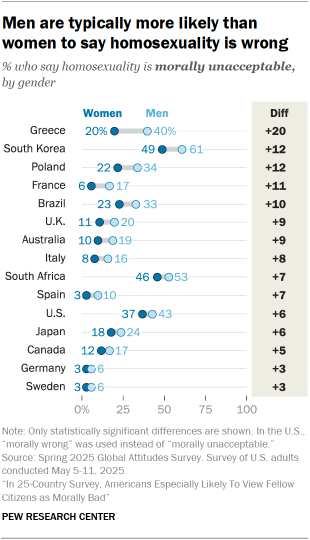
In many of the countries where there is a difference, men are about 10 points more likely than women to say homosexuality is wrong. For instance, in the United Kingdom, 20% of men say this, compared with 11% of women.
Differences between men and women are less strong or consistent on the morality of the other four behaviors we asked about. For example, in seven countries, men are slightly more likely than women to say that having an abortion is morally unacceptable. But in two countries (Indonesia and Kenya), more women than men say abortion is wrong.
Jump to this report’s detailed tables showing the percentages of men and women who say each behavior is morally unacceptable, morally acceptable or not a moral issue.
How do views of morality differ by religion?
Where data is available on the views of multiple religious groups, Christians are often among the most likely to consider each of the nine behaviors to be morally unacceptable.
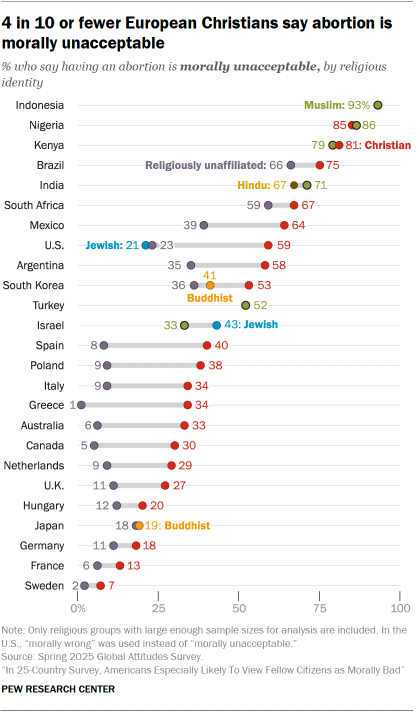
However, there is enormous variation between Christians in different countries.
For example, a majority of Christians surveyed in Africa, Latin America and the U.S. say that having an abortion is morally wrong. Yet across Europe, the share of Christians who hold this view ranges from 40% in Spain to 7% in Sweden.
Similarly, nearly all Muslims surveyed in Indonesia view abortion as morally wrong (93%), compared with a third of Muslims in Israel.
Religiously unaffiliated people – those who say they are atheist, agnostic or “nothing in particular” when asked about their religion – are less likely than other adults to say abortion is morally unacceptable. But even within this group, views vary widely from country to country. In Brazil and South Africa, a majority of religiously unaffiliated adults say abortion is wrong. But across Europe, only about one-in-ten or fewer unaffiliated individuals express moral qualms about abortion.
Related: In the U.S. and other countries, fewer people now say it’s necessary to believe in God to be moral
We are also able to examine differences between Protestants and Catholics in 13 of the 25 countries surveyed.
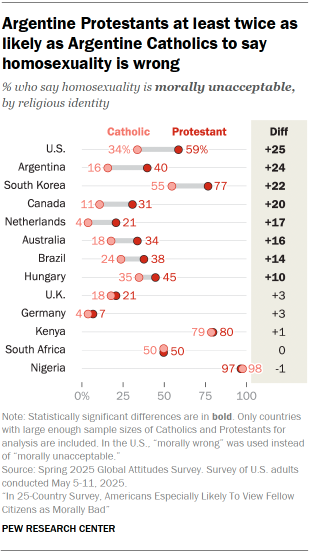
Within each country, Protestants and Catholics tend to hold similar views on moral issues. In Canada, for instance, 15% of Catholics and 16% of Protestants say that getting a divorce is morally unacceptable.
However, Protestants are typically more likely than Catholics in the same country to say that homosexuality is wrong. In the U.S., for example, 59% of Protestants say homosexuality is morally wrong, while 34% of Catholics say the same.
In addition, people who say religion is very important in their lives are generally more likely than other adults to view the various behaviors as morally wrong.
Refer to this report’s topline for the share of people in various religious groups who say each behavior is morally unacceptable, morally acceptable or not a moral issue.
How do views of morality differ by education and age?
On nearly all the behaviors we asked about, adults with less education are more likely than those with more education to say each behavior is morally unacceptable.
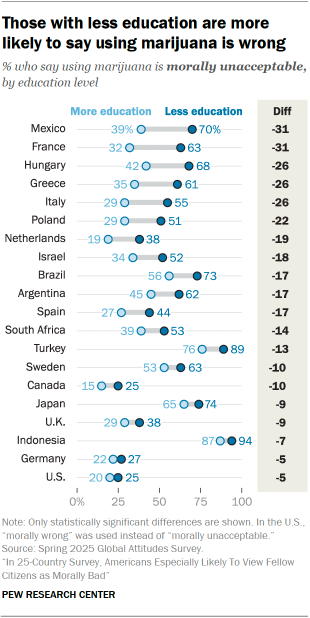
This pattern is readily apparent when considering the numbers who say using marijuana is wrong. In Mexico, for example, 70% of adults with less than a secondary education view marijuana use as morally wrong, compared with 39% of Mexican adults who have at least a secondary education.
Even in places where relatively few adults say that using marijuana is wrong – like Canada, Germany and the U.S. – those with lower levels of education consistently express more moral objections.
Age
Overall, older adults are more likely than younger adults to say several behaviors are morally unacceptable. This is the case with using marijuana in 19 of the 25 surveyed countries, including Germany, where adults ages 40 and older are twice as likely as younger adults to say marijuana use is morally wrong (30% vs. 15%).
Similar age patterns are generally observed when adults are asked about the morality of:
- Viewing pornography
- Drinking alcohol
- Homosexuality
- Gambling
However, the youngest adults are somewhat more likely to say that married people having an affair is morally unacceptable. For example, in Canada, 85% of adults ages 18 to 39 say affairs are wrong, compared with 73% of adults 40 and older.
In most countries surveyed, younger and older adults don’t differ significantly on the question of whether others in the same country are moral or ethical. In a few countries where there are differences, younger adults generally are less likely to say their fellow citizens are bad. But the pattern is reversed in the U.S.: Younger Americans (ages 18 to 39) are slightly more likely than older adults to say other Americans are morally bad (57% vs. 50%) – and this pattern persists even after controlling for age differences in political party affiliation.
Jump to this report’s detailed tables showing the percentages of people with different levels of education and of different ages who say each behavior is morally unacceptable, morally acceptable or not a moral issue.
Shares in 25 countries who say various behaviors are morally unacceptable
| Country | Married people having an affair | Using marijuana | Gambling | Viewing pornography | Having an abortion | Homosexuality | Drinking alcohol | Getting a divorce | Using contraceptives |
|---|---|---|---|---|---|---|---|---|---|
| Argentina | 65 | 52 | 49 | 54 | 53 | 19 | 41 | 12 | 4 |
| Australia | 84 | 24 | 33 | 36 | 18 | 15 | 7 | 7 | 3 |
| Brazil | 77 | 63 | 61 | 68 | 73 | 28 | 32 | 21 | 18 |
| Canada | 76 | 19 | 27 | 48 | 19 | 15 | 10 | 11 | 6 |
| France | 53 | 51 | 32 | 43 | 11 | 12 | 20 | 6 | 2 |
| Germany | 55 | 25 | 32 | 28 | 15 | 5 | 11 | 5 | 2 |
| Greece | 77 | 52 | 66 | 54 | 31 | 30 | 25 | 8 | 13 |
| Hungary | 64 | 60 | 31 | 36 | 18 | 34 | 24 | 11 | 4 |
| India | 77 | 81 | 83 | – | 67 | 59 | 76 | 65 | 48 |
| Indonesia | 92 | 91 | 89 | 85 | 93 | 93 | 83 | 45 | 28 |
| Israel | 85 | 44 | 55 | 59 | 40 | 47 | 28 | 22 | 28 |
| Italy | 67 | 50 | 71 | 42 | 28 | 12 | 33 | 12 | 5 |
| Japan | 65 | 70 | 40 | 20 | 18 | 21 | 9 | 7 | 6 |
| Kenya | 70 | 77 | 61 | 72 | 81 | 80 | 55 | 30 | 28 |
| Mexico | 76 | 56 | 49 | 64 | 60 | 24 | 39 | 24 | 11 |
| Netherlands | 67 | 32 | 44 | 26 | 18 | 8 | 11 | 8 | 2 |
| Nigeria | 83 | 83 | 72 | 85 | 86 | 96 | 56 | 55 | 47 |
| Poland | 80 | 43 | 41 | 39 | 32 | 28 | 22 | 16 | 11 |
| South Africa | 69 | 48 | 50 | 64 | 65 | 49 | 40 | 38 | 27 |
| South Korea | 83 | 80 | 78 | 50 | 42 | 56 | 23 | 12 | 10 |
| Spain | 65 | 37 | 40 | 45 | 27 | 7 | 21 | 7 | 4 |
| Sweden | 77 | 59 | 32 | 36 | 5 | 5 | 7 | 4 | 1 |
| Turkey | 92 | 82 | 81 | 69 | 51 | 80 | 54 | 17 | 18 |
| U.K. | 81 | 35 | 35 | 44 | 20 | 16 | 10 | 9 | 4 |
| U.S. | 90 | 23 | 29 | 52 | 47 | 39 | 16 | 23 | 8 |
Note: In the U.S., “morally wrong” was used instead of “morally unacceptable.” The question about viewing pornography was not asked in India.
Source: Spring 2025 Global Attitudes Survey. Survey of U.S. adults conducted May 5-11, 2025.
“In 25-Country Survey, Americans Especially Likely To View Fellow Citizens as Morally Bad”
Refer to this report’s topline for the shares who say each behavior is morally acceptable and “not a moral issue.”