Singapore is the world’s most religiously diverse country as of 2020, according to a new Pew Research Center study.
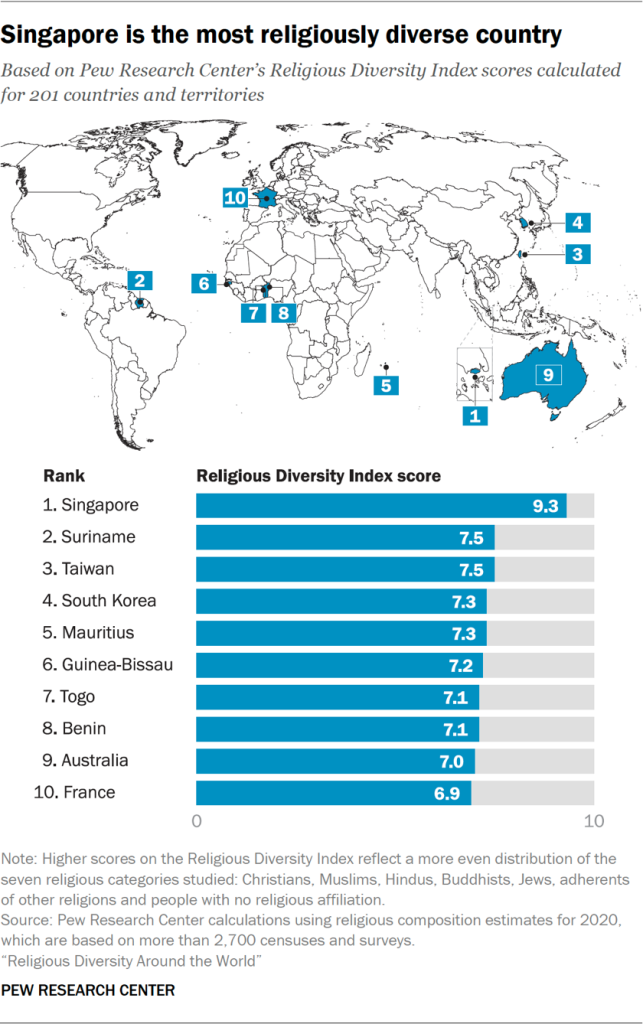
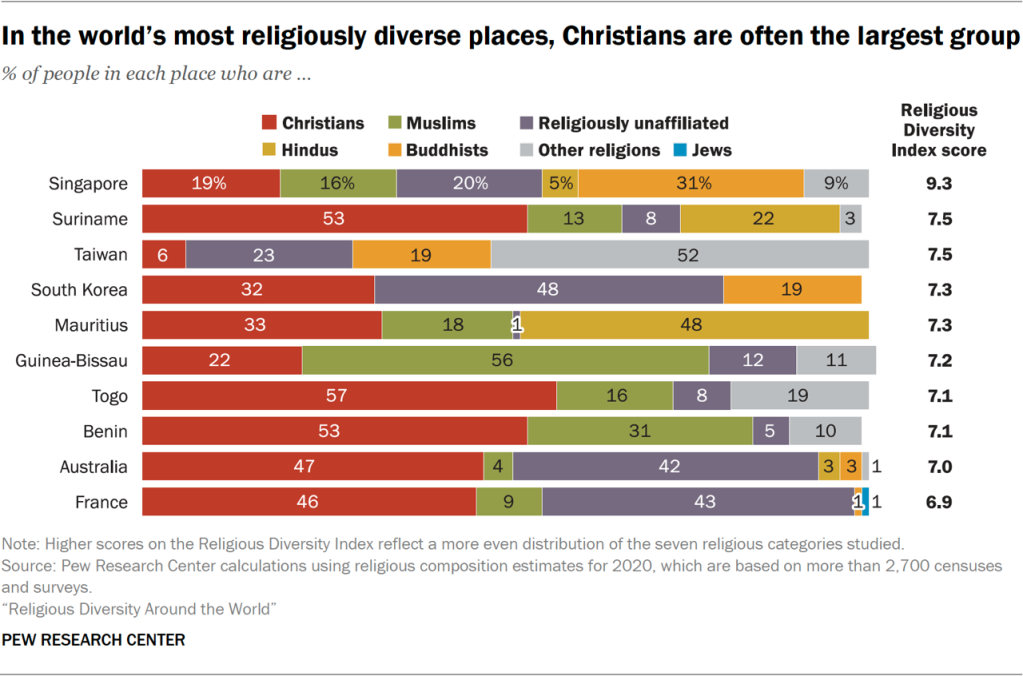
Buddhists (31%) are Singapore’s largest religious group, but its population also includes substantial shares of religiously unaffiliated people (20%), Christians (19%), Muslims (16%), Hindus (5%) and adherents of all other religions (9%).
Suriname ranks second in religious diversity and is the only Latin American country in the top 10. About half of Suriname’s residents (53%) are Christians. The rest are mainly Hindus (22%), Muslims (13%) and religiously unaffiliated people (8%).
Most of the other places in the top 10 are in the Asia-Pacific region (Taiwan, South Korea and Australia) or in sub-Saharan Africa (Mauritius, Guinea-Bissau, Togo and Benin).
France is the only European country on the top 10 list. Its population is largely Christian (46%) and religiously unaffiliated (43%), with a sizable Muslim minority (9%).
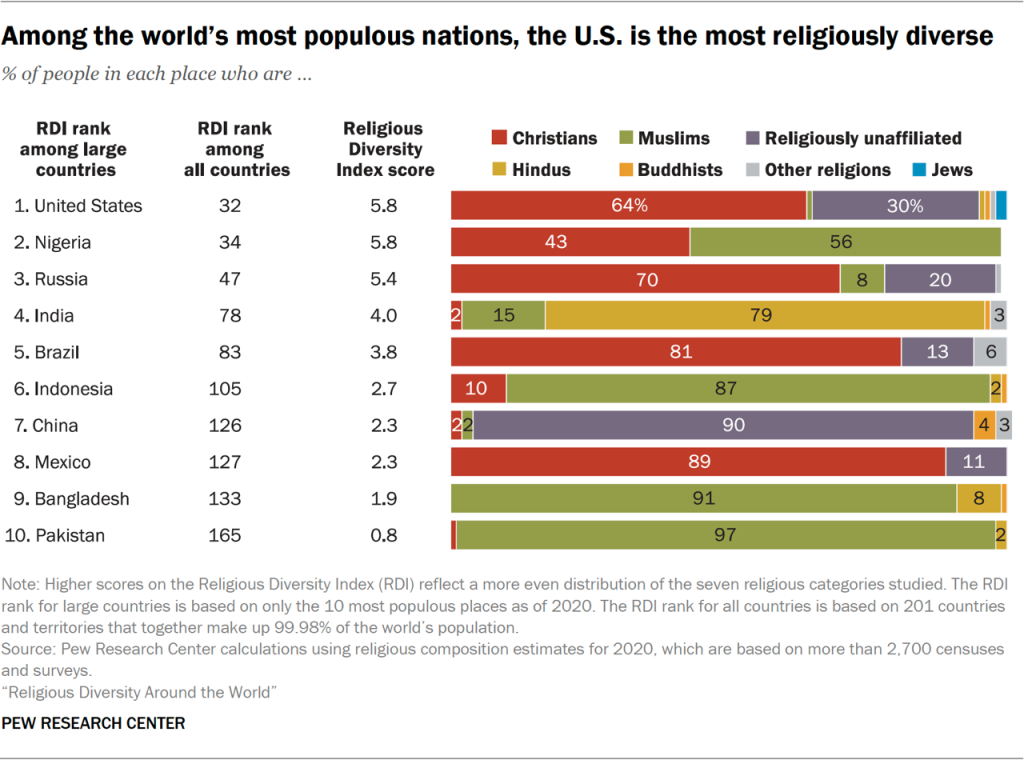
The United States is not among the 10 most religiously diverse countries in the world (it ranks 32nd overall). But when looking just at the 10 most populous nations, the U.S. ranks first in religious diversity, followed by Nigeria, Russia, India and Brazil.
This analysis divides the world’s population into seven categories – Christians, Muslims, Hindus, Buddhists, Jews, adherents of all other religions and people with no religious affiliation – and measures how evenly these groups are represented within each country or territory.1
We ranked a total of 201 countries and territories using our Religious Diversity Index (RDI). Possible scores range from 0 (for a country made up entirely of a single religious group) to 10 (for a country with perfectly even distributions of all seven groups, each making up about 14% of the population). (Refer to the Methodology for more on how we calculated RDI scores.)
With a score of 9.3, Singapore comes closer to an even distribution of religious groups than any other country. By comparison, South Korea’s score is 7.3, France’s is 6.9, and the United States’ score is 5.8.
(Explore our sortable table to see how all 201 countries and territories rank.)
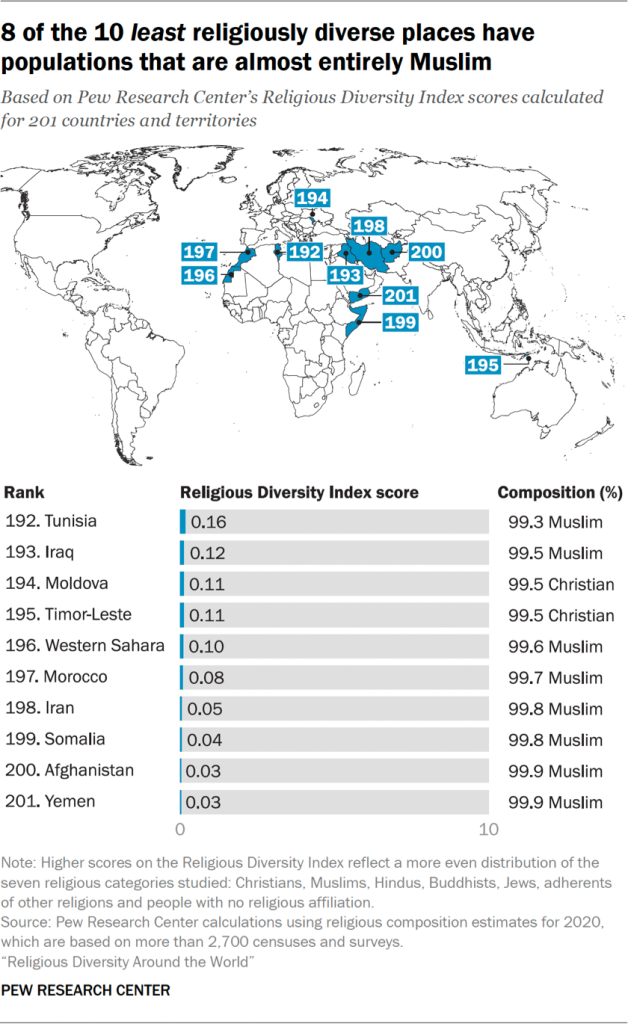
No country in our analysis has a score of 10. But three countries have scores near 0, making them the least religiously diverse places in the world, according to our analysis: Yemen, Afghanistan and Somalia. In each, Muslims represent 99.8% or more of the population.
Overall, Muslims make up at least 99% of the population in eight of the 10 least religiously diverse countries and territories. The other two – Timor-Leste and Moldova – have populations that are almost entirely Christian.
Diversity in the world’s largest societies
If we focus just on the world’s 10 most populous countries, each of which is home to at least 120 million people, then the United States emerges as the most religiously diverse.
Christians make up an estimated 64% of the U.S. population as of 2020, while religiously unaffiliated people account for about 30%. The remaining 6% are Muslims, Hindus, Buddhists, Jews and people in the “other religions” category, with each of these groups making up about 1% to 2%.2
Nigeria is the second-most religiously diverse of these big countries. Muslims and Christians, the largest groups in Nigeria, each make up more than 40% of the population. In fact, Nigeria is among the nations that are most evenly divided between two religious categories.
Related: 5 facts about religion in Nigeria
Pakistan, where Muslims account for 97% of all residents, is the least religiously diverse of the 10 most populous countries.
The RDI scores of the world’s most populous countries cover a large range, from 5.8 in the U.S. to 0.8 in Pakistan. Together, these 10 countries account for nearly 60% of the global population.
These are among the key findings of a Pew Research Center analysis of religious diversity around the world. The study is part of the Pew-Templeton Global Religious Futures project, which seeks to understand global religious change and its impact on societies.
The rest of this report covers the following:
- In almost every country, a single religious group forms a majority
- 10 countries where the population is most evenly split between two religious groups
- Where do countries fall on the diversity spectrum?
- Religious diversity by region
- What share of people live in religiously diverse societies?
- Change in religious diversity since 2010
In almost every country, a single religious group forms a majority
While some places around the world have a diverse mix of religious groups, it is more common for national populations to primarily consist of a single religious category.
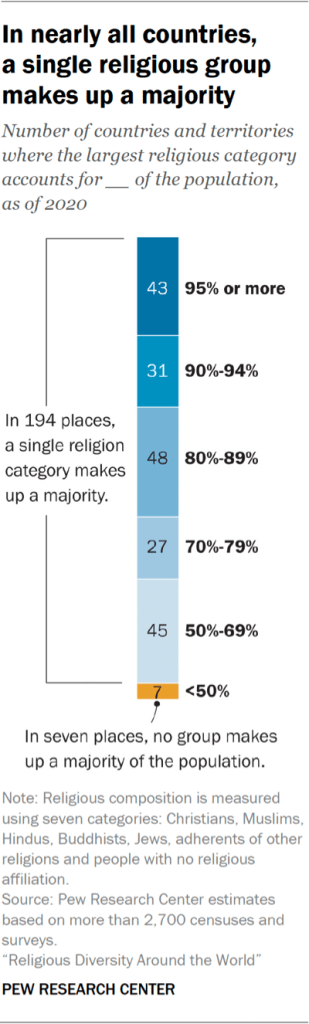
In 194 countries and territories, 50% or more of the population falls into just one religious category. This includes 43 places where at least 95% of the population belongs to the same religious group; these places are predominantly Muslim (25), Christian (17) or Buddhist (1).
In addition, many countries have a second religious category that accounts for most of the rest of the population.
Only 49 countries have three or more religious categories that each make up 5% or more of the population. This includes seven places (Guinea-Bissau, Malaysia, Singapore, Sri Lanka, Suriname, Taiwan and Togo) with at least four religious categories that each make up at least 5% of the population.3
There are seven countries in which no group makes up a majority of the population: the United Kingdom, Mauritius, South Korea, Australia, France, Ivory Coast and Singapore.
10 countries where the population is most evenly split between two religious groups
In 173 countries and territories, at least 90% of the population falls into just two of the seven religious categories we analyzed, sometimes resulting in a fairly even split. We calculated a “religious divide” score for each place to analyze just how evenly these populations are divided.
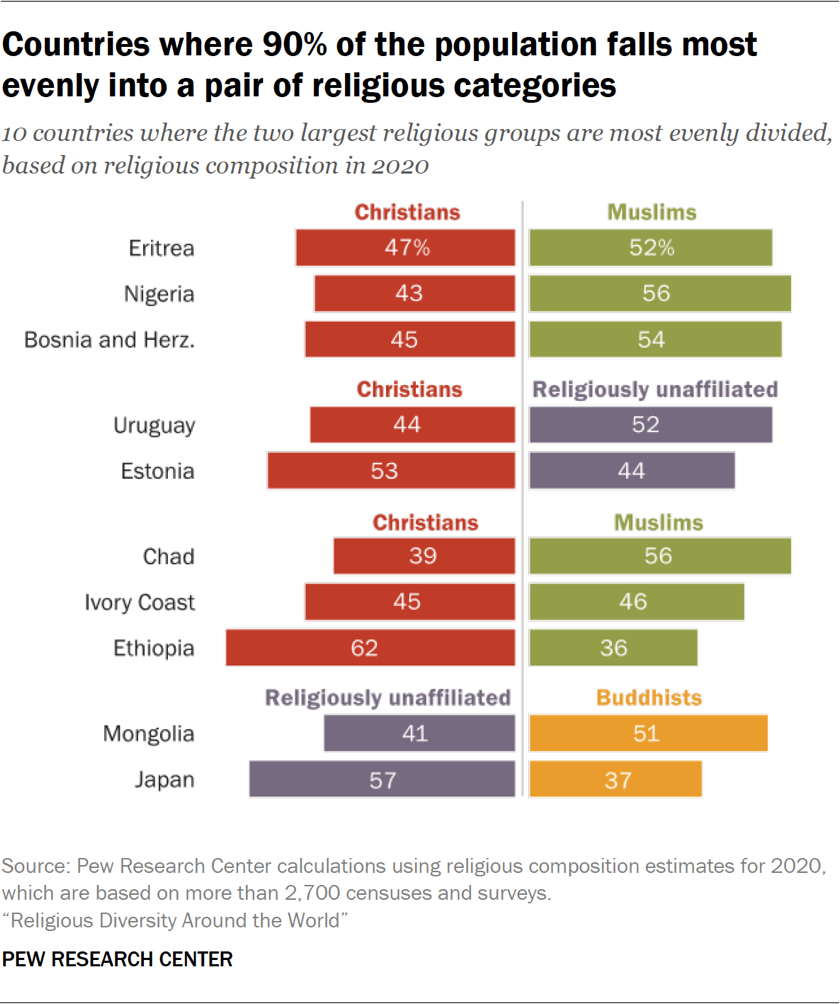
Eritrea ranks first on this measure, with a near-even divide between Muslims (52%) and Christians (47%), as of 2020.
Nigeria and Bosnia and Herzegovina – second and third on the list, respectively – also have large shares of Christians and Muslims.
Among the 10 countries with the most evenly divided religious composition, six have a Christian-Muslim split. In the remaining four, the split is between Christians and the unaffiliated (Uruguay and Estonia) or between Buddhists and the unaffiliated (Mongolia and Japan).
Where do countries fall on the diversity spectrum?
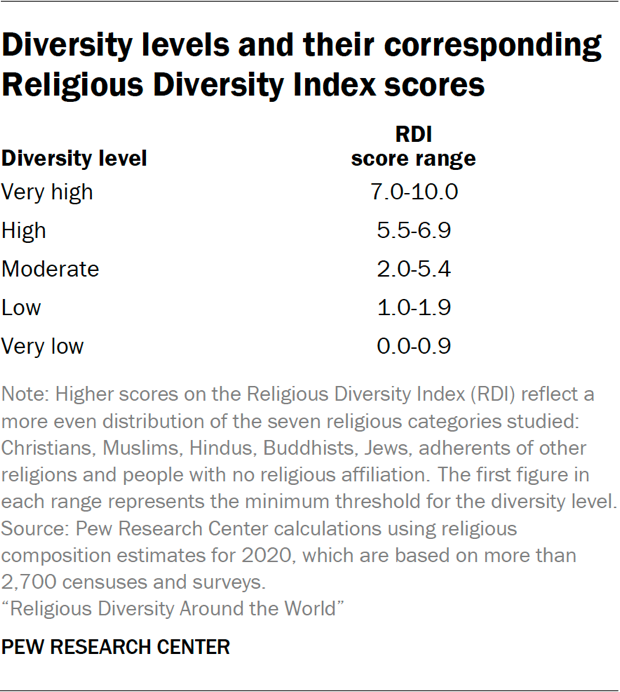
In addition to ranking countries based on their Religious Diversity Index score, we also grouped countries and world regions into five levels of diversity ranging from very high to very low.
Sorting countries by their overall level of diversity can help shed light on which regions of the world are most and least religiously diverse, and whether people more commonly live in places with high or low levels of diversity.
Countries and territories with scores of 7.0 to 10.0 are categorized as having a very high degree of religious diversity. Places with scores below 1.0 are categorized as having a very low degree of religious diversity.
Of the 201 countries and territories in this analysis, the largest number are moderately diverse (89). Many countries also fall into the low (30) or very low (41) range, while fewer are at the high (33) or very high (8) end of the spectrum.
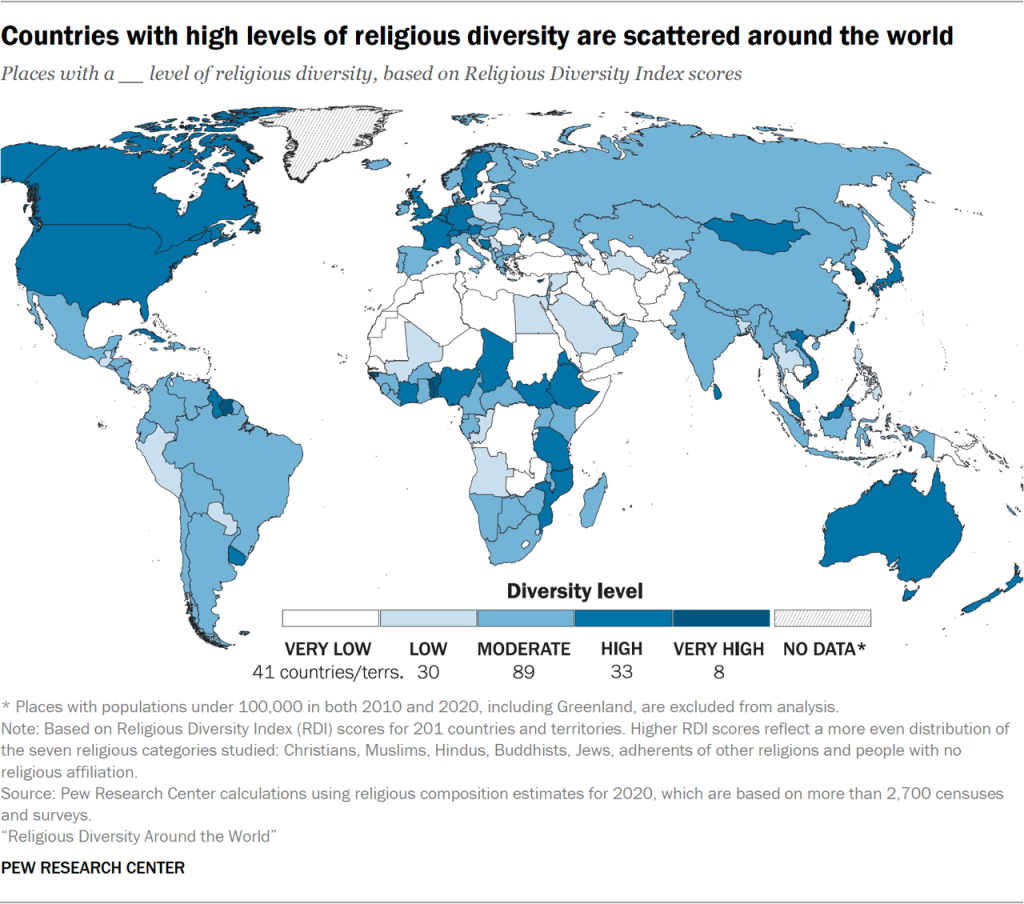
Religious diversity by region
The Asia-Pacific region, with an overall RDI score of 8.7 and a very high level of diversity, is the most religiously diverse of the six regions in our analysis.
Considered as a whole, the Asia-Pacific region is home to many millions of religiously unaffiliated people, Muslims, Hindus, Buddhists, Christians and people in the “other religions” umbrella category. Jews are the only major group with a small presence in this region.
No religious category constitutes a majority in the Asia-Pacific region. The largest single group – the religiously unaffiliated – makes up only about a third of the region’s population.
Three regions in this analysis have a high level of diversity: North America (with an RDI score of 6.0), sub-Saharan Africa (5.9) and Europe (5.6). In each of these regions, Christians make up a majority of the overall population. The second-largest group – the religiously unaffiliated in North America and Europe, and Muslims in sub-Saharan Africa – makes up a quarter or more.
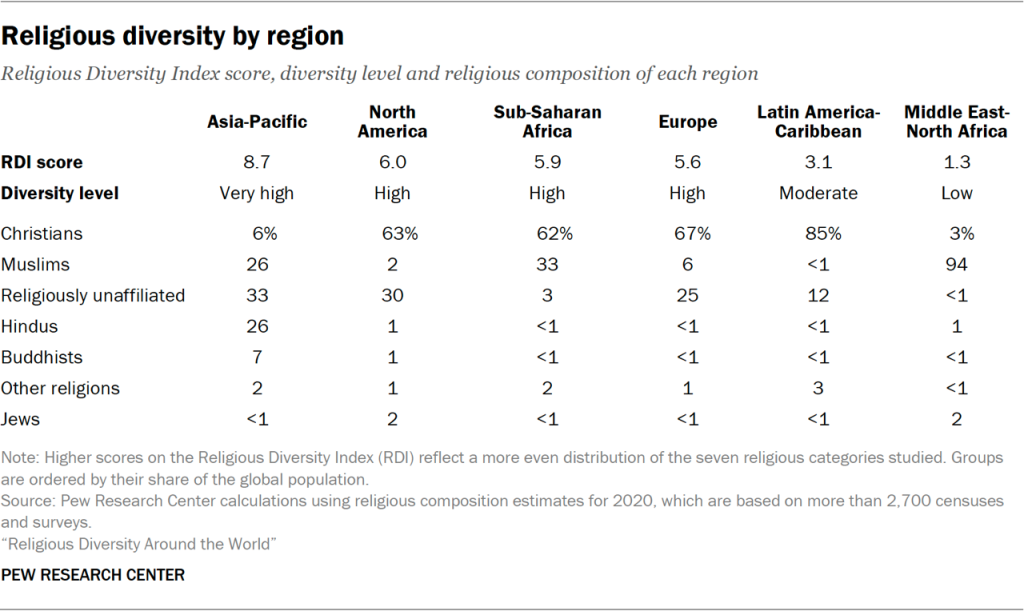
The Latin America-Caribbean region falls in the moderate diversity category, with an RDI score of 3.1. The region has a large Christian majority and a modest share of unaffiliated people.
The Middle East-North Africa region, with an RDI score of 1.3 and a low level of diversity, is the least diverse of the regions we studied, with a population that is 94% Muslim. This region includes five of the world’s 10 least religiously diverse countries and territories: Yemen, Morocco, Western Sahara, Iraq and Tunisia.
What share of people live in religiously diverse societies?
A majority of the global population lives in countries and territories with a moderate level of religious diversity.
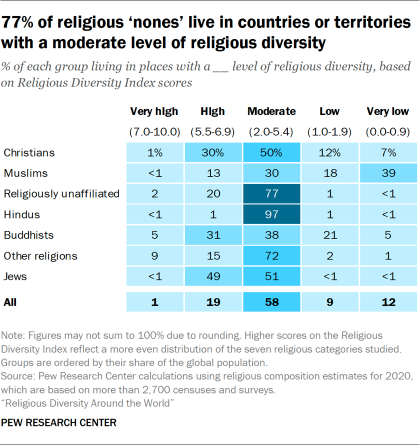
Just 1% of all people live in places with very high religious diversity. An additional 19% live in places with high diversity, while the remainder live in places with low (9%) or very low (12%) diversity.
Muslims are the group most likely to live in countries and territories with very low diversity, though they also tend to live in moderately diverse places. This is because many Muslims reside in Middle East-North African countries – where the vast majority of people are Muslim – and in moderately diverse Asian countries such as Indonesia and India.
Christians – who are, geographically, the most widely distributed of the groups in this analysis – are most likely to live in moderately diverse countries. However, many Christians also live in highly diverse places, such as the U.S., Nigeria and Ethiopia.
Religiously unaffiliated people mostly live in moderately diverse societies, such as China, which is home to two-thirds of the world’s unaffiliated population.
Jews are split almost evenly between moderately and highly diverse countries. Nearly 40% of the world’s Jewish population resides in the U.S. (a highly diverse country) and 46% live in Israel (moderately diverse).
Related: Many religions are heavily concentrated in a few countries
Hindus primarily live in places that are moderately diverse. This is because the vast majority of Hindus (95%) live in India, a moderately diverse country.
Buddhists are spread most evenly across the five levels of religious diversity, with the majority dwelling in moderately (38%) or highly (31%) diverse countries. Buddhists also are among the most likely to live in places with a very high level of diversity, such as Singapore, South Korea and Taiwan.
Change in religious diversity since 2010
Broadly speaking, religious diversity levels around the world did not change much between 2010 and 2020, as the religious composition of most countries was fairly stable.4
However, the RDI scores of around two dozen countries changed considerably over that decade, primarily due to widespread religious disaffiliation among Christians.5 In places where very large Christian populations shrank and a small religiously unaffiliated population gained ground, the RDI score rose. In places where the unaffiliated population was already large and expanded further, the RDI score fell.
Changes in RDI scores also led religious diversity levels to shift in some countries. For example, the religious diversity level of the U.S. rose from “moderate” to “high” over the decade. The country’s large Christian majority shrank by 14 percentage points to 64% in 2020 and a growing minority of Americans did not identify with any religion. Similarly, Ireland’s religious diversity level rose from “low” to “moderate” as the large Christian majority shrank by 11 points to 81%.
On the other side of this equation, a few places experienced a shift that lowered their RDI score. For example, in the Netherlands, the already-large share of religiously unaffiliated people grew by 9 points to 54%, while the Christian population shrank. As a result, the country’s religious diversity level fell from “very high” in 2010 to “high” in 2020.
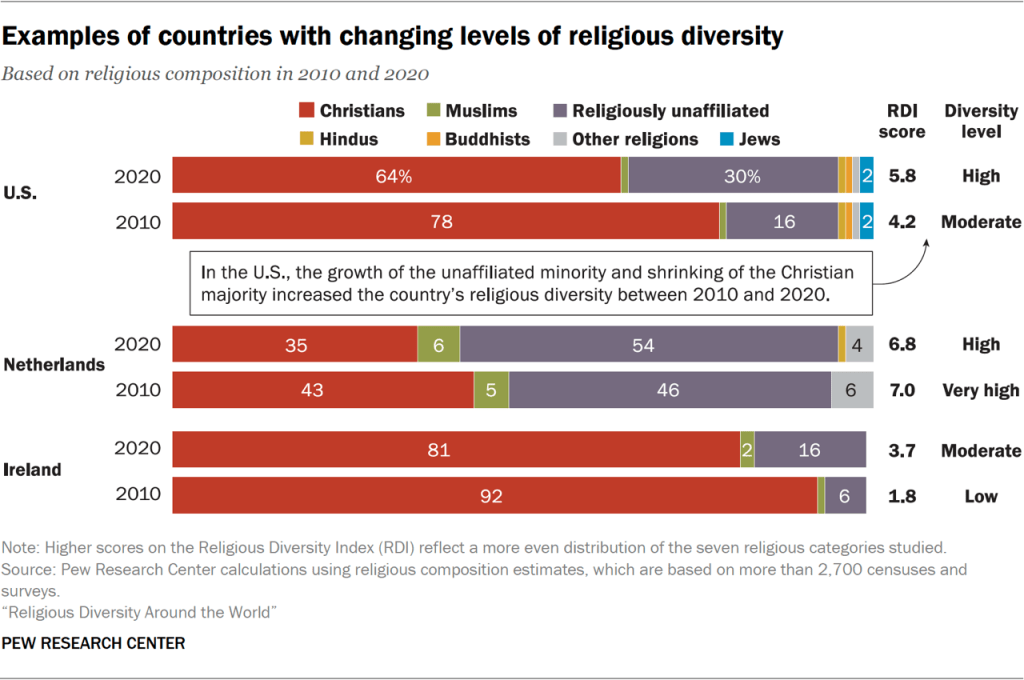
But changes in a country’s religious composition do not always lead to a change in its RDI score or religious diversity level. For example, New Zealand’s score remained at around 6.6, because its two largest groups essentially swapped places: The share of Christians in the population shrank by 9 points, and the share of unaffiliated people expanded by 7 points.
Some countries, such as Chile and Oman, remained in the “moderate” diversity classification despite an increase in their RDI scores. This is because their religious compositions were still not as evenly distributed as those of countries in the “high” diversity category.