In recent decades, religiously unaffiliated Americans – atheists, agnostics and people who identify religiously as “nothing in particular” – have risen as a share of the U.S. adult population.
This chapter explores the reasons why unaffiliated Americans (often called religious “nones”) don’t identify with a religion, and why many of them say they left the religion in which they were raised. Additionally, it looks at why some people who were raised without a religion have joined one as adults.
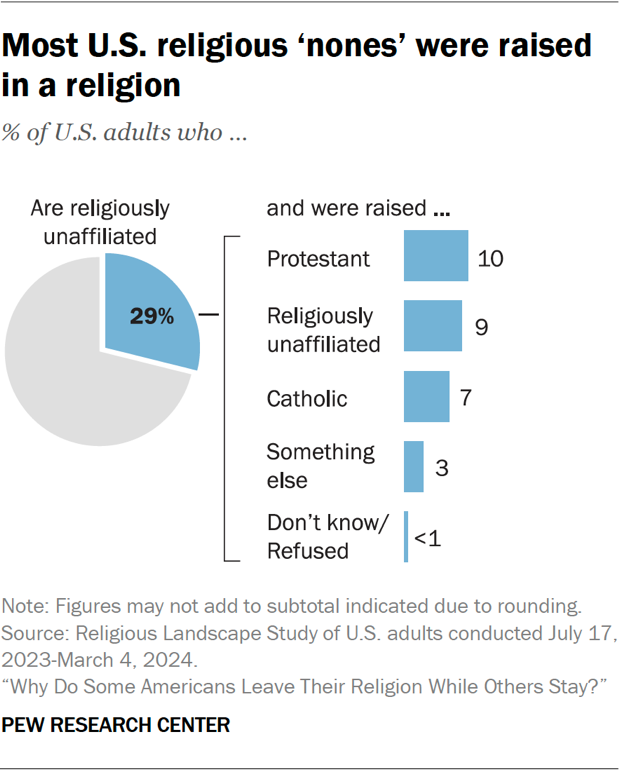
Overall, 29% of U.S. adults are religiously unaffiliated, according to the 2023-24 Religious Landscape Study (RLS). This group includes:
- 10% of all U.S. adults who are “nones” today and were raised Protestant
- 9% who were raised as “nones”
- 7% who were raised Catholic
- 3% who were raised in another religion (other than Protestantism or Catholicism)
Additionally, the RLS finds that 3% of U.S. adults were raised as “nones” but now identify with a religion, including 2% who are now Protestant and 1% who identify with other religions.
What reasons do people give for not having a religion?
A Pew Research Center survey conducted in May 2025 finds that most “nones” cite the following as extremely or very important reasons why they are not affiliated with a religion:
- They believe they can be moral without religion (cited by 78% of “nones”).
- They question a lot of religion’s teachings (64%).
- They don’t need religion to be spiritual (54%).
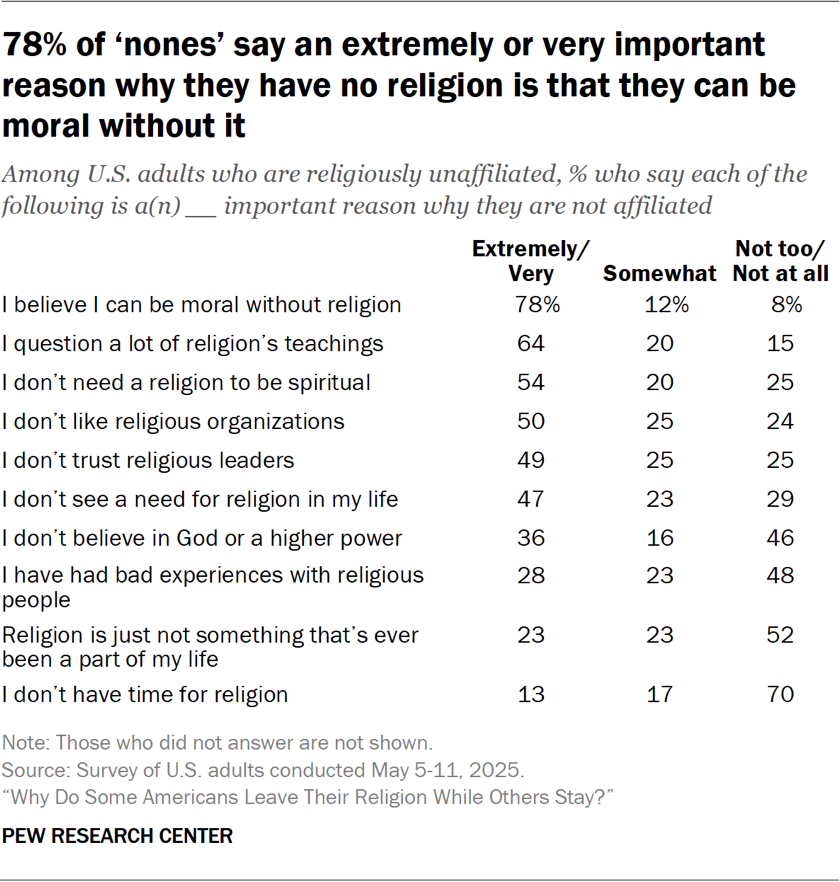
This data on the reasons “nones” don’t identify with a religion comes from a set of survey questions given to Americans of various religious backgrounds about the reasons for their current affiliation (or lack of affiliation).
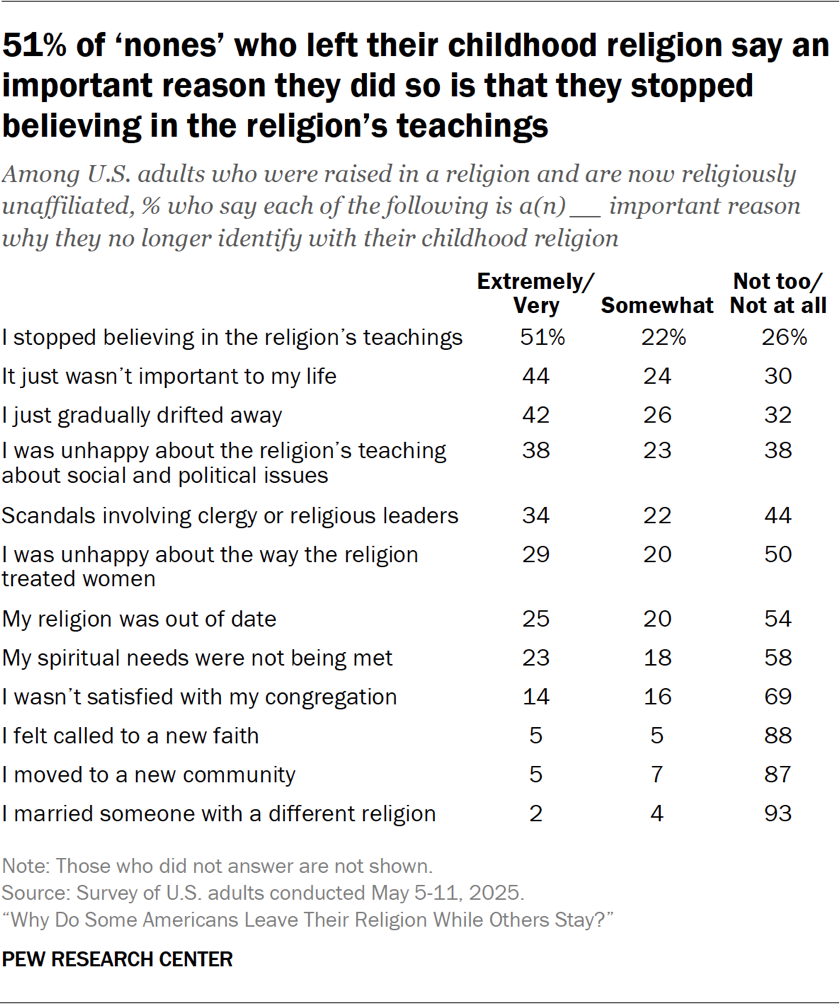
We also asked “nones” who were raised in a religion to rate the importance of 12 possible reasons why they left their childhood religion. They could describe each statement as an extremely, very, somewhat, not too, or not at all important reason why they left their childhood religion.
Here are a few reasons selected by many “nones” as extremely or very important:
- They stopped believing in the religion’s teachings (51%).
- It just wasn’t important to their life (44%).
- They just gradually drifted away (42%).
Read on to explore the following:
- Why some people who were not raised in a religion now identify with one
- Experiences being raised with no religion
Why some people who were not raised in a religion now identify with one
The transition from not having a religion as a child to identifying with one as an adult is relatively rare. Overall, 3% of U.S. adults have made this switch.
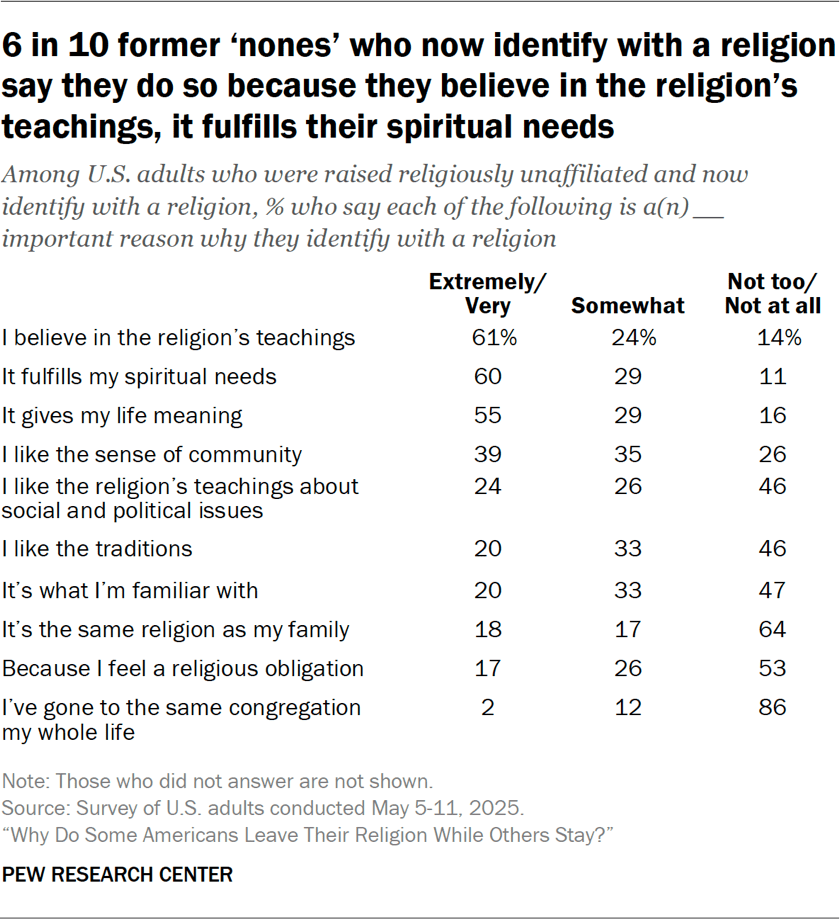
Americans who were raised as “nones” and have since joined a religion cite a variety of reasons for why they identify with their current religion. Of 10 possible reasons offered in the survey, the ones most commonly selected as extremely or very important are:
- They believe in the religion’s teachings (61%).
- It fulfills their spiritual needs (60%).
- It gives their life meaning (55%).
Experiences being raised with no religion
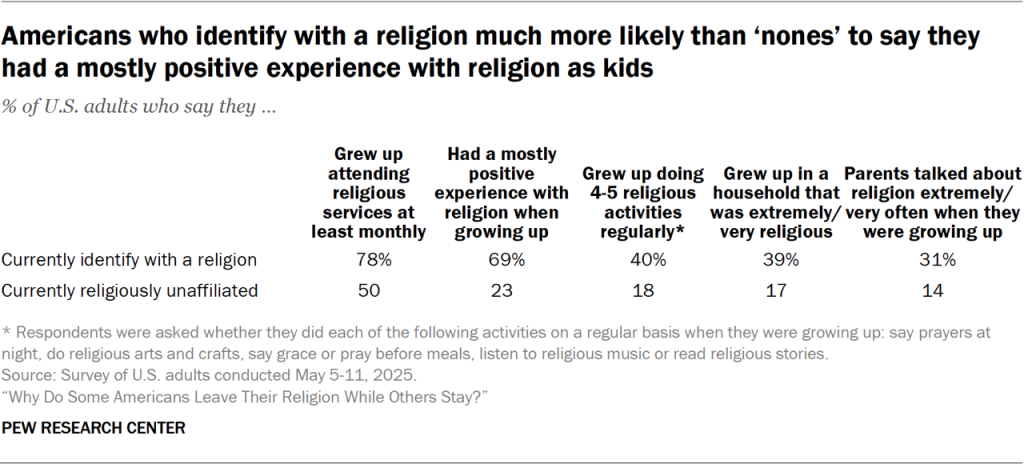
The May 2025 survey also included several questions about how much religion people had in their lives as children. The survey finds that people who are religious “nones” today are less likely than adults who identify with a religion to say they:
- Attended religious services at least once or twice a month as children (50% vs. 78%)
- Had a mostly positive experience with religion while growing up (23% vs. 69%)7
- Grew up regularly doing four or five religious activities that we asked about (18% vs. 40%)
- Grew up in an extremely or very religious household (17% vs. 39%)
- Had parents who spoke extremely or very often about religion (14 % vs. 31%)