This Pew Research Center analysis focuses on Latino registered voters and the 2026 midterm election.
Why did we do this?
Pew Research Center conducts research to inform the public, journalists and decision-makers. This analysis builds on a larger body of work that explores the views and attitudes of Latino voters in U.S. elections and the attitudes and experiences of Latinos in the United States.
We surveyed 5,062 U.S. adults, including 774 Hispanic registered voters, from Sept. 28 to Oct. 4, 2026. Everyone who took this survey is part of the Center’s American Trends Panel. The survey was conducted in English and Spanish and represents the views of the full U.S. adult population. Read more about the ATP’s methodology.
The terms Hispanic and Latino are used interchangeably in this report.
In a previous survey, respondents were asked a question about their voter registration status. In this report, respondents are considered registered voters if they self-report being absolutely certain they are registered at their current address. Respondents are considered not registeredto vote if they report not being registered or express uncertainty about their registration.
The terms “registered voters” and “voters” are used interchangeably in this report.
This analysis includes comparisons between Latino registered voters and other registered voters. In these cases, the terms otherregistered voters or other voters refer to those who are not Latino.
Validated voters are adult citizens who told us in a postelection survey that they voted in a given general election and have a record of voting in a commercial voter file. Trump voters are validated voters who self-reported that they voted for Republican Donald Trump in the 2024 presidential election. Harris voters are validated voters who self-reported that they voted for Democrat Kamala Harris in the 2024 presidential election.
Nonvoters are those who did not vote in 2024 but were eligible to do so.
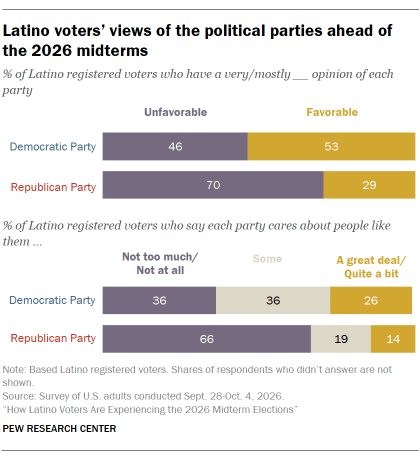
Latino registered voters have more positive views of the Democratic Party than the Republican Party overall.
About half (53%) have a favorable opinion of the Democratic Party, higher than the 44% who said this in the months before the 2024 election. By comparison, 29% have a favorable opinion of the Republican Party today, about the same share as in 2024.
Latino registered voters are also more likely to say the Democratic Party cares about “people like them” than they are to say the same about the Republican Party.
Still, Latino voters do not have overwhelmingly positive views of the party they are supporting:
Among Latino voters who support their district’s Democratic House candidate in the 2026 midterm election, 42% say the Democratic Party cares about people like them a great deal or quite a bit. Another 10% say the party doesn’t care much or at all.
Among Latino voters who back their Republican candidate, 43% say the GOP cares about people like them, while 19% say it doesn’t.
These findings come from a new Pew Research Center survey of U.S. adults, including 774 Latino registered voters, conducted from Sept. 28 to Oct. 4, 2026.
This is part of alarger reporton the attitudes and dynamics among Latino registered voters in the 2026 midterm elections.