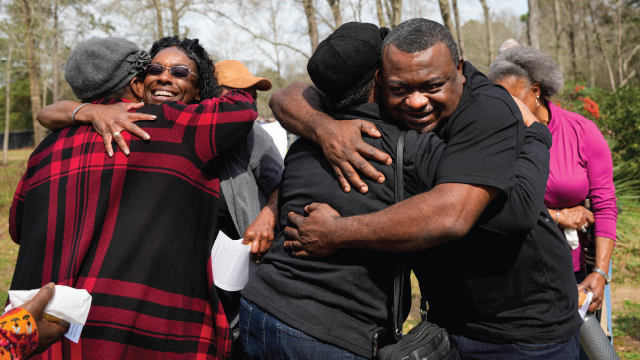
Many Black Americans have broad family networks that are important sources of support. These networks reflect long traditions of connection that often go beyond households and biological relations.
To understand how Black Americans think about and support their families, Pew Research Center surveyed 4,271 Black adults and 2,555 adults of other races and ethnicities in June 2025. We asked:
- Who in their lives is considered family?
- How close are respondents to people in their family?
- How does emotional and financial support flow through family networks?
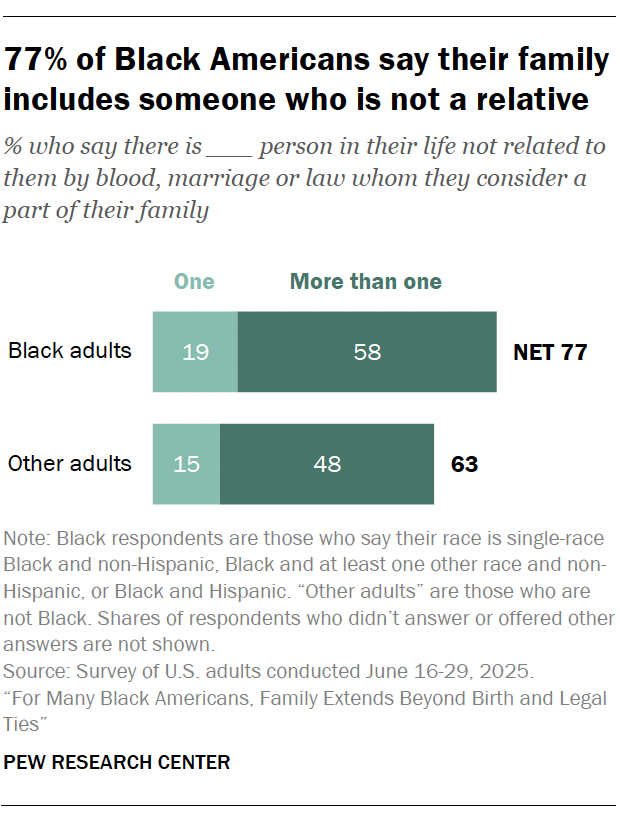
The survey finds Black Americans have wider family networks than other U.S. adults, often encompassing non-relatives like close friends and play cousins.
Among Black adults, 77% have at least one non-relative they consider family. This might be someone with whom they share childhood experiences, religious beliefs, an identity such as race or gender, or other commonalities. Among non-Black adults, a smaller share (63%) say they have a non-relative family member.
This research contributes to Pew Research Center’s ongoing work documenting the views and experiences of Black Americans today.
A brief history of Black family networks
Wide family networks have historically played an important role for Black Americans, allowing members to share economic resources, emotional support and a sense of collective identity.
Closeness to grandparents, aunts, uncles and cousins often softens the line between “nuclear” and “extended” family for Black people. Families can also include people who are not biologically related, often referred to by experts as fictive kin.
These structures have roots in African kinship systems in which various relatives lived in tight communities. During the trans-Atlantic slave trade, Black family networks had to adapt when enslaved Black people were forcibly separated from their families. In response, many formed kinship bonds with other enslaved people on their plantations. These networks provided practical support when biological family members were sold away to new enslavers.
Family networks helped Black Americans cope and survive through emancipation, Jim Crow and persistent economic inequality — and they continue to be sources of support today. These broader networks often share caregiving responsibilities and serve as a cultural resource despite systemic barriers.
Many Black families continue to maintain these networks through routine gatherings and family reunions. These occasions sustain family ties and are often sources of joy and connection.
How Black Americans connect with their family networks
When asked which family members they feel close to, Black adults are more likely than other Americans to choose people researchers traditionally refer to as extended family.
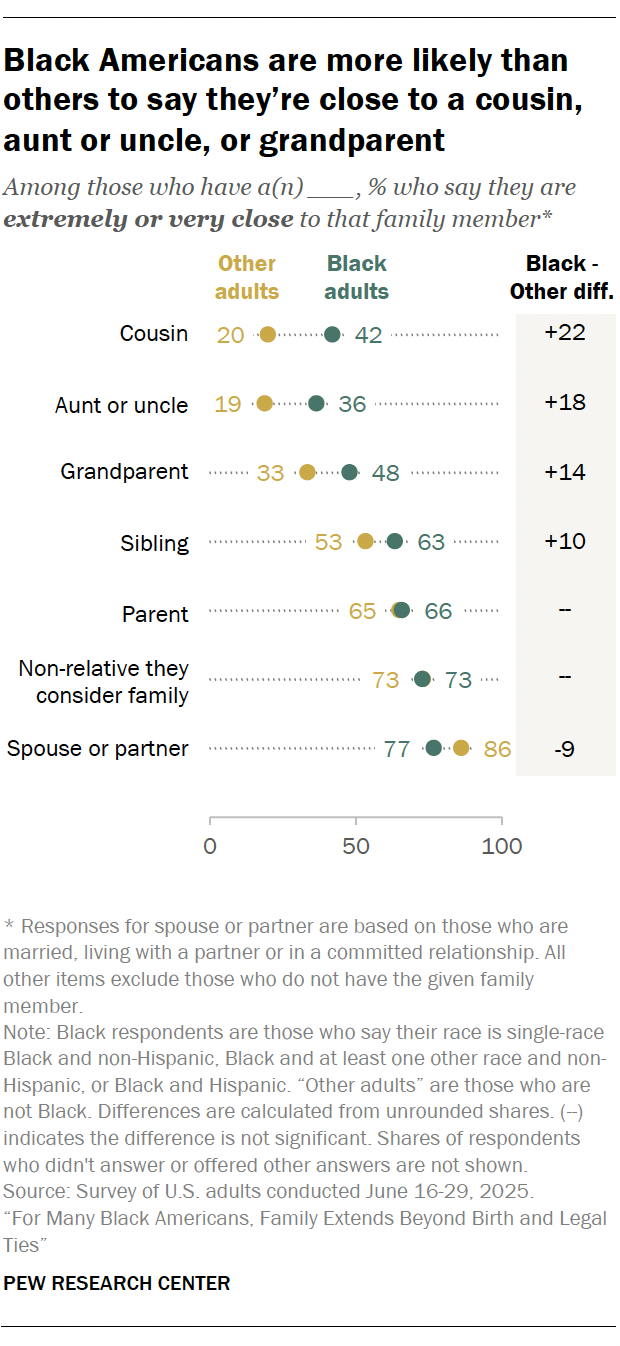
For example, Black adults are more likely than other adults to say they feel extremely or very close to a grandparent (48% vs. 33%), cousin (42% vs. 20%), or aunt or uncle (36% vs. 19%).
However, Black adults and other adults are equally likely to say they feel extremely or very close to a non-relative they consider family (73% each).
Read more about how Black Americans define family and how Black adults experience emotional closeness with their family.
Who makes up Black Americans’ emotional support networks?
Like other Americans, Black adults often rely on family members they feel close to for emotional support, whether those people are related to them or not.
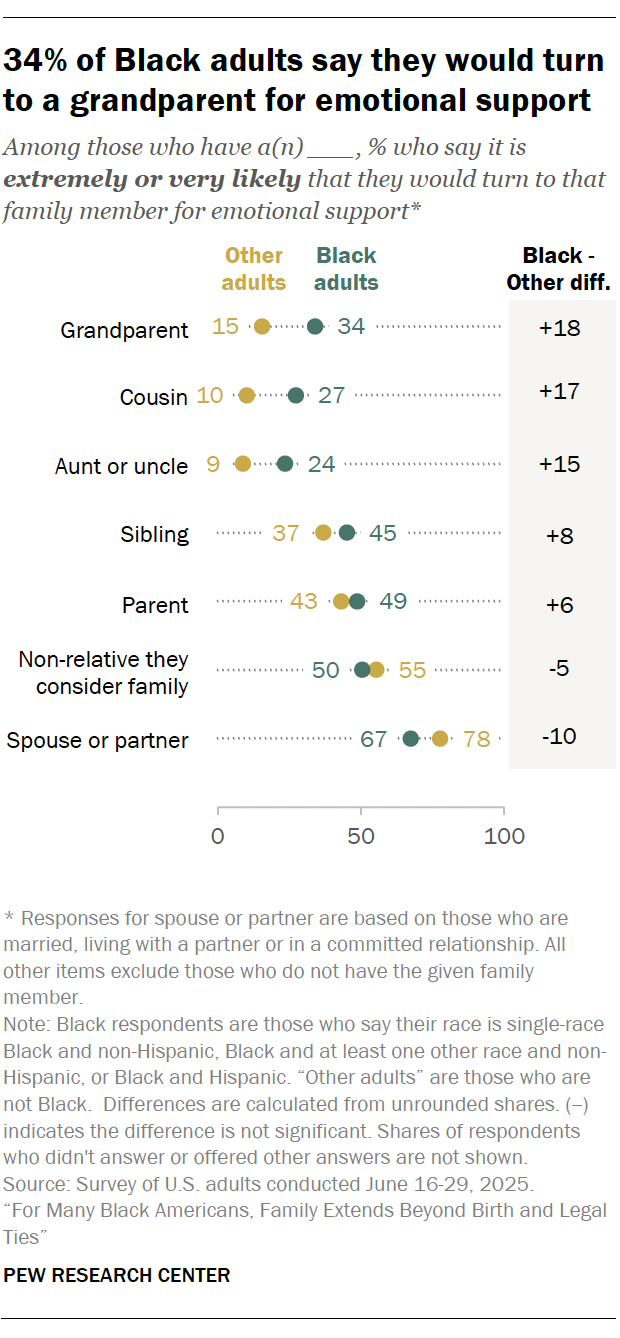
But Black adults are more likely than other Americans to lean on extended family. For instance, 34% of Black adults say they are extremely or very likely to turn to a grandparent for emotional support, compared with 15% of non-Black adults.
Black adults also act as a source of emotional support for their extended families more often than non-Black adults do. For example, 21% of Black adults say a grandparent turns to them for support extremely or very often. Only 9% of non-Black adults say the same.
Overall, Black Americans find the experience of providing emotional support to their families more positive than negative. Among Black adults who give emotional support to any family member, 46% describe it as rewarding and 36% say it is enjoyable. About one-in-five describe it as stressful (18%) or tiring (17%).
Read more about how Black Americans exchange emotional support with their families.
Financial support within Black families
Financial help plays a larger role in Black family life than it does for other Americans:
- 59% of Black adults say they personally gave money or financial assistance to their parents or other family members in the year prior to the survey.
- 42% of other Americans say the same.
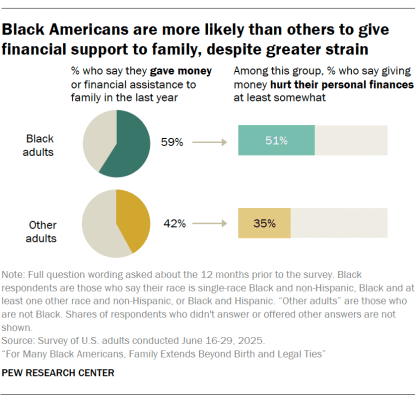
Providing financial support can have trade-offs. About half of Black adults who gave money to family say that doing so hurt their own financial situation at least somewhat (51%), including 25% who say it hurt a great deal or fair amount. By contrast, a smaller share of non-Black adults who gave money to family say it hurt their finances at least somewhat (35%).
For Black adults, receiving financial help from family is less common than giving it. Still, Black adults are more likely than other Americans to rely on their families for financial support:
- 32% of Black adults say they received financial help from family in the prior year.
- 23% of non-Black adults say the same.
Black adults (83%) and non-Black adults (84%) who received financial help from family members are about equally likely to say that it helped their financial situation at least somewhat.
Read more about how Black adults share financial support with their families.
Connection to other Black Americans
Many Black adults also feel connected to Black people beyond their own family.
- 58% say they generally consider other Black people in the United States to be their brothers or sisters.
- 79% say they feel a responsibility to look out for other Black people in the U.S. at least somewhat often. This includes 39% who say they feel this responsibility extremely or very often, and 39% who feel it somewhat often.
Whether Black adults feel these connections to other Black people varies significantly by how important their Black identity is to them personally.
- Feeling of racial connection: Among those who say being Black is extremely important or very important to them, 65% consider other Black Americans to be their brothers or sisters. The share is smaller among those who say being Black is less important (38%).
- Looking out for other Black Americans: Among those who say being Black is important to their identity, 49% feel a responsibility to look out for other Black people extremely or very often – roughly four times the share among those who say being Black is less important (12%).
Read more about Black Americans’ broader sense of connection and family.
How Black adults differ in their family experiences
Black adults vary in how connected they feel to their family networks and how they share support with them. Differences also appear in how Black adults view their ties to other Black Americans in the U.S., including feelings of closeness and responsibility.
Importance of Black identity
Black Americans who say being Black is extremely or very important to their identity are more likely to be close to their families and turn to them for emotional support. Those who say being Black is important to them are also more likely to consider other Black people their brothers and sisters and to feel a sense of responsibility for them.
Age
Black adults under 50 are more likely than those ages 50 and older to give emotional support to their families. However, younger Black adults are just as likely as older Black adults to receive emotional support from their families. Younger Black adults are also more likely to both give and receive financial support in their families.
Gender
Black women are generally more likely than Black men to turn to their families for both emotional and financial support. Black women are also more likely than Black men to give emotional support to family members, such as parents, siblings, cousins and non-relatives they consider family. This is especially true for Black women younger than 50.