
Pew Knight Initiative
The Pew-Knight Initiative supports new research on how Americans absorb civic information, form beliefs and identities, and engage in their communities.
Pew Research Center is a nonpartisan, nonadvocacy fact tank that informs the public about the issues, attitudes and trends shaping the world. Knight Foundation is a social investor committed to supporting informed and engaged communities. Learn more >
Americans today describe a complicated relationship with the news. Most say being informed is essential for civic life – especially voting – yet many feel overwhelmed, skeptical and selective about how they engage with information, according to a new Pew Research Center study from the Pew-Knight Initiative.
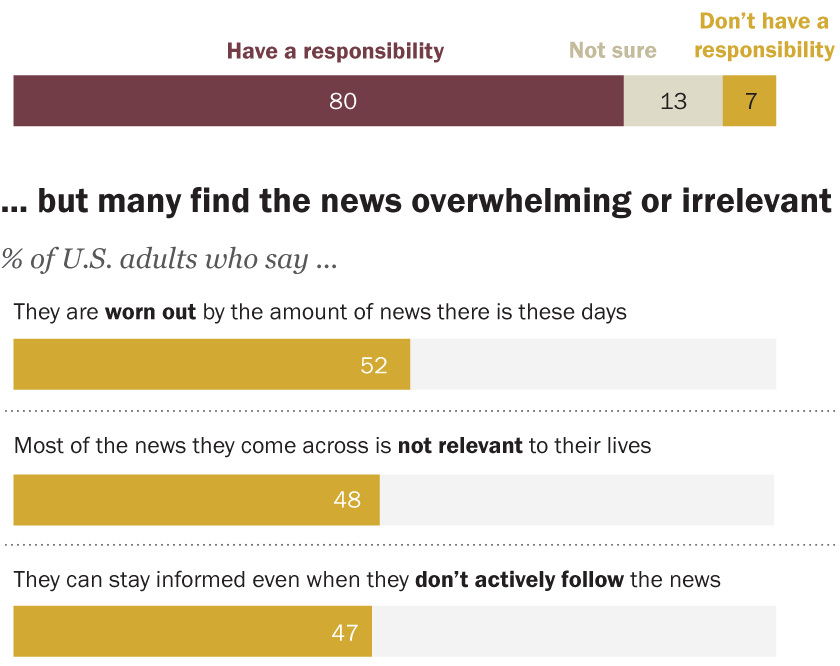
| Have a responsibility | Not sure | Do not have a responsibility | |
|---|---|---|---|
| % of U.S. adults who say Americans __ to be informed about the news when they vote | 80% | 13% | 7% |
| % of U.S. adults who say … | |||
| They are worn out by the news | 52% | ||
| Most of the news they come across is not relevant to their lives | 48% | ||
| The can stay informed even when they don’t actively follow the news | 47% | ||
A central tension shapes today’s news landscape. Most people believe Americans have a civic responsibility to be informed when they vote. But far fewer say regularly following news is extremely or very important in general, and roughly half say they can stay informed even if they don’t actively follow it.
The reality of how people get news nowadays plays into this tension. Americans are evenly split between those who mostly get news because they are seeking it out and those who mostly let news find them. But either way, the high volume of information reaching people from a wide variety of sources brings with it several challenges.
For one, people feel the onus is on news consumers to check whether the news they get is accurate. Americans have far more confidence in their own ability to do this than in other people’s ability.
News fatigue is also widespread – and shaping Americans’ news choices. About half of U.S. adults say they are worn out by the amount of news these days, and people are more likely to say most of the news they come across is not relevant to their lives than to say it is relevant. Following the news often feels like an obligation, and only about one-in-ten Americans say they follow it solely because they enjoy it.
Many have adjusted their news habits: Two-thirds say they have stopped getting news from a specific source, and six-in-ten say they have reduced their overall news intake.
These are some of the key findings of a survey of more than 3,500 U.S. adults that Pew Research Center conducted in December 2025 and nine focus groups held in June 2025. To learn more about this study, read “About this research.”
Skip to:
- How important is following the news, and what does it help people do?
- How Americans check the accuracy of news
- Americans are split in whether they mostly seek news or come across it
- Are Americans tuning out the news?
How important is following the news, and what does it help people do?
Americans see following the news as essential in some ways, particularly for civic participation. Eight-in-ten U.S. adults – including similar shares of Republicans and Democrats – say Americans have a responsibility to be informed about the news when they vote.

Note: Respondents who did not answer are not shown.
“Americans’ Complicated Relationship With News”
| A lot | A little | Not at all | Not employed* | |
|---|---|---|---|---|
| Feel more informed about what’s happening | 46% | 45% | 9% | N/A |
| Discuss current events with others | 35% | 51% | 13% | N/A |
| Make voting decisions | 40% | 39% | 21% | N/A |
| Make decisions in their daily life | 14% | 52% | 34% | N/A |
| Make things better in their community | 12% | 50% | 37% | N/A |
| Be better at their job | 5% | 17% | 36% | 42% |
Note: Respondents who did not answer are not shown.
“Americans’ Complicated Relationship With News”
A similar share (78%) say the news helps them at least a little with making voting decisions, including 40% who say it helps a lot. Large majorities also say the news helps them feel informed about what’s happening (91%) and discuss current events with others (86%) at least a little.
Read more on why Americans discuss the news (or don’t) with others.
“News has a way of affecting us in different ways,” said a man in his 50s who was part of focus groups held for this study. “It can affect our financial wealth. It can affect our physical health. It can affect whether we decide to go out the door that day or not. So for me, it’s a critical part, it’s a routine part of my day.”
This is not true for everybody. People are less inclined to say that the news helps them make decisions in their daily lives or improve their community – with small shares of adults saying the news helps them a lot in doing either of these things. At least a third of Americans say the news doesn’t help them at all in making daily decisions or improving their community.
“It is so easy to access information,” a man in his 60s said. “But that doesn’t mean you’re well informed.”
The survey asked Americans whether various civic behaviors are important to being a good member of society. Following the news ranks below voting, paying taxes, respecting others’ views, serving jury duty and volunteering in the eyes of U.S. adults.
Younger adults consistently place lower importance than older adults on several of these civic duties – especially following the news.
Read more on differences in how younger and older Americans get and think about news.

“Americans’ Complicated Relationship With News”
| Extremely important | Very important | Somewhat important | Not too important | Not at all important | |
|---|---|---|---|---|---|
| Vote in elections | 49% | 27% | 16% | 4% | 3% |
| Pay taxes | 28% | 37% | 23% | 6% | 5% |
| Respect the opinions and beliefs of those they disagree with | 26% | 36% | 29% | 5% | 3% |
| Serve jury duty if they are called | 25% | 32% | 28% | 8% | 6% |
| Volunteer to help others | 18% | 36% | 36% | 6% | 2% |
| Follow the news | 11% | 30% | 41% | 12% | 6% |
| Attend rallies or protests on issues they think are important | 5% | 11% | 32% | 28% | 23% |
“Americans’ Complicated Relationship With News”
There are also mixed views on what specific news habits matter. Most U.S. adults say it is extremely or very important for people to avoid sharing inaccurate information and get news from multiple sources. Smaller shares say it is highly important to get news from sources with a range of political views or get news on a regular basis.

“Americans’ Complicated Relationship With News”
| Extremely important | Very important | |
|---|---|---|
| Avoid sharing inaccurate information | 55% | 29% |
| Get news from multiple sources | 25% | 39% |
| Get news from sources with a range of political views | 18% | 34% |
| Get news on a regular basis | 14% | 33% |
“Americans’ Complicated Relationship With News”
Democrats and Democratic-leaning independents (53%) are somewhat more likely than Republicans and GOP leaners (43%) to say regularly getting news is highly important.
Only 8% of Americans say people in the U.S. have a responsibility to pay for news, and most do not pay for it themselves. One woman in her 20s who was part of our focus groups said, “I don’t think that information should be a privilege.”
Read more on how Americans feel about paying for news.
How Americans check the accuracy of news
Going into this study, we already knew that Americans feel like they are regularly encountering inaccurate information, and that many are having a hard time figuring out what is true.
This new survey finds that nearly all Americans say it is at least somewhat important for people to do their own research to check the accuracy of the news they get (94%), including two-thirds (66%) who say it is extremely or very important.
Read more on what Americans think it means to “do your own research” when it comes to news.

“Americans’ Complicated Relationship With News”
| Very confident | Somewhat confident | Not too/Not at all confident | |
|---|---|---|---|
| You | 29% | 50% | 20% |
| Other people | 3% | 22% | 73% |
“Americans’ Complicated Relationship With News”
At the same time, people have much more confidence in their own ability to check the accuracy of a news story than they do in others. Most U.S. adults say they are very (29%) or somewhat (50%) confident they would know what steps to take to verify the accuracy of a news story. But only a quarter are very (3%) or somewhat (22%) confident in other people’s ability to do so.
“I think ideally you can … absorb the information, and then do your own kind of research into understanding what they’ve delivered,” a man in his 30s said in a focus group. “And it helps you become more informed. I don’t think others do that, though. I think that’s a problem.”
When asked who should be most responsible for making sure Americans know how to check accuracy, the largest share (44%) say individuals themselves – ahead of news organizations (22%), teachers or schools (9%) and the government (9%).
Read more details on these findings.
Americans are split in whether they mostly seek news or come across it
The rapid growth of digital platforms has reshaped how news reaches people. News that once required deliberate effort – for example, turning on the TV or picking up a newspaper – now regularly finds people in digital spaces or through conversations with others.
“News finds you nowadays,” a man in his 40s said.

“Americans’ Complicated Relationship With News”
| They are looking for it | They happen to come across it | |
|---|---|---|
| 2025 | 50% | 49% |
| 2020 | 52% | 47% |
| 2019 | 60% | 39% |
“Americans’ Complicated Relationship With News”
Americans are now evenly divided between those who mostly get news because they are looking for it (50%) and those who mostly happen to come across it (49%). And a similar percentage of Americans (47%) say they can stay informed even when they don’t actively follow the news.
A woman in her 20s said, “Even when you’re not pursuing it, something’s being put in front of you.”
Americans who mostly seek out news are much more likely than those who mostly come across it to say it is extremely or very important for people to regularly get news (62% vs. 32%). They’re also much more likely to say that following the news is highly important to being a good member of society (55% vs. 26%).
Different types of news also reach people in different ways. Americans are more likely to get up-to-date and in-depth information about an issue or event because they are looking for it than because they happen to find it.
But the reverse is true for opinions or funny posts about an issue or event. For example, 64% of Americans say they mostly get opinions about issues or events because they happen to come across them, compared with 21% who say they mostly seek out opinions.
Are Americans tuning out the news?
There are many possible reasons why fewer Americans are now seeking out news.

“Americans’ Complicated Relationship With News”
| Not worn out | Worn out | Not sure | |
|---|---|---|---|
| Are __ by the amount of news there is these days | 34% | 52% | 14% |
| No | Yes | Not sure | |
| Have ever stopped getting news from a specific source | 24% | 67% | 9% |
| Have ever reduced the amount of news they get overall | 30% | 60% | 9% |
“Americans’ Complicated Relationship With News”
About half of Americans (52%) say they are worn out by the amount of news there is these days, compared with 34% who say they are not worn out (the remainder say they are not sure).
“It’s good to be informed, but too much information is just like an overload,” a man in his 40s explained.
And nearly half (48%) of U.S. adults say most of the news they encounter is not relevant to their life, while 35% say it is mostly relevant. Republicans are less likely than Democrats to say most of the news they come across is relevant to them.
Many Americans have tuned out, at least temporarily: Two-thirds say they have ever stopped getting news from a specific source, and six-in-ten have reduced their news intake overall at some point.

“Americans’ Complicated Relationship With News”
| They enjoy it | They feel they should | A mix of both | They don’t follow the news | |
|---|---|---|---|---|
| U.S. adults | 9% | 24% | 51% | 16% |
“Americans’ Complicated Relationship With News”
Even though many feel personally exhausted, half of U.S. adults say news consumption in the country overall has been rising in the past decade, while 18% say it has been falling. This reflects another disconnect between people’s own experiences and what they feel is going on around them.
Ultimately, relatively few Americans (9%) say they follow the news just because they enjoy it. By comparison, 24% say they do so only because they feel like they should. About half (51%) cite a mix of these two reasons, while 16% say they don’t follow the news at all.