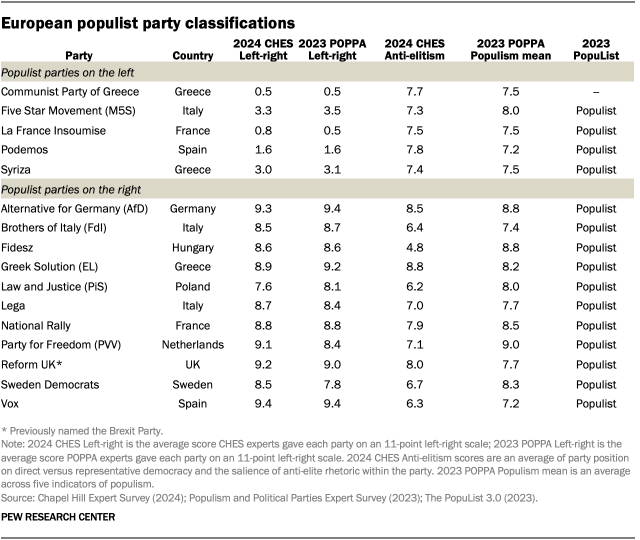
Classifying parties as populist
Although experts generally agree that populist political leaders or parties display high levels of anti-elitism, definitions of populism vary. We use three measures to classify parties as populist: anti-elite ratings from the 2024 Chapel Hill Expert Survey (CHES), the 2023 Populism and Political Parties Expert Survey (POPPA) and the 2023 PopuList. We define a party as populist when at least two of these three measures classify it as such.
CHES, which was conducted from October to December 2024, asked 609 political scientists specializing in political parties and European integration to evaluate the 2024 positions of 279 European political parties across all European Union member states, except for Luxembourg. The survey also gathered their views of parties in Iceland, Norway, Switzerland, Turkey and the United Kingdom. CHES results are regularly used by academics to classify parties with regard to their left-right ideological leanings, their key party platform positions and their degree of populism, among other things.
We measure anti-elitism using an average of two variables in the CHES data. First, we used “PEOPLE_VS_ELITE,” which asked the experts to measure the parties with regard to their position on direct versus representative democracy, where 0 means the parties support elected officeholders making the most important decisions and 10 means the parties support “the people,” not politicians, making the most important decisions. Second, we used “ANTIELITE_SALIENCE,” which is a measure of the salience of anti-establishment and anti-elite rhetoric for that particular party, with 0 meaning the rhetoric is not at all salient and 10 meaning it is extremely salient. The average of these two measures is shown in the table below as “anti-elitism.” We define parties that score 7.0 or more as populist.
POPPA, which was fielded between January and May 2023, asked 324 experts to measure positions and attitudes of 312 political parties on key characteristics related to populism and political representation in 31 European countries. We used “POPULISM_MEAN,” which is an average of five indicators:
- “MANICHEAN,” which is a measure of the extent to which parties see politics as a moral struggle between good and bad, with 0 meaning not at all Manichean and 10 meaning very Manichean
- “INDIVISIBLE,” which is a measure of the extent to which some parties consider the ordinary people to be indivisible, with 0 meaning not at all indivisible and 10 meaning very indivisible
- “GENERALWILL,” which is a measure of the extent to which some parties consider the ordinary people’s interest to be singular, with 0 meaning not at all singular and 10 meaning very singular
- “PEOPLECENTRISM,” which is a measure of the extent to which some parties believe that sovereignty should lie exclusively with the ordinary people, not the elites, with 0 meaning not at all people-centered and 10 meaning very people-centered
- “ANTIELITISM,” which is a measure of the extent to which some parties are characterized by their attitudes toward the establishment and elites, with 0 meaning not at all anti-elitist and 10 meaning very anti-elitist
We define parties that score 7.0 or more on the “POPULISM_MEAN” measure as populist.
The PopuList is a project to classify European political parties as populist, far right or far left. The project specifically looks at parties that have won at least one seat or 2% of a national parliamentary election since 1989. In an iterative process, comparative and country experts collaborate to classify parties based on their core ideological attributes. This appendix uses The PopuList 3.0.
Classifying parties as left, right or center
We can further classify traditional and populist parties into three groups: left, right and center. When classifying parties based on ideology, we relied on the variable “LRGEN” in the CHES dataset. CHES asked experts to rate the positions of each party in terms of its overall ideological stance, with 0 meaning extreme left, 5 meaning center and 10 meaning extreme right. We define left parties as those that score below 4.5 and right parties as those that score above 5.5. Parties in the center have ratings between 4.5 and 5.5.
The POPPA dataset also measures party ideology with the variable “LROVERALL.” POPPA asked experts to rate each party’s overall ideology on a scale ranging from 0, meaning left, to 10, meaning right. We considered left parties as those that score below 4.5 and right parties as those that score above 5.5. Parties in the center have ratings between 4.5 and 5.5. We used POPPA to confirm CHES’s ratings, with 100% agreement on the parties we classify as populist based on the methodology explained above.