Nearly six weeks into the U.S. military campaign against Iran, a new Pew Research Center survey finds that higher gas prices are the outcome that concerns Americans the most. But majorities also worry about the United States sending ground troops into Iran, large numbers of military casualties, terrorist attacks on U.S. soil, and the war expanding outside the Middle East.
The survey was conducted March 23-29 among 3,507 U.S. adults.
Conduct of the war
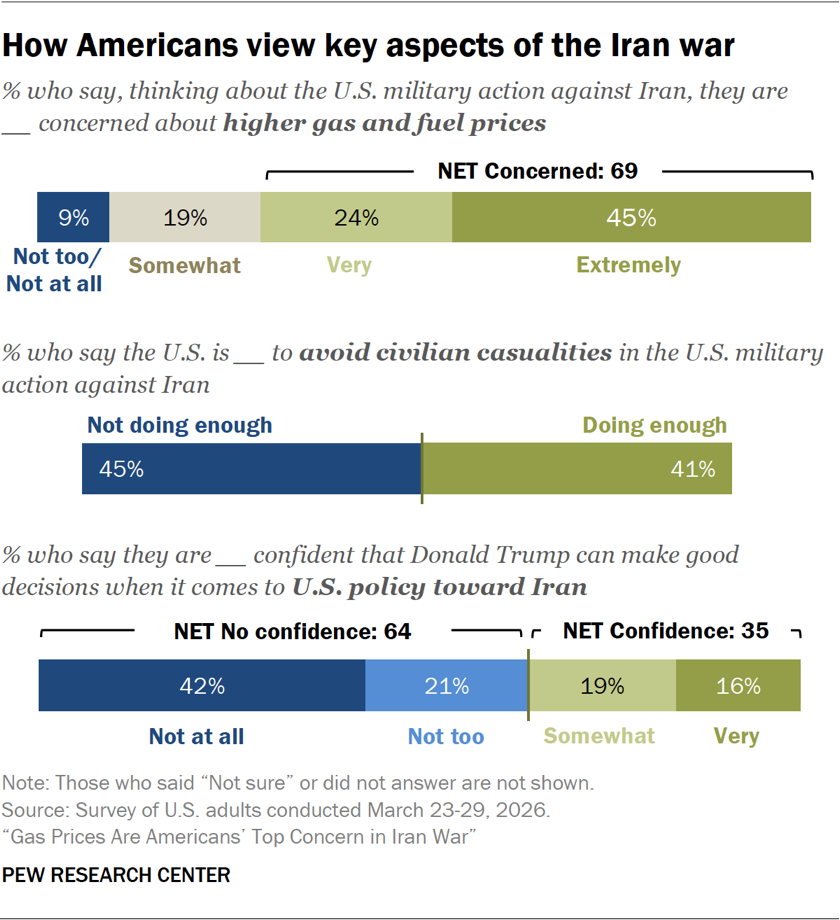
Americans are closely divided on whether the U.S. is doing enough to prevent civilian casualties in the Iran war: 41% say it’s doing enough, while 45% say the opposite; 13% are not sure.
Most Republicans and Republican-leaning independents say the U.S. is doing enough to prevent civilian casualties (65%), while a similar share of Democrats and Democratic leaners (68%) say it is not. But there is broad agreement among all adults that Iran itself is not doing enough to prevent civilian casualties (69%).
Americans also express little faith in President Donald Trump’s ability to make good decisions when it comes to Iran: 35% are confident in his policymaking in this area, while 64% are not.
Around two-thirds of Republicans (66%) are confident, compared with fewer than one-in-ten Democrats (7%).
Read more on confidence in Trump’s ability to handle various foreign policy issues.
How might the war affect Iran?
Americans are equally divided on whether U.S. military action will make Iran’s development of a nuclear weapon more likely (27%), less likely (27%) or about as likely as before (29%), while another 16% are not sure. Younger Americans and Democrats are more likely than older adults and Republicans to say U.S. military action will increase the likelihood of Iran obtaining a nuclear weapon.
Americans also have differing views about the ultimate fate of Iran after the conflict ends. More say the Iranian people will be worse off (36%) than say they will be better off (25%), while 16% believe they will be about as well off as before and 21% are not sure.
Additionally, most Americans (77%) say the U.S. military action against Iran is important to them personally, including 48% who say it is very important to them. Majorities of Republicans (81%) and Democrats (76%) alike hold this view.
Do Americans think Trump can make good decisions about Iran?
Confidence in Trump’s ability to make good decisions about U.S. policy toward Iran has declined among both Republicans and Democrats.
In the latest survey, 35% of Americans are very or somewhat confident in Trump’s policymaking in this area, while 64% are not too or not at all confident.
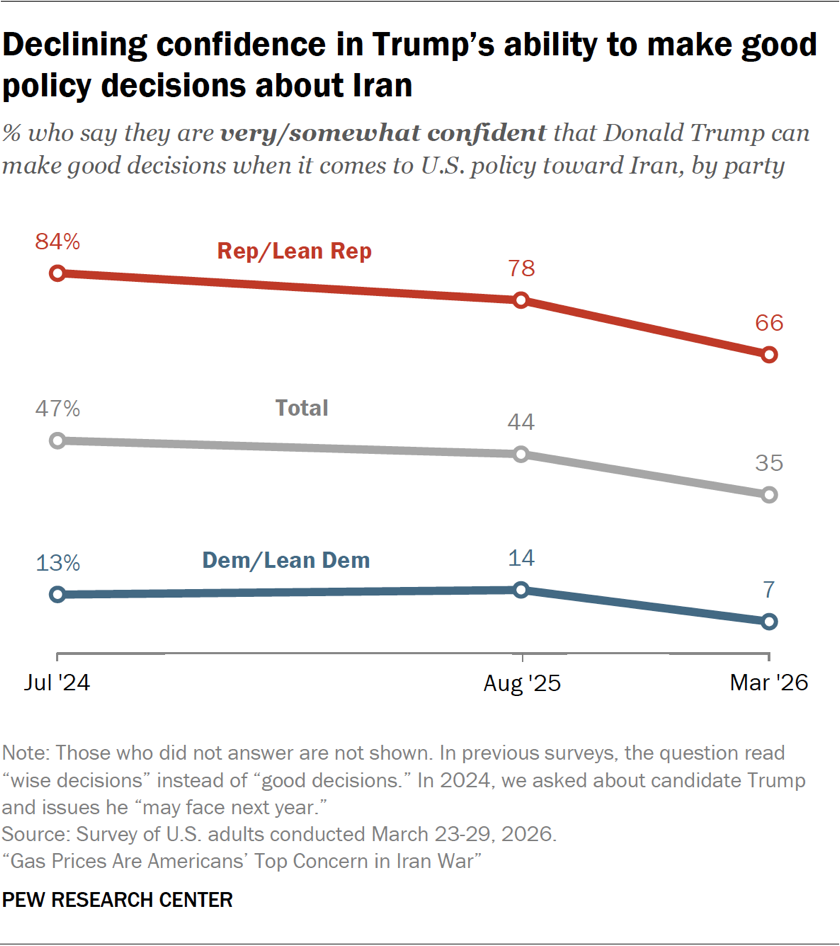
Confidence in Trump’s dealings with Iran is down 12 percentage points since 2024, when he was running for a second presidential term. And it has declined by 9 points since August 2025.
Among Republicans, there has been an 18-point decline in confidence since 2024 and a 12-point drop since 2025. Confidence among Democrats has decreased from 14% in 2025 to 7% today.
There is also a stark age divide among Republicans.
The youngest Republicans (ages 18 to 29) are divided: 46% are confident in Trump’s policymaking toward Iran, while 53% are not. But Republicans ages 65 and older are overwhelmingly confident (80%) in Trump’s ability to make good decisions in this area.
Republicans who are concerned about the higher gas prices as a result of the war are also less likely to have confidence in Trump’s policymaking on Iran. Among Republicans who are extremely or very concerned about gas prices increasing, 56% have confidence in him, while 44% do not. Among Republicans who are not concerned about gas prices increasing, 86% have confidence in Trump to make good policy decisions.
What are Americans’ concerns about the Iran war?
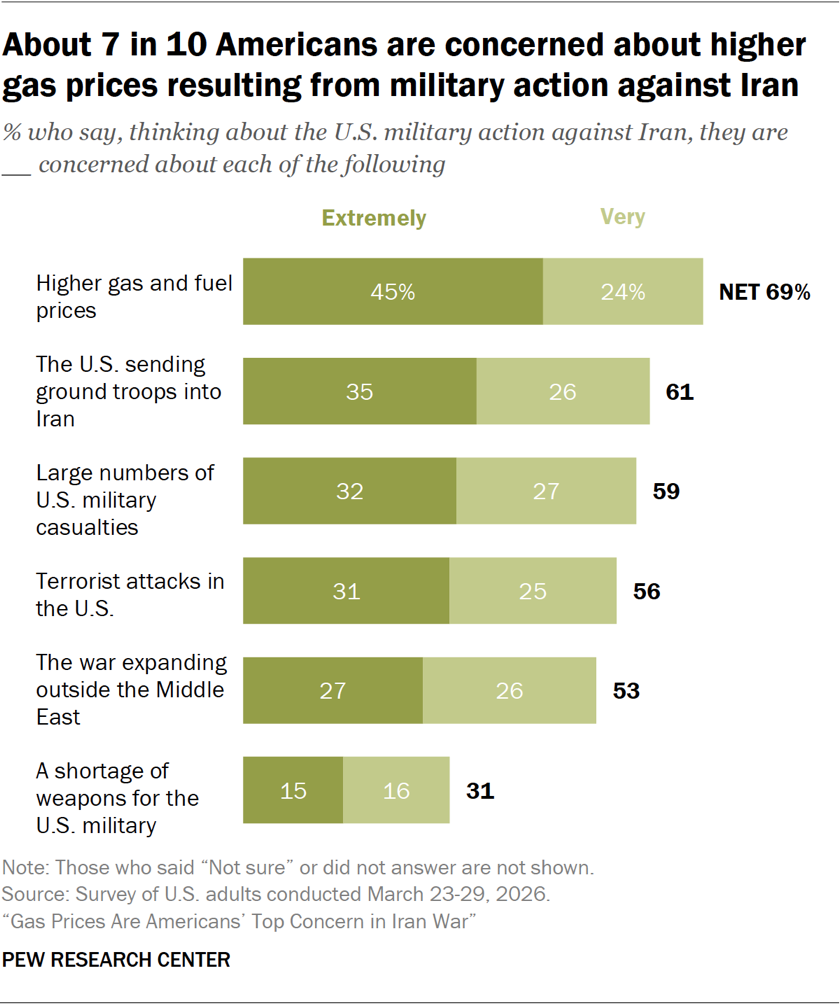
About seven-in-ten Americans (69%) are concerned about higher gas and fuel prices as a result of the U.S. military action against Iran, including 45% who are extremely concerned. Of the potential outcomes we asked about, this one worries Americans most.
Majorities also are concerned about the U.S. sending ground troops into Iran, large numbers of military casualties, terrorist attacks in the U.S., and expansion of the war into countries outside the Middle East.
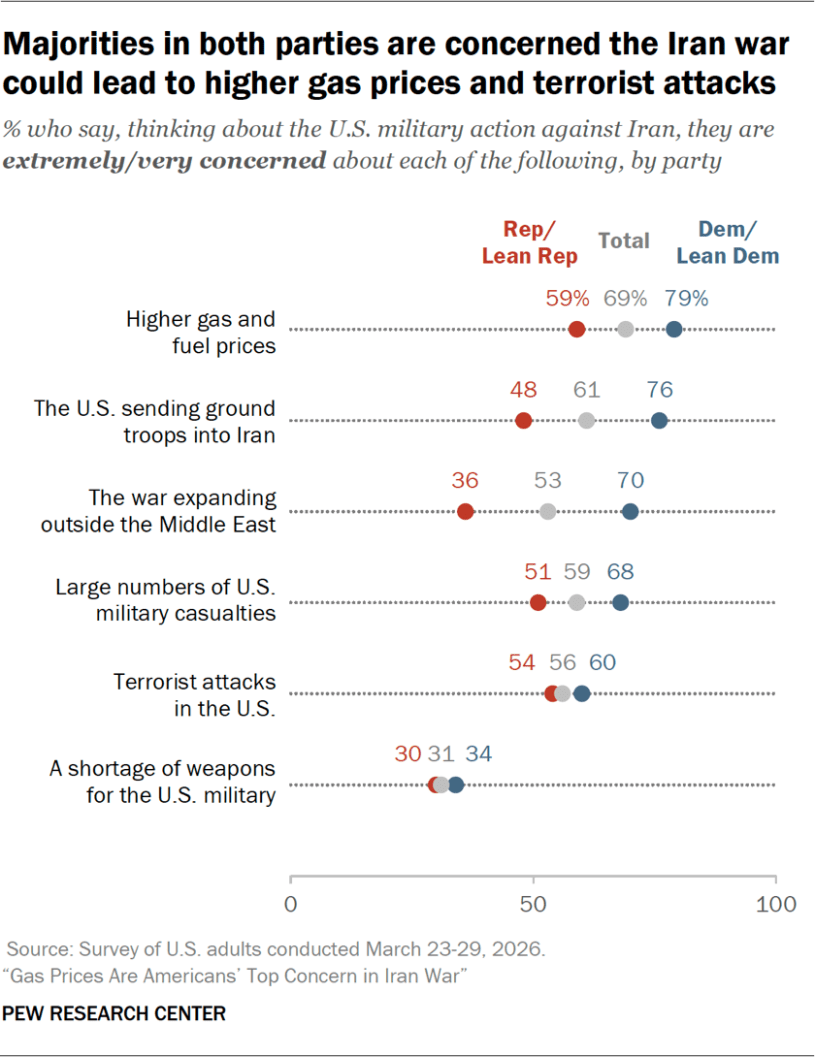
Fewer Americans (31%) are concerned about a shortage of weapons for the U.S. military.
Levels of concern also differ by party. Still, most Democrats (79%) and Republicans (59%) are worried about higher gas prices as a result of the Iran war.
However, Democrats are about twice as concerned as Republicans about the conflict expanding outside the Middle East.
Another Pew Research Center survey conducted in March found that 68% of Democrats think the war will continue for six months or longer, while 58% of Republicans expect the war to end within the next six months.
Related: Americans Broadly Disapprove of U.S. Military Action in Iran
Are both sides doing enough to avoid civilian casualties?
Majorities of Americans in both parties say Iran is not doing enough to avoid civilian casualties in the war.
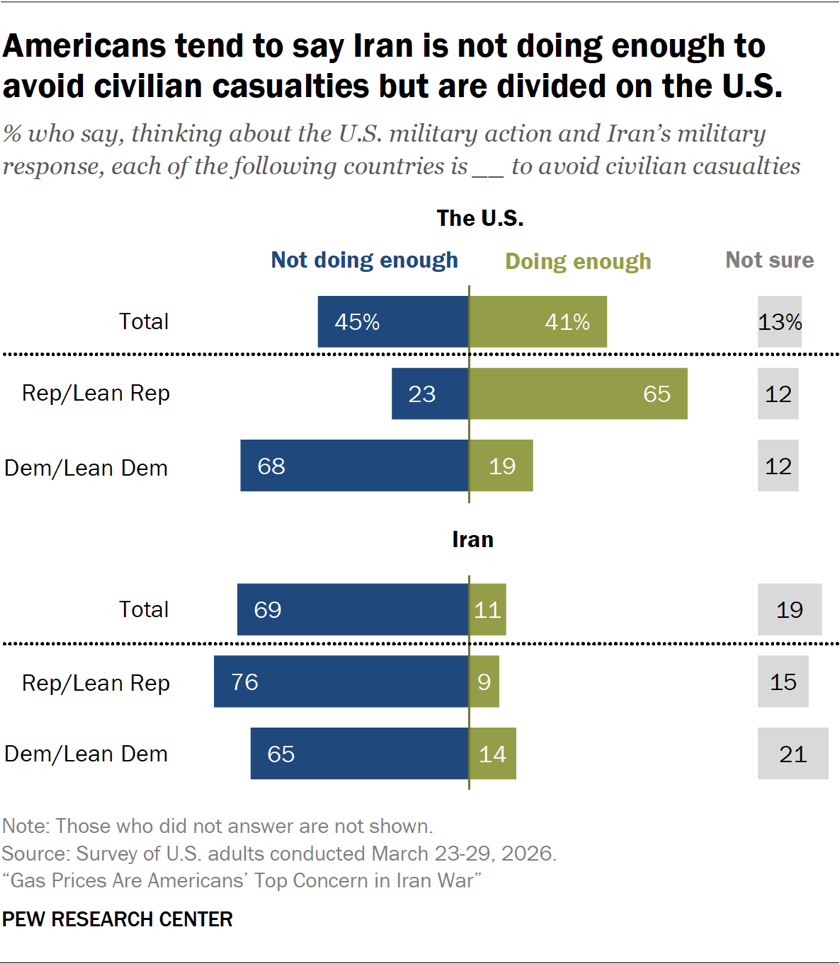
But the public is more divided on the U.S., though slightly more say it is not doing enough to prevent civilian casualties (45%) than say it is doing enough (41%).
Around two-thirds of Democrats (68%) say the U.S. is not doing enough to avoid civilian casualties, compared with 23% of Republicans.
Younger Republicans are more likely than older Republicans to say that the U.S. is not doing enough to avoid civilian casualties. Around one-third of Republicans ages 18 to 29 (35%) say this is the case, compared with 13% of those ages 65 and older.
Among Democrats, there are no significant age differences on this question.
What are the projected outcomes of the war?
Americans are evenly divided on whether U.S. military action will hinder Iran’s ability to develop a nuclear weapon. But more predict the conflict will leave the Iranian people worse off, rather than better off, in the long run. Younger Americans and Democrats tend to be more skeptical of the outcomes of military action.
Likelihood of Iran developing a nuclear weapon
There are no real differences in the shares of Americans who say Iran will be more likely (27%), less likely (27%) or about as likely as before (29%) to develop a nuclear weapon.
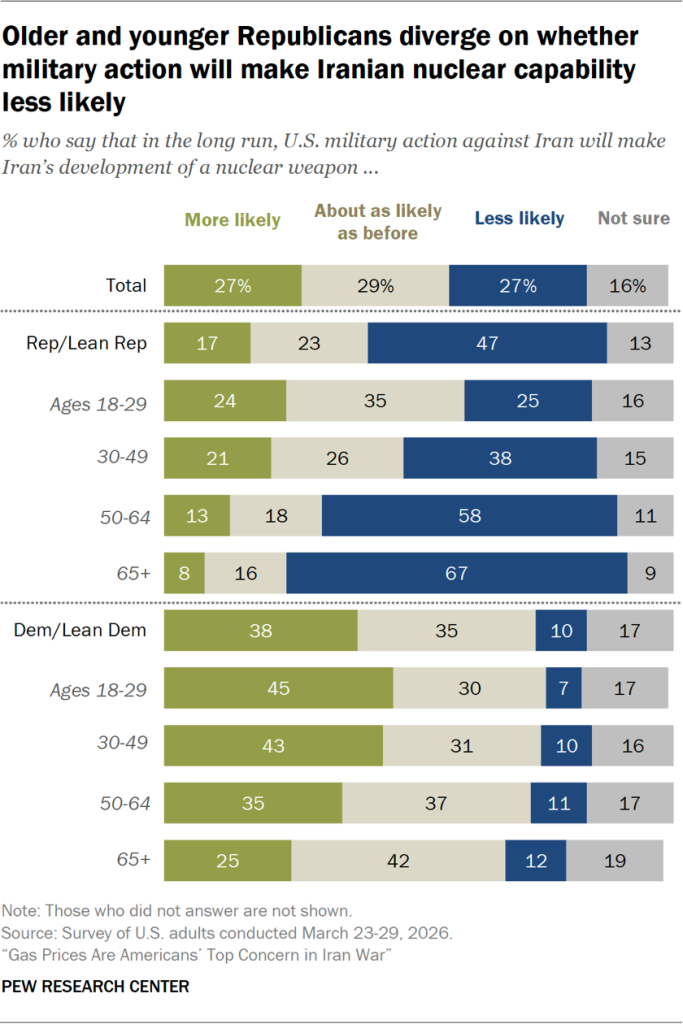
Republicans are nearly five times more likely than Democrats to say this will be less likely in the long run (47% vs. 10%). In contrast, 17% of Republicans and 38% of Democrats expect Iran will be more likely to develop a nuclear weapon than before.
Republicans ages 65 and older are significantly more likely than those ages 18 to 29 to say Iran will be less likely to develop a nuclear weapon (67% vs. 25%).
Democrats ages 18 to 29 are more likely than those ages 65 and older to say this is more likely (45% vs. 25%).
Impact of the conflict on the Iranian people
When it comes to the ultimate outcome of U.S. military action, 36% of Americans say that the Iranian people will be worse off. A quarter say the Iranian people will be better off, and 16% expect no change.
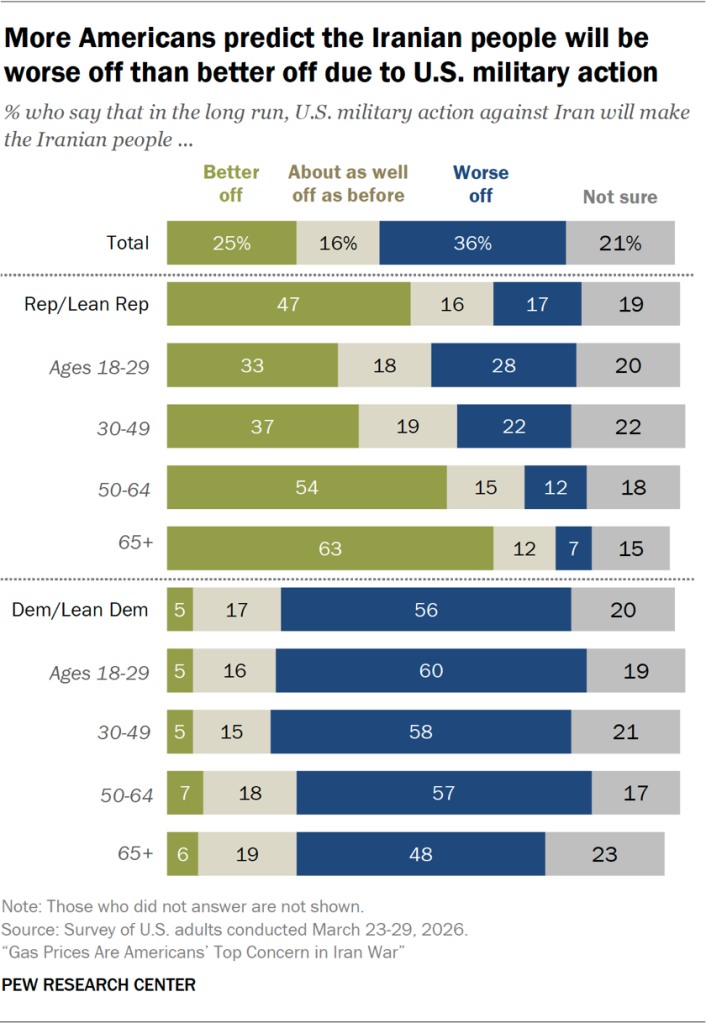
Just under half of Republicans (47%) expect the Iranian people to be better off as a result of U.S. military action, while just 5% of Democrats agree. A majority of Democrats (56%) expect the Iranian people to be worse off, as do 17% of Republicans.
Again, there are age differences within each party, but the contrast is much more stark among Republicans: Around six-in-ten Republicans ages 65 and older (63%) say the Iranian people will be better off in the long run, compared with 33% of those ages 18 to 29.