Most U.S. Catholics view Pope Leo favorably; many think Trump has been too critical of him
About eight-in-ten U.S. Catholics view Pope Leo XIV favorably, though opinions on the tension between Leo and President Trump split sharply along party lines.
Numbers, Facts and Trends Shaping Your World
Read our research on:

All
Publications
About eight-in-ten U.S. Catholics view Pope Leo XIV favorably, though opinions on the tension between Leo and President Trump split sharply along party lines.
The number of countries with high or very high social hostilities rose for the third year in a row; government interference in worship also increased.
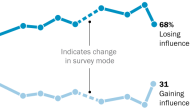
A growing share of U.S. adults say religion is gaining influence, but most still want churches to stay out of politics, a 2026 survey finds.
Among Trump’s strongest supporters, relatively few people say they think he is very religious. Just 8% of Republicans and 5% of White evangelicals say this is the case.
Majorities in Brazil, Colombia and Peru want leaders who stand up for their religious beliefs. Protestants are especially supportive of Christianity in public life.
There has been an 8-percentage point drop since early 2025 in the share of White evangelicals who support all or most of Trump’s plans and policies.
In general, U.S. adults who are Republican or lean toward the GOP are more religious than Democrats and Democratic leaners.
As of 2020, Muslims made up a majority of Nigeria’s total population (56.1%), while Christians made up 43.4%.
Americans’ views of religion’s role in society have grown more positive in recent years. But many feel their religious beliefs conflict with the mainstream.
Around half of Muslim adults (53%) identify with or lean toward the Democratic Party, while 42% identity with or lean toward the Republican Party.