
The Briefing
☀️ Happy Thursday! The Briefing is your guide to the world of news and information. Sign up here!
In today’s email:
- Featured story: White House asks Politico to retract some reporting
- New from Pew Research Center: Where Americans are getting their news in the digital age
- In other news: FCC chairman warns broadcasters against airing “fake polls”
- Looking ahead: C-SPAN to include YouTube creators in election night coverage
- Chart of the week: News consumption across digital platforms
🔥 Featured story
According to a report by Axios, the White House sent a letter this week warning Politico that it must retract or correct recent articles about Chief of Staff Susie Wiles or face consequences including possible legal action. At the center of the dispute: Politico reported last week that President Donald Trump was considering replacing Wiles, which Trump called “fake news.”
In the letter, White House Counsel Will Scharf wrote that “freedom of the press is not a professional exemption from accountability.” Politico is also among three outlets that were banned from the White House last month, prompting legal pushback from the news organizations.
We recently asked Americans whether the U.S. government should be able to force a news organization to take down a story in a few different circumstances. While about half of U.S. adults (51%) say this should be possible in cases where the story contains false information, far fewer say the government should be able to do this if a story clearly favors one political side (14%) or is critical of the government (10%), according to a Pew Research Center survey from the Pew-Knight Initiative.
🚨 New from Pew Research Center
Earlier this week, we added new data from an August 2026 survey to two fact sheets looking at the devices and platforms and social media sites Americans use to get news.
Among the key findings from both fact sheets:
- Digital devices are by far the most common way Americans get news, although a majority (63%) also get news from television at least sometimes.
- Between 2025 and 2026, the share of Americans who say they prefer to get news from television decreased (from 34% to 28%), while the share who prefer social media increased (from 14% to 19%).
- 40% of U.S. adults say they regularly get news on Facebook, and 34% say the same about YouTube.
- Younger adults are much more likely than older people to be regular news consumers on TikTok and Instagram.
Related: 1 in 5 Americans Regularly Get News on TikTok
📌 In other news
- FCC Chairman Brendan Carr warns broadcasters against airing “fake polls”
- Competing newsrooms in Alaska are working together to cover the midterms
- Judge orders Meta to pay $25 billion in Cambridge Analytica data privacy case
- President Trump weighs moving press corps out of the White House; CNN threatens legal action over continued denial of access to Air Force One
- Trump ordered to sit for deposition in BBC defamation lawsuit
- BBC cancels Gen Z-focused nightly news round-up
- Christiane Amanpour to leave CNN after 43 years
- Axel Springer CEO pitches deal to buy TikTok’s European arm
- How CBS News Editor-in-Chief Bari Weiss is involved in coverage of Michigan Senate candidate Abdul El-Sayed
- Washington Post photographer attacked by Israeli settlers in West Bank
📅 Looking ahead
C-SPAN will bring creator-led coverage into its election night lineup, showing YouTube livestreams from The Young Turks and Patrick Bet-David’s PBD Podcast on C-SPAN2 and C-SPAN3. Its flagship channel will continue to offer C-SPAN’s traditional results coverage and nonpartisan analysis.
The move is another example of traditional news outlets implementing newer forms of media into their programming. About one-in-five U.S. adults (21%) regularly get news from news influencers on social media, including 38% of adults under 30, according to a 2025 Center survey from the Pew-Knight Initiative. And the share of Americans who regularly get news on YouTube has risen in recent years (from 23% in 2020 to 34% in 2026).
Both The Young Turks and Bet-David bring a political perspective to their coverage, which is common among news influencers on social media, according to our 2024 study.
📊 Chart of the week
This week’s chart comes from our recently updated news platform fact sheet. It shows how often U.S. adults get news through various digital pathways. More than half say they often or sometimes get news from search engines, news websites and apps, and social media, while about a third say the same about email newsletters and podcasts.
Fewer get news from artificial intelligence chatbots such as ChatGPT or Google Gemini, but these have become a source of news for more Americans in the past year. As of August 2026, 15% say they get news from AI chatbots at least sometimes, up from 9% in 2025.
digital platform …
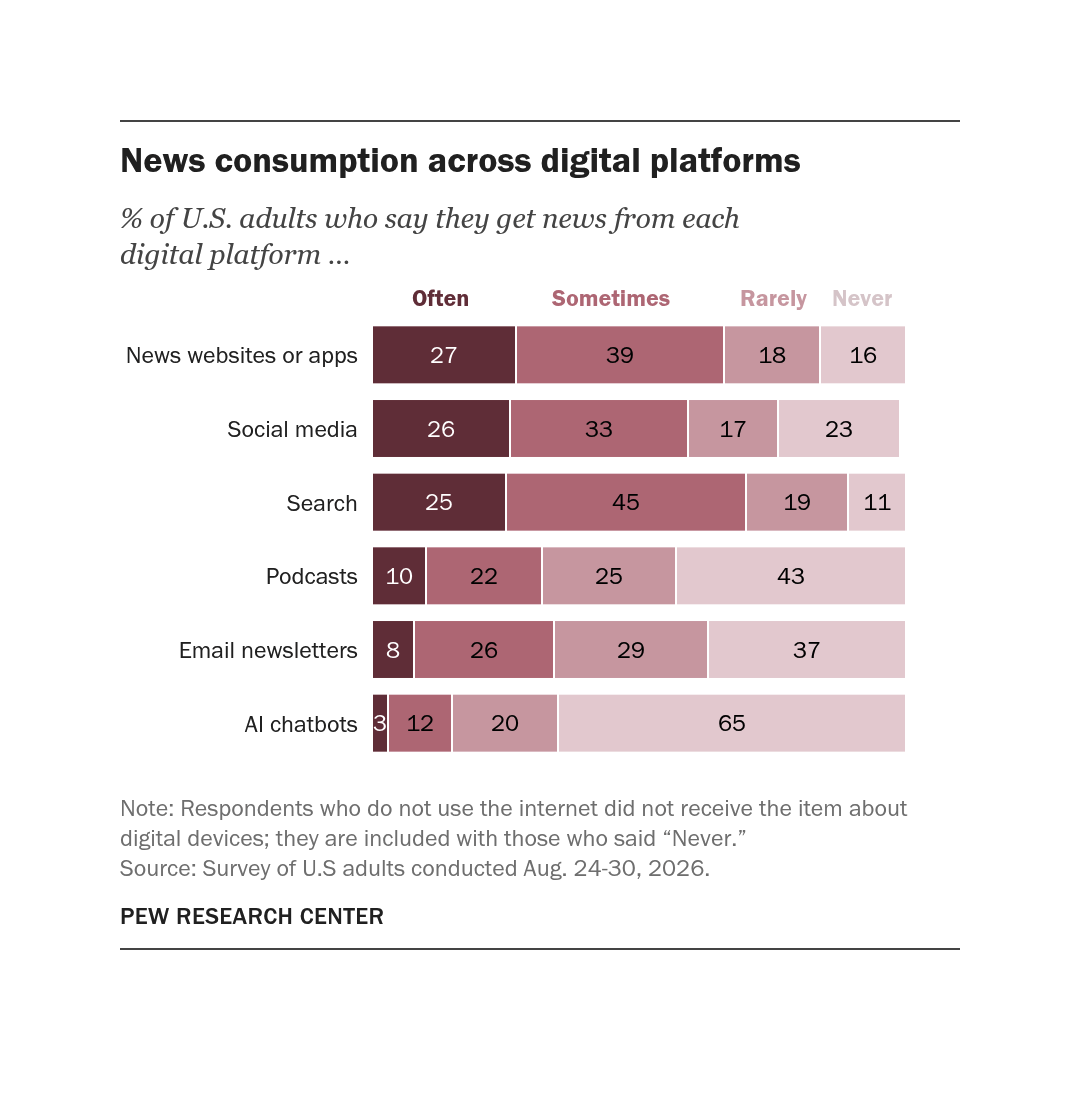
digital platform …
| Often | Sometimes | Rarely | Never | |
|---|---|---|---|---|
| News websites or apps | 27 | 39 | 18 | 16 |
| Social media | 26 | 33 | 17 | 23 |
| Search | 25 | 45 | 19 | 11 |
| Podcasts | 10 | 22 | 25 | 43 |
| Email newsletters | 8 | 26 | 29 | 37 |
| AI chatbots | 3 | 12 | 20 | 65 |
👋 That’s all for this week.
The Briefing is compiled by Pew Research Center staff, including Naomi Forman-Katz, Christopher St. Aubin, Emily Tomasik, Joanne Haner, and Sawyer Reed. It is edited by Michael Lipka and copy edited by David Kent.
Do you like this newsletter? Email us at journalism@pewresearch.org or fill out this two-question survey to tell us what you think.
