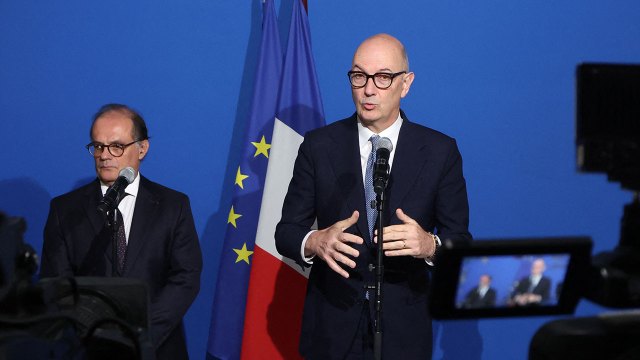
France’s Minister of the Economy, Finance and Industrial, Energy and Digital Sovereignty Roland Lescure, right, and Bank of France Governor Emmanuel Moulin speak to the press on Sept. 15, 2026.
Hundreds of thousands of people in France have taken to the streets in protest in recent weeks. The protesters have cited underfunded and overcrowded schools as a major reason, as the country also deals with a growing debt crisis.
About this research
This Pew Research Center analysis looks at how people in France view their country’s economic situation. It comes amid widespread protests in France.
Why did we do this?
Pew Research Center does research to help the public, media and decision-makers understand important topics. We have studied economic views in countries around the world for more than two decades.
We surveyed 1,006 people in France from Feb. 9 to April 17, 2026. The survey is representative of France’s adult population. Here are the survey questions used for this analysis along with responses, and the survey methodology.
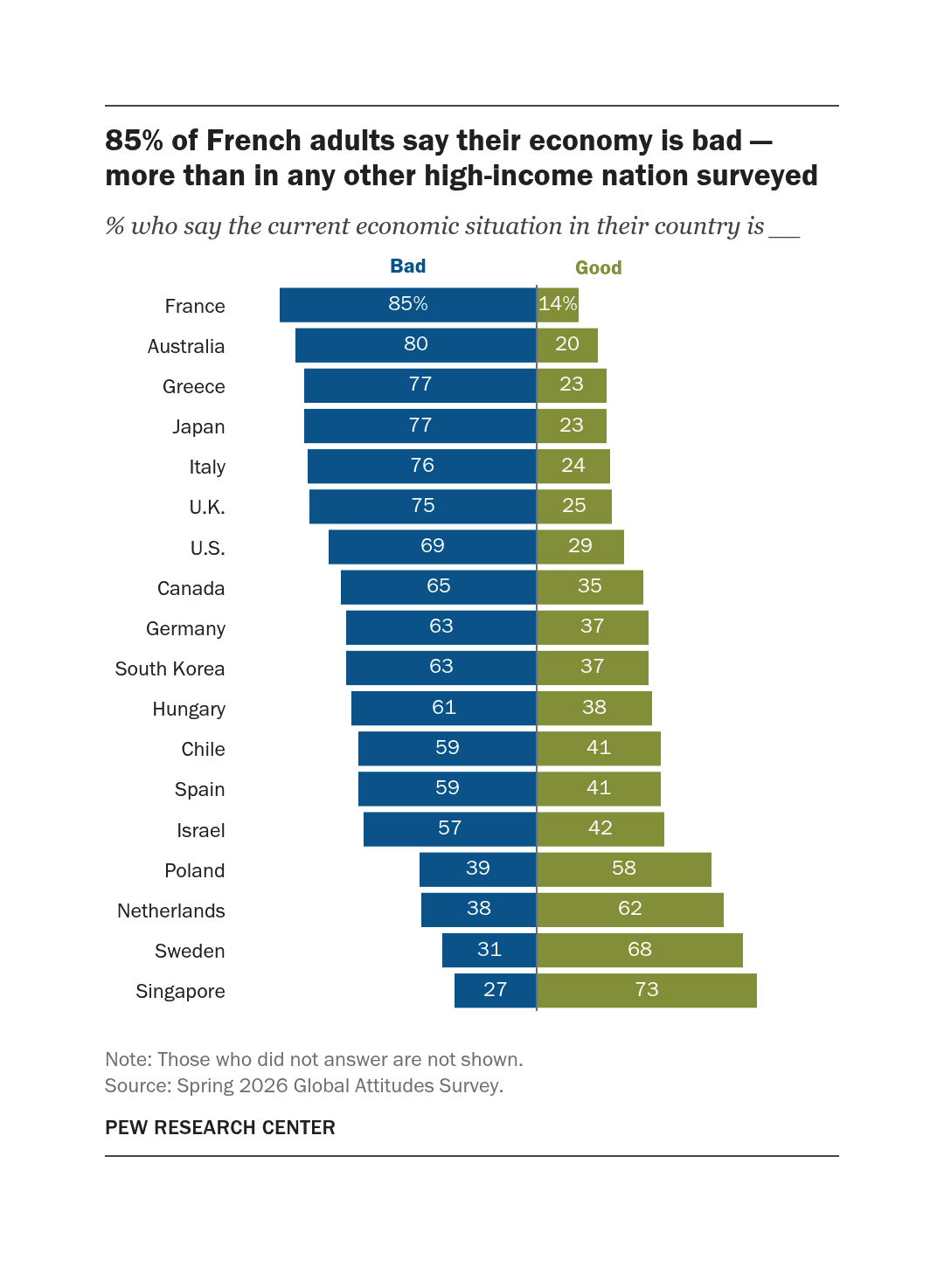
85% of French adults say their economy is bad — more than in any other high-income nation surveyed
% who say the current economic situation in their country is …
Note: Those who did not answer are not shown.
Source: Spring 2026 Global Attitudes Survey.
PEW RESEARCH CENTER
Share this chart
85% of French adults say their economy is bad — more than in any other high-income nation surveyed
% who say the current economic situation in their country is …
In a spring 2026 Pew Research Center survey, 85% of French adults said their country’s economic situation is bad, including about four-in-ten who said it is very bad. Negative views of the economy were more widespread in France than in any of the other 17 high-income countries we surveyed this year.
The share of French adults who express a negative view of the national economy has grown since 2022. French adults rate the economy about as negatively this year as they did in summer 2020, a few months into the COVID-19 pandemic.
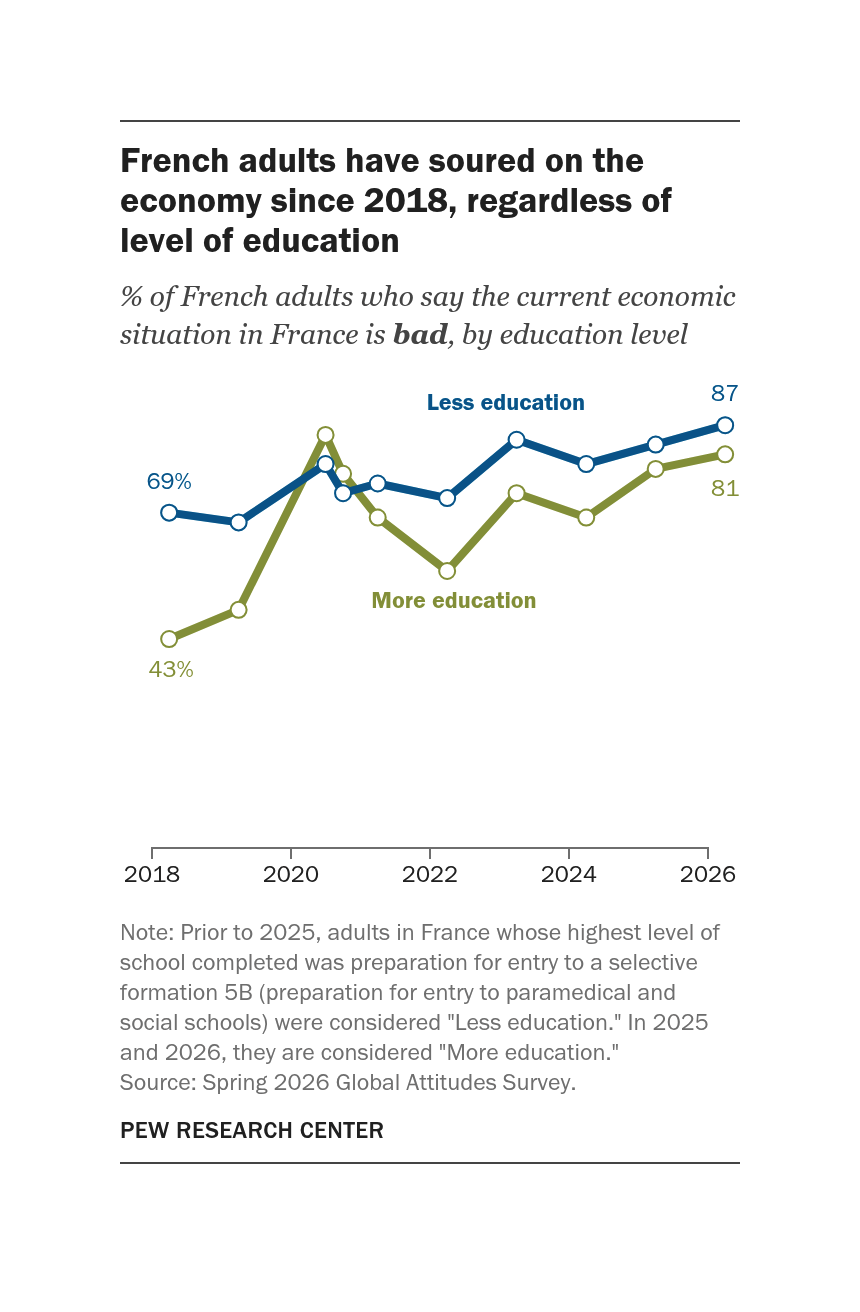
French adults have soured on the economy since 2018, regardless of level of education
% of French adults who say the current economic situation in France isbad, by education level
Note: Prior to 2025, adults in France whose highest level of school completed was preparation for entry to a selective formation 5B (preparation for entry to paramedical and social schools) were counted as “Less education.” In 2025 and 2026, they are counted as “More education.”
Source: Spring 2026 Global Attitudes Survey.
PEW RESEARCH CENTER
Share this chart
French adults have soured on the economy since 2018, regardless of level of education
% of French adults who say the current economic situation in France isbad, by education level
Note: Prior to 2025, adults in France whose highest level of school completed was preparation for entry to a selective formation 5B (preparation for entry to paramedical and social schools) were counted as “Less education.” In 2025 and 2026, they are counted as “More education.”
Source: Spring 2026 Global Attitudes Survey.
PEW RESEARCH CENTER
Across demographic groups, French adults are overwhelmingly negative about the country’s economy. Notably, the youngest French adults in our survey (those ages 18 to 34) and the oldest (those ages 50 and up) are about equally likely to say the economy is bad.
French adults without a postsecondary education are slightly more negative about the economy than adults with more education are. However, this gap has narrowed since 2022.
While ratings of the economy are low across the ideological spectrum, they are particularly low among those on the ideological right, where 91% rate the economy poorly. And among French adults with a favorable view of Marine Le Pen’s right-wing populist party, National Rally, 92% say the economy is bad, including 58% who say it is very bad.