
About eight-in-ten U.S. adults say they are currently taking at least one supplement for their health, according to a new Pew Research Center survey. And most people who do this say supplements are at least somewhat important to their health.
Vitamins and minerals (such as iron, calcium or multivitamins) are by far the most common supplement. Two-thirds of Americans say they are currently taking vitamin or mineral supplements for their health.
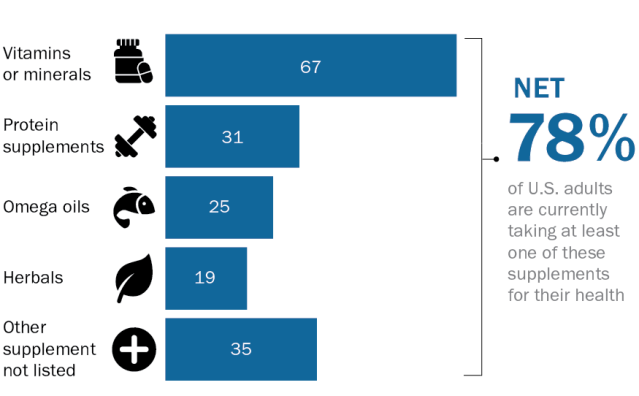
| % | |
|---|---|
| Vitamins or minerals | 67 |
| Protein supplements | 31 |
| Omega oils | 25 |
| Herbals | 19 |
| Other supplements not listed | 35 |
| NET currently taking at least one of these supplements for their health | 78 |
No more than one-third take each of the other specific types of supplements we asked about:
- 31% say they are taking protein supplements (such as protein powders, drinks or bars).
- 25% say they take omega oil supplements (such as omega-3, fish oil or krill oil).
- 19% say they are taking herbal supplements (such as ashwagandha or ginseng).
What is a supplement?
Dietary supplements encompass a wide range of products, from vitamins and minerals to herbals and botanicals. Supplements can come in many forms, including pills, capsules, liquids and powders. Unlike prescription or over-the-counter medicines, supplements do not require Food and Drug Administration approval before they are marketed.
In addition, 35% say they are taking supplements other than the four types we asked about (such as melatonin or probiotics).
Supplements are a booming industry, with an estimated global value of $209.5 billion in 2025. And they’re a common topic of discussion for social media health and wellness influencers, whom Americans are increasingly turning to for information.
Older adults are more likely to take supplements
Older adults are more likely than younger adults to be taking supplements. Among those ages 65 and older, 85% say they do this, compared with 67% of adults under 30.
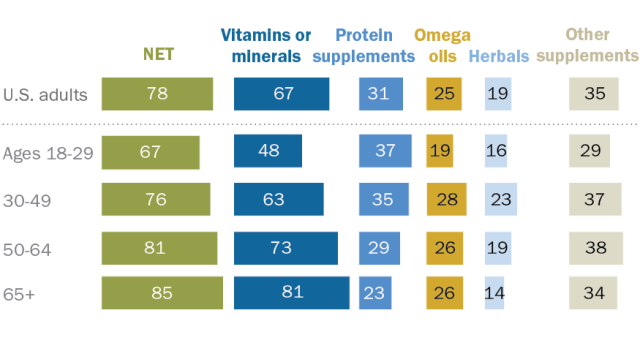
| NET | Vitamins or minerals | Protein supplements | Omega oils | Herbals | Other supplements | |
|---|---|---|---|---|---|---|
| U.S. adults | 78 | 67 | 31 | 25 | 19 | 35 |
| Ages 18-29 | 67 | 48 | 37 | 19 | 16 | 29 |
| 30-49 | 76 | 63 | 35 | 28 | 23 | 37 |
| 50-64 | 81 | 73 | 29 | 26 | 19 | 38 |
| 65+ | 85 | 81 | 23 | 26 | 14 | 34 |
This gap is largely due to age differences among those who take vitamins or minerals. Most adults 65 and older (81%) take vitamins or minerals, compared with 48% of adults under 30. Older people may need more of some vitamins and minerals, like calcium and vitamin D, than younger folks do.
One type of supplement that younger adults are more likely to take? Protein supplements. Roughly a third or more of adults ages 18 to 29 (37%) and 30 to 49 (35%) say they are taking protein supplements. A smaller share of adults 65 and older (23%) say the same.
With the rise of “protein maxxing” on social media and updated federal dietary guidelines that emphasize protein, protein marketing and additives are seemingly everywhere.
There are smaller differences by age for omega oils, herbals and other supplements.
Other demographic differences
Women are slightly more likely than men to say they are currently taking supplements (82% vs. 74%). This difference is driven by women being more likely than men to take vitamins or minerals, herbals, and other supplements. Women are also more likely than men to spend money on supplements, and they spend more on healthcare in general.
In addition, Asian adults are particularly likely to say they are taking omega oils. Four-in-ten Asian adults say they are taking these kinds of supplements, compared with about a quarter of Hispanic, Black and White adults.
Read the table below for more on these detailed breaks.
How essential do Americans think supplements are to their health?
Whether supplements are beneficial or not has long been debated. Many medical professionals advise caution.
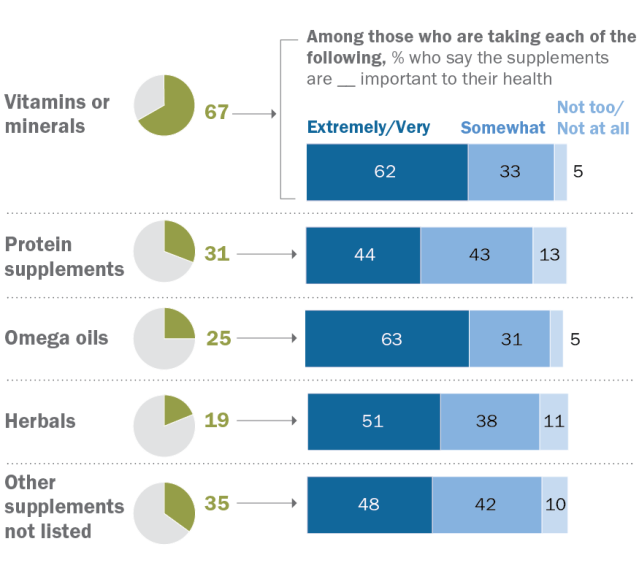
| Vitamins or minerals | Protein supplements | Omega oils | Herbals | Other supplements not listed | |
|---|---|---|---|---|---|
| % | 67 | 31 | 25 | 19 | 35 |
| Among those who are taking each of the above, % who say the supplements are __ important to their health | |||||
| Extremely/Very | 62 | 44 | 63 | 51 | 48 |
| Somewhat | 33 | 43 | 31 | 38 | 42 |
| Not too/Not at all | 5 | 13 | 5 | 11 | 10 |
In our survey, Americans who take supplements largely see them as at least somewhat important for their health.
They’re especially likely to say this about vitamins or minerals. Two-thirds of Americans take vitamins or minerals, and a majority of those who do (62%) say they are extremely or very important to their health. Another 33% who take these supplements say they are somewhat important to their health.
Similarly, 63% of those who take omega oils find them extremely or very important to their health. (Adults are much less likely to say they’re currently taking omega oil supplements than vitamin and minerals, though.)
Fewer of those who take herbals (51%) or protein supplements (44%) say these things are extremely or very important for their health.
Detailed table
| NET currently taking any supplements | Vitamins or minerals | Protein supplements | Omega oils | Herbals | Other supplements not listed | |
|---|---|---|---|---|---|---|
| U.S. adults | 78 | 67 | 31 | 25 | 19 | 35 |
| Men | 74 | 61 | 30 | 24 | 16 | 30 |
| Women | 82 | 72 | 33 | 27 | 21 | 40 |
| White | 79 | 70 | 32 | 23 | 16 | 37 |
| Hispanic | 73 | 58 | 32 | 27 | 22 | 32 |
| Black | 77 | 65 | 30 | 23 | 24 | 32 |
| Asian* | 82 | 70 | 29 | 40 | 19 | 34 |
| Postgrad | 82 | 75 | 36 | 29 | 20 | 41 |
| College grad | 81 | 70 | 37 | 27 | 18 | 38 |
| Some college | 78 | 67 | 33 | 25 | 21 | 38 |
| HS or less | 74 | 61 | 24 | 23 | 17 | 29 |
| Upper income | 85 | 75 | 40 | 27 | 18 | 42 |
| Middle income | 78 | 67 | 31 | 25 | 18 | 37 |
| Lower income | 74 | 61 | 28 | 24 | 21 | 30 |
Note: NET figure is those who said they are currently taking at least one of the types of supplements we asked about. Read the topline for full question wording. White, Black and Asian adults include those who report being only one race and are not Hispanic. Hispanic adults are of any race. Family income tiers are based on adjusted 2024 earnings.
Note: Here are the survey questions used for this analysis, the detailed responses and the survey methodology.