
☀️ Happy Thursday! The Briefing is your guide to the world of news and information. Sign up here!
In today’s email:
- Featured story: Theories of voter fraud swirl around LA mayoral race
- New from Pew Research Center: How informed do Americans feel about key news topics?
- In other news: Paramount CEO promises editorial independence for 60 Minutes
- Looking ahead: World Cup starts today
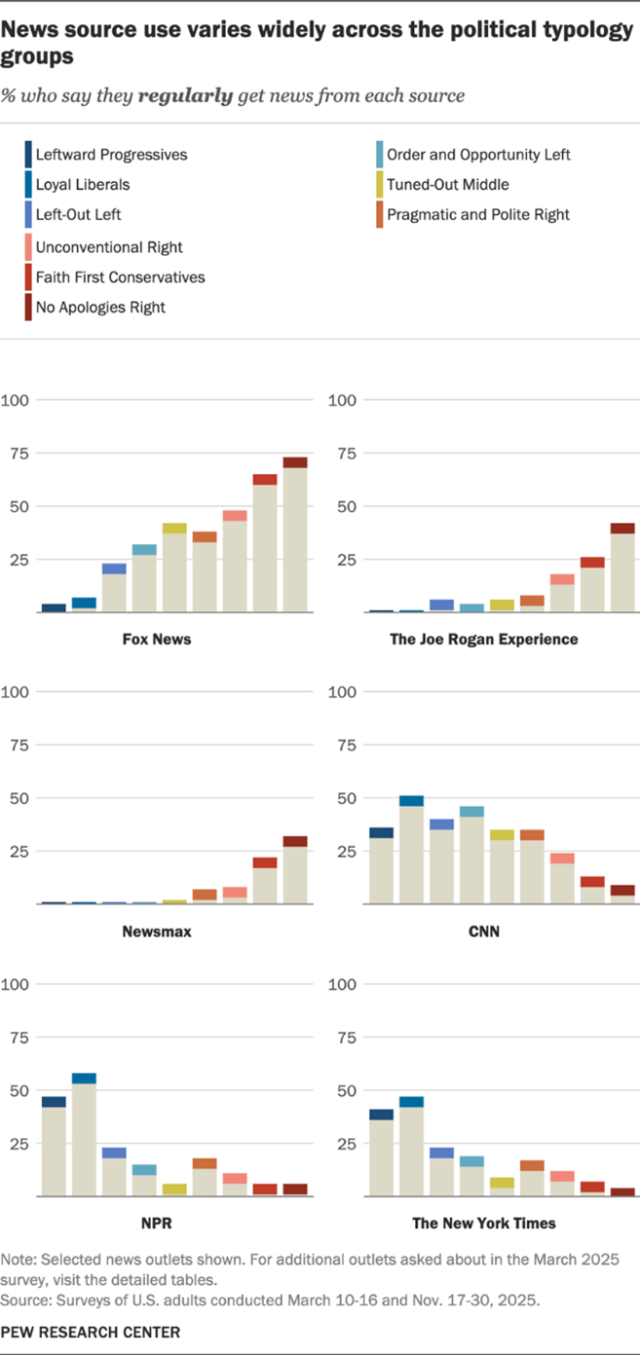
- Chart of the week: How news sources differ across political typology groups
🔥 Featured story
Incumbent Karen Bass and fellow Democrat Nithya Raman have advanced to the runoff election for Los Angeles mayor. Raman overtook Republican Spencer Pratt in votes as mail-in ballots were processed after Election Day.
But President Donald Trump, Elon Musk and others have questioned the race results – especially following a set of Associated Press updates that showed thousands of new votes for Bass and Raman but none for Pratt, then vice versa. The Department of Justice reviewed official county records and debunked claims of anomalies.
Many Americans say it’s hard for them to assess election-related news. When asked about the 2024 presidential election in September of that year, about half of U.S. adults (52%) said it is difficult to determine what’s true and what isn’t when getting news about campaigns, with Republicans and GOP leaners especially likely to express this view (61%).
Republican voters have expressed skepticism that mail-in ballots would be counted as intended ahead of elections in 2022 and 2024 (though their confidence increased dramatically after the 2024 election).
🚨 New from Pew Research Center
While most U.S. adults say it is important for individual Americans to stay informed about a variety of news topics related to politics and policy, far fewer say they are highly informed about these topics themselves, according to a new Pew Research Center analysis. For example, 75% say it is extremely or very important for people to be informed about economic and tax policies, but just 24% say they are extremely or very informed about the topic personally.
📌 In other news
- Paramount CEO David Ellison promises editorial independence for 60 Minutes after turmoil
- New York passes law requiring disclosures on AI use in news content
- German court rules Google liable for false claims in AI Overviews
- Meta plans to use activity from other websites to personalize user feeds and AI responses
- Maryland governor vetoes bill that would require government to spend advertising dollars with local news outlets
- The White House will be closed to reporters Sunday during UFC fight, unless UFC grants access
- Trump will ask Supreme Court to revive defamation lawsuit against CNN over the use of the phrase “big lie” to describe his 2020 election claims
- Trump walks out of interview with NBC’s Meet the Press
- New study shows “hard news” is more likely to prompt local news readers to subscribe
- Laid-off Eater journalists found a new food media outlet centering paying subscribers instead of search traffic
📅 Looking ahead
The 2026 FIFA World Cup opens today with a game between Mexico and South Africa. As the United States, Mexico and Canada co-host the 48-team tournament, journalists and content creators have no shortage of angles for coverage – from match outcomes to ticket prices, geopolitical tensions and potential protests.
In the U.S., 28% of adults say they are at least somewhat likely to follow the World Cup, according to a March Pew Research Center survey, with some groups especially likely to do so. For instance, 54% of immigrants in the U.S. say they will follow the action, compared with 23% of U.S.-born adults. Asian (44%) and Hispanic (42%) adults are more likely than Black (29%) and White (23%) Americans to say they will be paying attention.
📊 Chart of the week
This week’s chart comes from Pew Research Center’s 2026 political typology, which divides Americans into nine distinct ideological groups based on their political values and beliefs. People across these groups differ in whether they regularly get news from several major news sources.
Read the full 2026 typology report, take the political typology quiz and learn more about this project.
👋 That’s all for this week.
The Briefing is compiled by Pew Research Center staff, including Naomi Forman-Katz, Christopher St. Aubin, Emily Tomasik, Joanne Haner, and Sawyer Reed. It is edited by Michael Lipka and copy edited by Anna Jackson.
Do you like this newsletter? Email us at journalism@pewresearch.org or fill out this two-question survey to tell us what you think.
