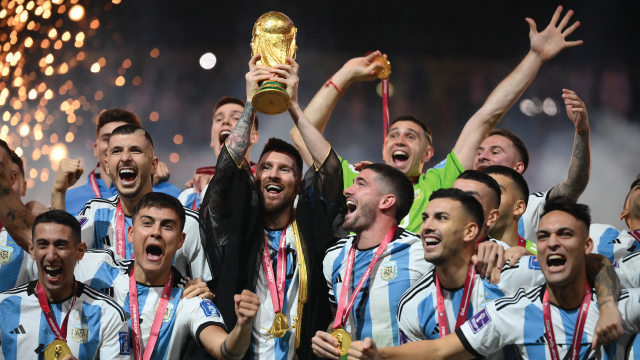
Before the men’s soccer World Cup kicks off on June 11 in the United States, Mexico and Canada, we asked 3,507 Americans how likely they are to follow the competition and who they think will win.
Overall, most Americans (66%) say they are not too or not at all likely to follow the competition. However, 28% say they are at least somewhat likely to follow it, including 14% who say they are very or extremely likely to do so.
We fielded this survey in March, nearly three months before the tournament begins, so interest in the World Cup might look different closer to the tournament. But these results are broadly consistent with a 2023 Pew Research Center survey that found that many Americans don’t follow sports closely.
Who do Americans predict will win the World Cup?
| Team | % |
|---|---|
| Spain | 9 |
| Brazil | 8 |
| Argentina | 8 |
| U.S. | 7 |
| France | 7 |
| Germany | 4 |
| Portugal | 3 |
| Mexico | 3 |
| England | 2 |
| Not sure | 41 |
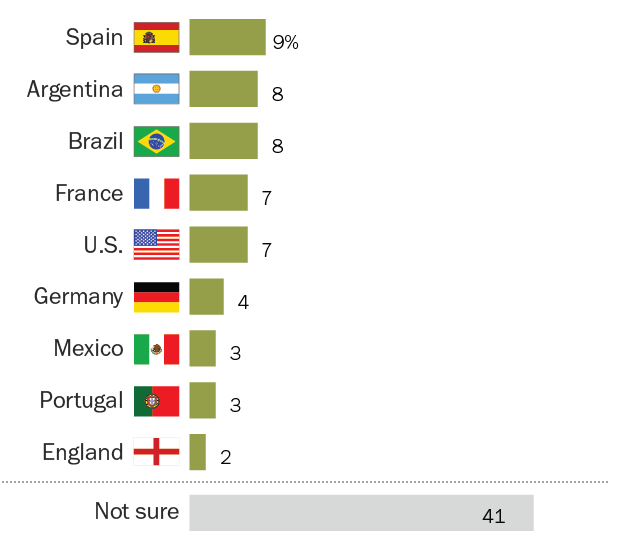
Among the 28% of Americans who are at least somewhat likely to follow the games, there is no consensus on who will win. In an open-ended question, a large share (41%) said they are unsure of who they think will win, and those who offered a prediction are divided.
Around one-in-ten (9%) of those planning to watch the men’s World Cup say they expect Spain to win. That would be the country’s second title.
Another 8% expect Argentina to repeat as the champion. And the same share say Brazil will win, which would be its sixth title.
France received 7% of responses, and another 7% predict the U.S. will win its first men’s World Cup.
Smaller shares predicted that Germany, Mexico, Portugal or England will win.
Who is planning to follow the World Cup?
Note: White, Black and Asian adults include those who report being only one race and are not Hispanic. Hispanics are of any race.
| Group | % | Grouping |
|---|---|---|
| Total | 28 | Total |
| Men | 33 | Gender |
| Women | 24 | Gender |
| White | 23 | Race |
| Hispanic | 42 | Race |
| Black | 29 | Race |
| Asian* | 44 | Race |
| Ages 18-29 | 31 | Age |
| 30-49 | 31 | Age |
| 50-64 | 28 | Age |
| 65+ | 22 | Age |
| U.S. born | 23 | Origin |
| Immigrant | 54 | Origin |
Note: White, Black and Asian adults include those who report being only one race and are not Hispanic. Hispanics are of any race.
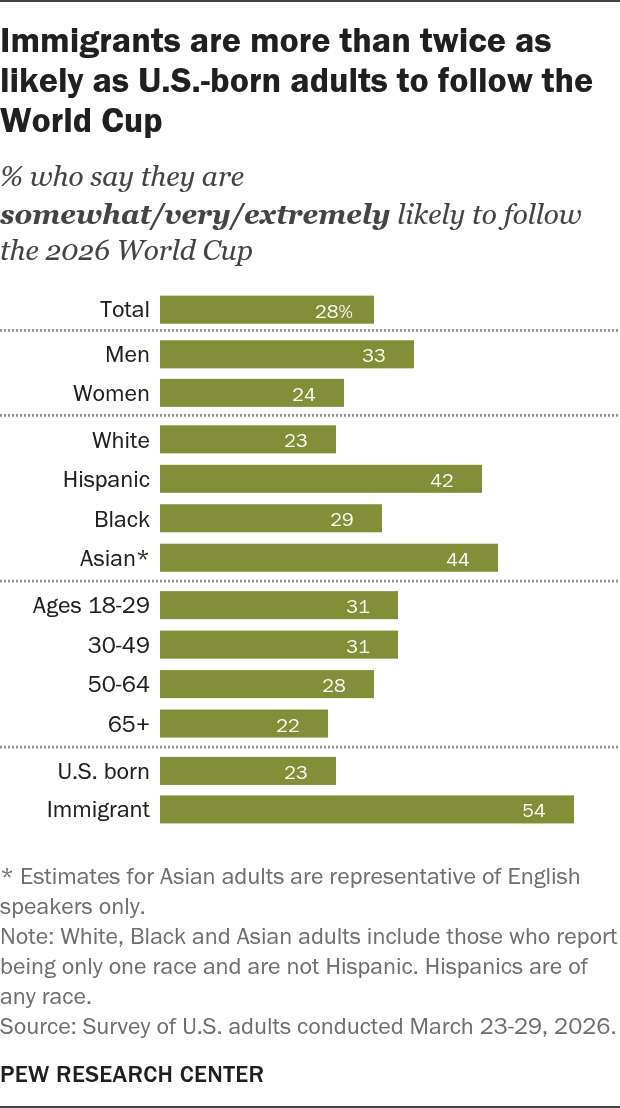
Although most Americans are unlikely to follow the World Cup, about three-in-ten expect to follow it. Some groups are more likely than others to say this.
For instance, men are slightly more likely than women to say they are at least somewhat likely to follow the tournament. Adults ages 18 to 64 are also more likely than those 65 and older to say they’ll follow it.
Additionally, Hispanic and Asian Americans are more likely than White and Black Americans to say they’ll pay attention to the tournament. And immigrants (54%) are much more likely than U.S.-born adults (23%) to say this.
Related: By a wide margin, Americans say football – not baseball – is ‘America’s sport’
Note: Here are our survey questions, the detailed responses and our survey methodology.