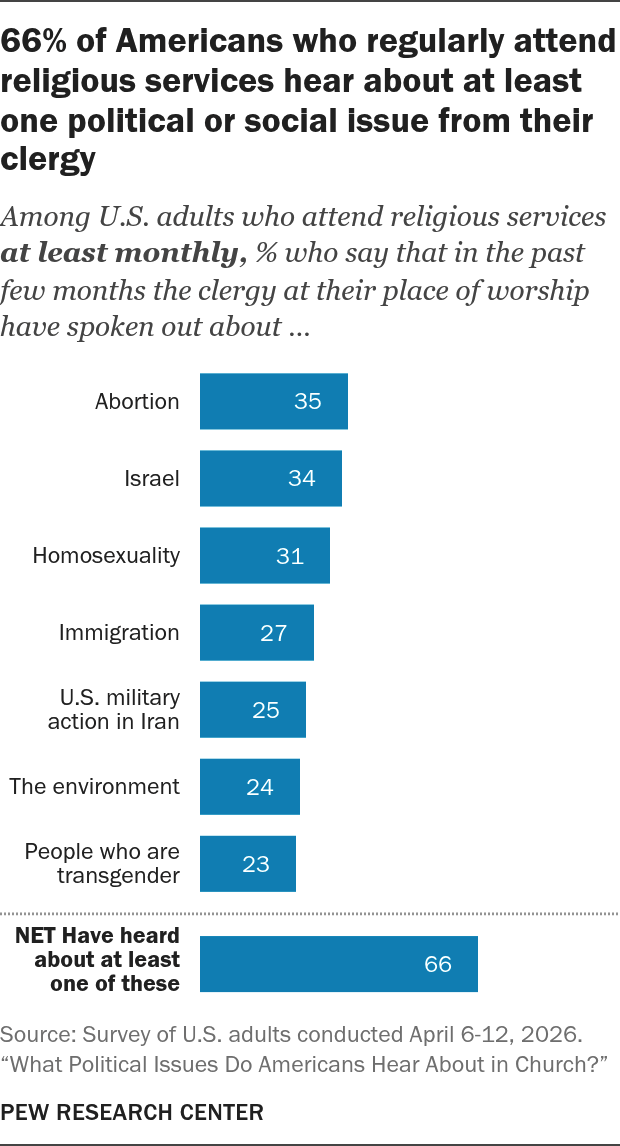
A new Pew Research Center survey finds that two-thirds of U.S. adults who regularly attend religious services say they have heard their clergy speak about at least one political or social issue in the past few months. Of the seven topics we asked about, abortion, Israel and homosexuality were among the most commonly cited.
“What Political Issues Do Americans Hear About in Church?”
| Issue | Percent | Category |
|---|---|---|
| Abortion | 35 | 1 |
| Israel | 34 | 1 |
| Homosexuality | 31 | 1 |
| Immigration | 27 | 1 |
| U.S. military action in Iran | 25 | 1 |
| The environment | 24 | 1 |
| People who are transgender | 23 | 1 |
| NET Have heard about at least one of these | 66 | 2 |
“What Political Issues Do Americans Hear About in Church?”
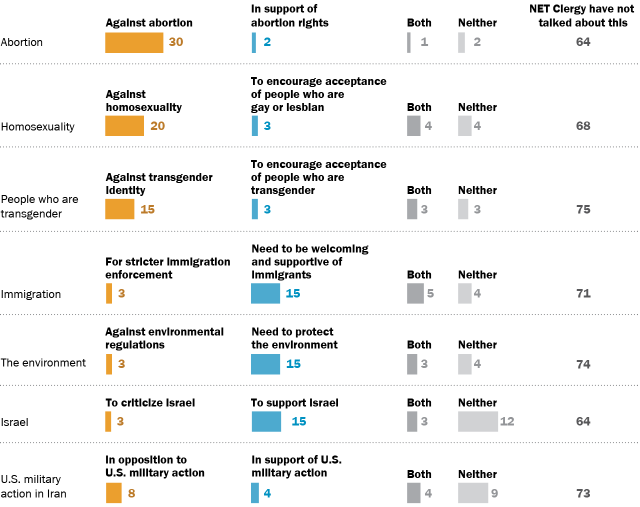
When people hear their minister, priest, rabbi or other clergyperson speak out about these topics, they report that they tend to hear messages against abortion, against homosexuality or in support of Israel. Fewer Americans say they’ve recently heard the clergy at their place of worship speak in favor of abortion rights, encourage acceptance of people who are gay or lesbian, or criticize Israel.
The nationwide survey, conducted April 6-12, 2026, included 1,391 U.S. adults who say they go to religious services at least once or twice a month. We also asked respondents about four additional social and political issues, spanning topics such as immigration and U.S. military action in Iran.
On these topics, we found that Americans who regularly attend religious services hear more about:
- The need to welcome and support immigrants (15%) than the need for stricter immigration enforcement (3%)
- Protecting the environment (15%) than opposing environmental regulations (3%)
- Opposing transgender identity (15%) than accepting people who are transgender (3%)
The messages from American pulpits appear to be more mixed when it comes to U.S. military action in Iran. About one-in-ten regular attenders (8%) say they have recently heard their clergy speak in opposition to the U.S. military action in Iran, while 4% say their religious leaders have spoken in support of it. An additional 9% report that their clergy have talked about the conflict without supporting or opposing it.
“What Political Issues Do Americans Hear About in Church?”
| Against abortion | In support of abortion rights | Both | Neither | NET Clergy have not talked about this | |
|---|---|---|---|---|---|
| Abortion | 30 | 2 | 1 | 2 | 64 |
| Against homosexuality | To encourage acceptance of people who are gay or lesbian | Both | Neither | NET Clergy have not talked about this | |
| Homosexuality | 20 | 3 | 4 | 4 | 68 |
| Against transgender identity | To encourage acceptance of people who are transgender | Both | Neither | NET Clergy have not talked about this | |
| People who are transgender | 15 | 3 | 3 | 3 | 75 |
| For stricter immigration enforcement | Need to be welcoming and supportive of immigrants | Both | Neither | NET Clergy have not talked about this | |
| Immigration | 3 | 15 | 5 | 4 | 71 |
| Against environmental regulations | Need to protect the environment | Both | Neither | NET Clergy have not talked about this | |
| The environment | 3 | 15 | 3 | 4 | 74 |
| To criticize Israel | To support Israel | Both | Neither | NET Clergy have not talked about this | |
| Israel | 3 | 15 | 3 | 12 | 64 |
| In opposition to U.S. military action | In support of U.S. military action | Both | Neither | NET Clergy have not talked about this | |
| U.S. military action in Iran | 8 | 4 | 4 | 9 | 73 |
“What Political Issues Do Americans Hear About in Church?”
The survey also shows that many Americans are not sure whether the leaders of their religious congregations are Republicans or Democrats.
Among people who attend services at least once or twice a month, 19% say they think their clergy are mostly Republicans, while 8% think their clergy are mostly Democrats. But most either think their clergy are politically mixed (27%) or say they’re unsure about their clergy’s political leanings (44%).
How religious groups differ in what they hear from their clergy
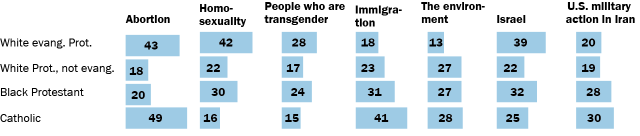
Among U.S. adults who attend religious services at least monthly, Catholics and White evangelical Protestants are the most likely to say their clergy have spoken recently about abortion.
In addition, White evangelicals are especially likely to say they hear their clergy talk about homosexuality. And Catholics stand out for hearing immigration discussed in their churches.
By contrast, White evangelicals are less likely than others to say their clergy discuss environmental issues. About one-in-ten White evangelicals say they’ve recently heard their clergy talk about the environment, compared with about a quarter of regular attenders who belong to other major Christian denominations.
“What Political Issues Do Americans Hear About in Church?”
| Abortion | Homosexuality | People who are transgender | Immigration | The environment | Israel | U.S. military action in Iran | |
|---|---|---|---|---|---|---|---|
| White evang. Prot. | 43 | 42 | 28 | 18 | 13 | 39 | 20 |
| White Prot., not evang. | 18 | 22 | 17 | 23 | 27 | 22 | 19 |
| Black Protestant | 20 | 30 | 24 | 31 | 27 | 32 | 28 |
| Catholic | 49 | 16 | 15 | 41 | 28 | 25 | 30 |
“What Political Issues Do Americans Hear About in Church?”
(The survey was open to people of all religions, but there are not enough respondents from other religious groups – such as Jews, Muslims, Buddhists or Hindus – who regularly attend religious services to be able to analyze their responses separately. Read more on why we typically can’t report the views of smaller U.S. religious groups.)
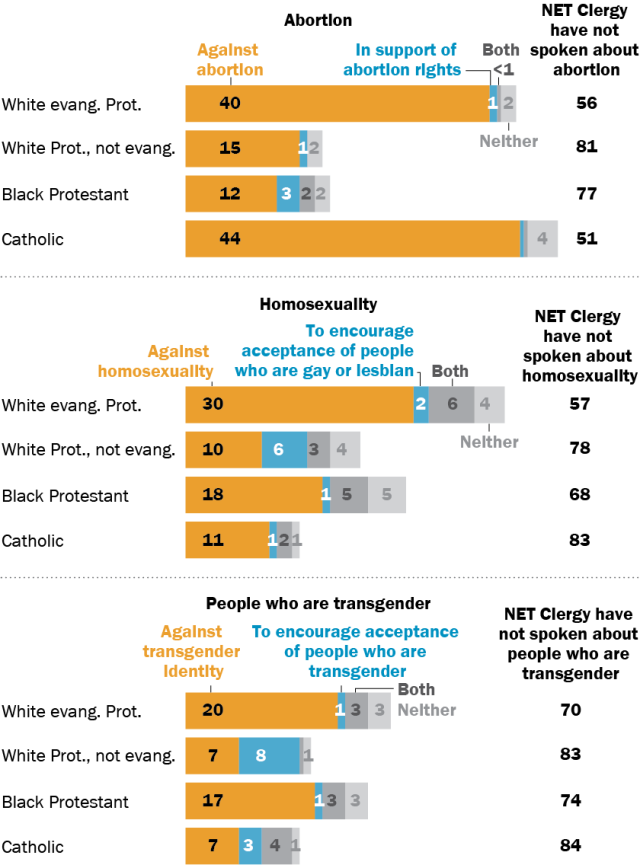
Regular attenders in most of the large U.S. religious groups we can analyze are more likely to say their clergy have spoken out against abortion, homosexuality and transgender identity than in support of abortion rights or accepting people who are gay, lesbian or transgender.
“What Political Issues Do Americans Hear About in Church?”
| Against abortion | In support of abortion rights | Both | Neither | NET Clergy have not spoken about abortion | |
|---|---|---|---|---|---|
| White evang. Prot. | 40 | 1 | <1 | 2 | 56 |
| White Prot., not evang. | 15 | 1 | 0 | 2 | 81 |
| Black Protestant | 12 | 3 | 2 | 2 | 77 |
| Catholic | 44 | <1 | <1 | 4 | 51 |
| Against homo-sexuality | To encourage acceptance of people who are gay or lesbian | Both | Neither | NET Clergy have not spoken about homo-sexuality | |
| White evang. Prot. | 30 | 2 | 6 | 4 | 57 |
| White Prot., not evang. | 10 | 6 | 3 | 4 | 78 |
| Black Protestant | 18 | 1 | 5 | 5 | 68 |
| Catholic | 11 | 1 | 2 | 1 | 83 |
| Against trans-gender identity | To encourage acceptance of people who are transgender | Both | Neither | NET Clergy have not spoken about people who are transgender | |
| White evang. Prot. | 20 | 1 | 3 | 3 | 70 |
| White Prot., not evang. | 7 | 8 | <1 | 1 | 83 |
| Black Protestant | 17 | 1 | 3 | 3 | 74 |
| Catholic | 7 | 3 | 4 | 1 | 84 |
“What Political Issues Do Americans Hear About in Church?”
White nonevangelical Protestants are the exception: They are as likely to say their clergy urge acceptance of gay, lesbian and transgender people as to say they hear messages from the pulpit against homosexuality or against transgender identity.1
“What Political Issues Do Americans Hear About in Church?”
| For stricter immigration enforcement | The need to be welcoming and supportive of immigrants | Both | Neither | NET Clergy have spoken about immigration | |
|---|---|---|---|---|---|
| White evang. Prot. | 4 | 4 | 6 | 4 | 79 |
| White Prot., not evang. | 3 | 18 | <1 | 2 | 76 |
| Black Protestant | 2 | 20 | 7 | 3 | 67 |
| Catholic | 1 | 29 | 7 | 4 | 58 |
| Against environ-mental regulations | The need to protect the environment | Both | Neither | NET Clergy have spoken about the environment | |
| White evangelical | 1 | 7 | 3 | 3 | 85 |
| White, not evangelical | 0 | 23 | 1 | 3 | 73 |
| Black Protestant | 2 | 13 | 7 | 6 | 71 |
| Catholic | <1 | 18 | 4 | 6 | 72 |
“What Political Issues Do Americans Hear About in Church?”
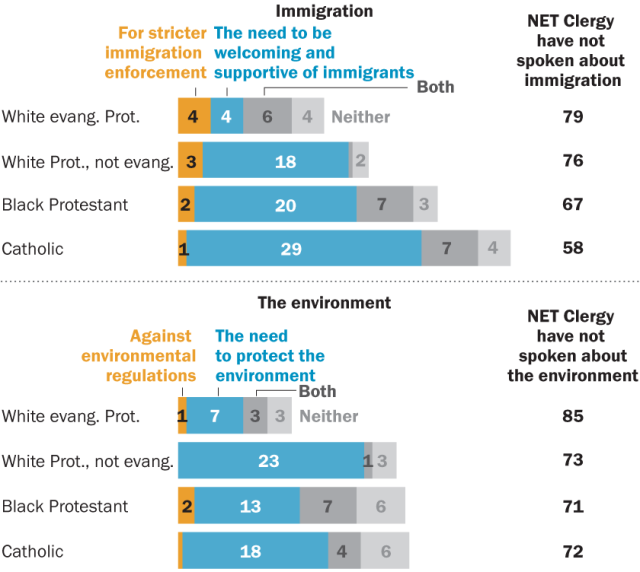
Both Catholics and members of most Protestant subgroups who regularly attend religious services are more likely to say their clergy have spoken in support of immigrants and protecting the environment than to report hearing the alternative.
White evangelicals, on the other hand, are just as likely to say their clergy have called for stricter immigration enforcement (4%) as to say their clergy have talked about needing to welcome and support immigrants (4%).
“What Political Issues Do Americans Hear About in Church?”
| To criticize Israel | To support Israel | Both | Neither | NET Clergy have not spoken about Israel | |
|---|---|---|---|---|---|
| White evang. Prot. | 1 | 24 | 1 | 13 | 58 |
| White Prot., not evang. | 3 | 5 | 1 | 13 | 77 |
| Black Protestant | 3 | 16 | 5 | 7 | 66 |
| Catholic | 2 | 7 | 3 | 13 | 74 |
| In opposition to U.S. military action | In support of U.S. military action | Both | Neither | NET Clergy have not spoken about U.S. military action in Iran | |
| White evang. Prot. | 2 | 7 | 4 | 7 | 78 |
| White Prot., not evang. | 7 | 3 | 1 | 8 | 81 |
| Black Protestant | 10 | 2 | 8 | 7 | 70 |
| Catholic | 12 | 3 | 4 | 10 | 69 |
“What Political Issues Do Americans Hear About in Church?”
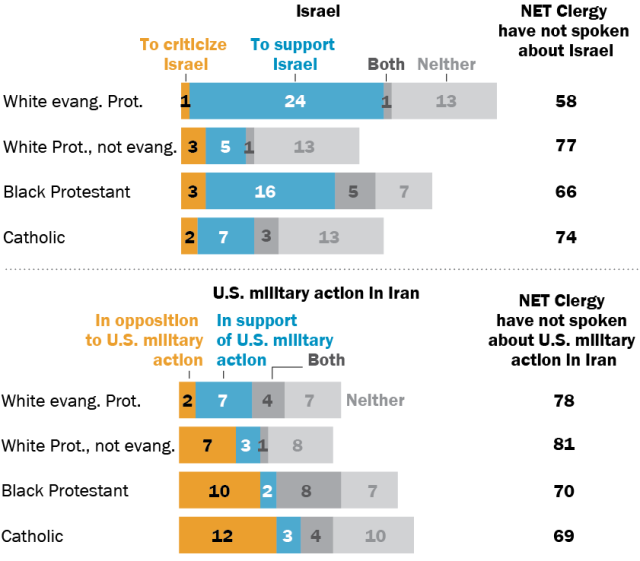
The pattern of messaging on U.S. military action in Iran is somewhat less clear.
Catholics, White nonevangelical Protestants and Black Protestants are about as likely to say their clergy have spoken in opposition to U.S. military action in Iran as they are to say their clergy have spoken about the conflict without either supporting or opposing it.
On Israel, White evangelicals and Black Protestants who attend religious services at least monthly are more likely to say they have heard messages of support, rather than criticism, from their clergy.
But roughly one-in ten adults in most of the large U.S. religious groups analyzed here say they’ve heard their clergy speak about Israel in ways that are neither supportive nor critical.
How regular attenders perceive their clergy’s partisanship
The survey also asked regular attenders whether the clergy or other religious leaders at their place of worship are mostly Republicans, mostly Democrats, or a mix of both.
“What Political Issues Do Americans Hear About in Church?”
| Republicans | Democrats | A mix of both | Not sure | No answer | Group | |
|---|---|---|---|---|---|---|
| All regular attenders | 19 | 8 | 27 | 44 | 1 | 1 |
| White evang. Prot. | 36 | 3 | 25 | 36 | 1 | 2 |
| White Prot., not evang. | 15 | 13 | 26 | 44 | 3 | 2 |
| Black Protestant | 8 | 21 | 25 | 44 | 3 | 2 |
| Catholic | 9 | 2 | 29 | 59 | 1 | 2 |
| Rep/lean Rep | 28 | 3 | 26 | 43 | 1 | 3 |
| Dem/lean Dem | 8 | 16 | 32 | 44 | <1 | 3 |
“What Political Issues Do Americans Hear About in Church?”
Upward of four-in-ten attenders (44%) say they are unsure about their clergy’s political affiliation. About a quarter (27%) say their religious leaders are a mix of both Republicans and Democrats, while fewer say they are either mostly Republicans (19%) or mostly Democrats (8%).
Across groups, some regular attenders stand out:
- 36% of White evangelical Protestants say their clergy are mostly Republicans, while just 3% say they are mostly Democrats.
- 21% of Black Protestants say their clergy are mostly Democrats, while 8% say they are mostly Republicans.
- Self-identified Republicans are more likely to say the religious leaders at their house of worship are mostly Republicans (28%), rather than mostly Democrats (3%).
- Democrats are more likely to say their clergy are mostly Democrats (16%), rather than mostly Republicans (8%).
Still, large shares of regular attenders across groups say the political makeup of their clergy is either mixed or unclear to them.