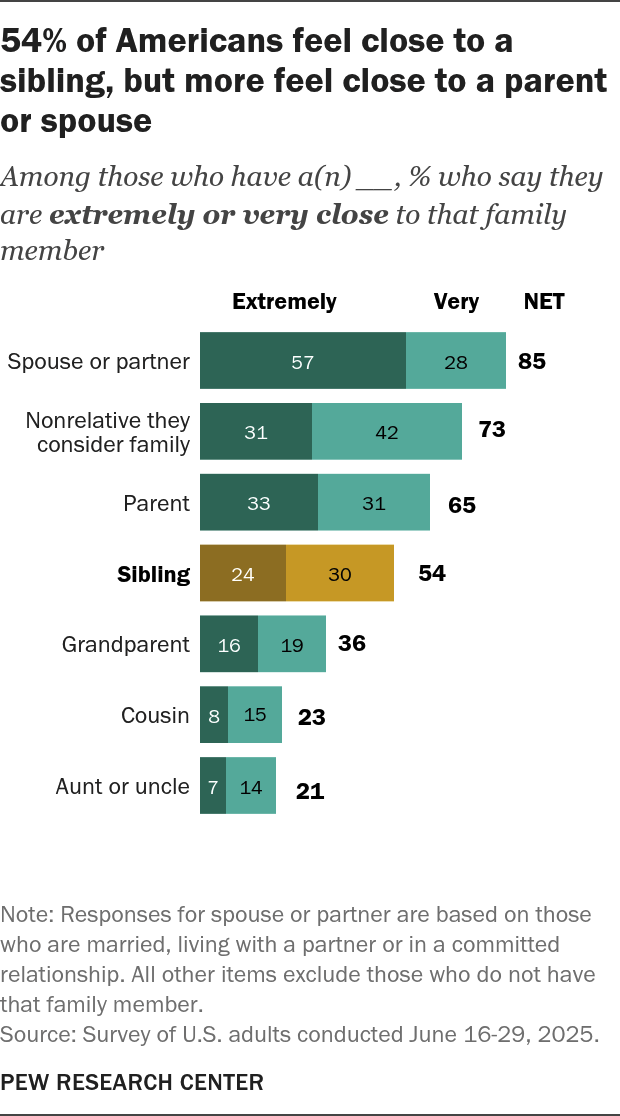
Ahead of National Siblings Day on April 10, about half of U.S. adults who have a sibling say they are extremely (24%) or very (30%) close to at least one, according to a Pew Research Center survey.
| Category | Extremely | Very | NET |
|---|---|---|---|
| Spouse or partner | 57 | 28 | 85 |
| Nonrelative they consider family | 31 | 42 | 73 |
| Parent | 33 | 31 | 65 |
| Sibling | 24 | 30 | 54 |
| Grandparent | 16 | 19 | 36 |
| Cousin | 8 | 15 | 23 |
| Aunt or uncle | 7 | 14 | 21 |
Siblings hold a middle ground in Americans’ family relationships. Americans are more likely to say they are extremely or very close to a spouse or partner (85%), a nonrelative they consider family (73%) or a parent (65%) than a sibling. At the same time, they are more likely to say they are close to a sibling than to a grandparent (36%), cousin (23%), or aunt or uncle (21%).
There are some demographic differences in the shares of Americans who say they are close to a sibling:
- Women (57%) are slightly more likely than men (52%) to say they are extremely or very close to a sibling.
- Black (64%) and Hispanic adults (63%) are more likely than White adults (50%) to say they are close to a sibling. Black adults are also more likely than Asian adults (56%) to say this.
- Adults ages 30 to 64 (50%) are less likely than younger (59%) and older (62%) adults to say this.
Related: Black Americans have close relationships with many family members
Siblings as a source of emotional support
Note: White, Black and Asian adults include those who report being only one race and are not Hispanic. Hispanics are of any race.
| Category | Extremely/very – Sup 1 | Extremely/very – Sup 2 | Category |
|---|---|---|---|
| Total | 38 | 24 | Total |
| Men | 31 | 16 | Gender |
| Women | 44 | 31 | Gender |
| White | 35 | 18 | Race |
| Black | 46 | 38 | Race |
| Hispanic | 45 | 32 | Race |
| Asian* | 34 | 22 | Race |
| Ages 18-29 | 39 | 31 | Age |
| 30-49 | 38 | 26 | Age |
| 50-64 | 35 | 20 | Age |
| 65+ | 39 | 17 | Age |
Note: White, Black and Asian adults include those who report being only one race and are not Hispanic. Hispanics are of any race.
While about half of Americans with siblings say they are close to a sibling, smaller shares say they exchange emotional support with one. About four-in-ten (38%) say they would be extremely or very likely to turn to their sibling for emotional support. And 24% say their sibling turns to them for support extremely or very often.
Women, Black Americans and Hispanic Americans are particularly likely to say they give emotional support to or receive it from their siblings. Americans who feel closer to a sibling are also more likely to rely on one for emotional support.
When it comes to emotional support, siblings again fall somewhere in the middle of Americans’ family relationships. Americans are more likely to rely on spouses, parents and nonrelative family members than on siblings. But they are more likely to turn to siblings than to extended relatives such as grandparents, cousins, aunts or uncles.
Note: A new topline and questionnaire were added for this post on April 10, 2026. Here are the survey questions (updated), the detailed responses (updated) and the survey methodology.