
Many recent surveys have pointed to a Christian resurgence among young adults in the United Kingdom. This narrative, however, may be misleading. These surveys canvass members of opt-in panels who have signed up to participate, often in response to website ads or email campaigns.
Surveys using random samples of the population do not show clear evidence of a Christian resurgence. In such surveys, you can only participate if the researchers randomly select you to respond.
In this analysis, we’ll highlight the results of these recent opt-in surveys and compare them with the results of surveys based on random samples.
Online opt-in surveys find high levels of religiousness among young adults in Britain
Despite the widely recognized decline of Christianity in the U.K., there have been persistent rumblings of a Christian resurgence.
Last year, media stories highlighted the results of online opt-in surveys that were commissioned by the Bible Society for a report called The Quiet Revival. These surveys found that the share of 18- to 34-year-olds in England and Wales who are regular churchgoing Christians more than tripled between 2018 and 2024.
Other online opt-in surveys in Britain have also found high levels of religious activity among young adults in recent years:
- Tearfund, a Christian charity, commissioned a 2020 opt-in survey that found that 18- to 34-year-olds were more likely than older adults to have watched or listened to an online worship service.
- The Eternal Wall of Answered Prayer project commissioned a 2021 opt-in survey showing that 18- to 34-year-olds were twice as likely as adults 55 and older to pray at least once a month. A Church of England-sponsored opt-in survey in 2022 found similar results.
- In a 2024 opt-in survey commissioned by the Institute for the Impact of Faith in Life, adults ages 18 to 24 were more likely than those 55 and older to say their faith significantly impacted their lives. Separately, in a 2024 opt-in survey commissioned to promote his book on finding God, author Christopher Gasson found that young adults were less likely than their elders to identify as atheists.
- In January 2025, the online opt-in survey firm YouGov found that belief in God is most common among 18- to 24-year-old British adults, whose belief nearly tripled to 45% that month, up from 16% in mid-2021.
- In another Tearfund-sponsored opt-in survey in 2025, about 60% of adults ages 18 to 44 planned to attend Christmas services, while fewer than 40% of adults 45 and older had such plans.
Stories about these opt-in surveys frequently mention a Christian organization that commissioned the survey and quote a representative who offers an interpretation of the findings – often that Christianity is making a comeback among young adults in the U.K.
Surveys based on random population samples do not support the Christian revival narrative
Recent surveys based on random samples show that Christian identity and practice are not increasing among young adults in Britain.
The Labour Force Survey (LFS) measures religious self-identification among more than 50,000 individuals in a typical quarter across more than 20,000 randomly sampled U.K. households. In summer 2025, 44% of adults in Britain identified as Christian in the LFS, down from 54% in early 2018.
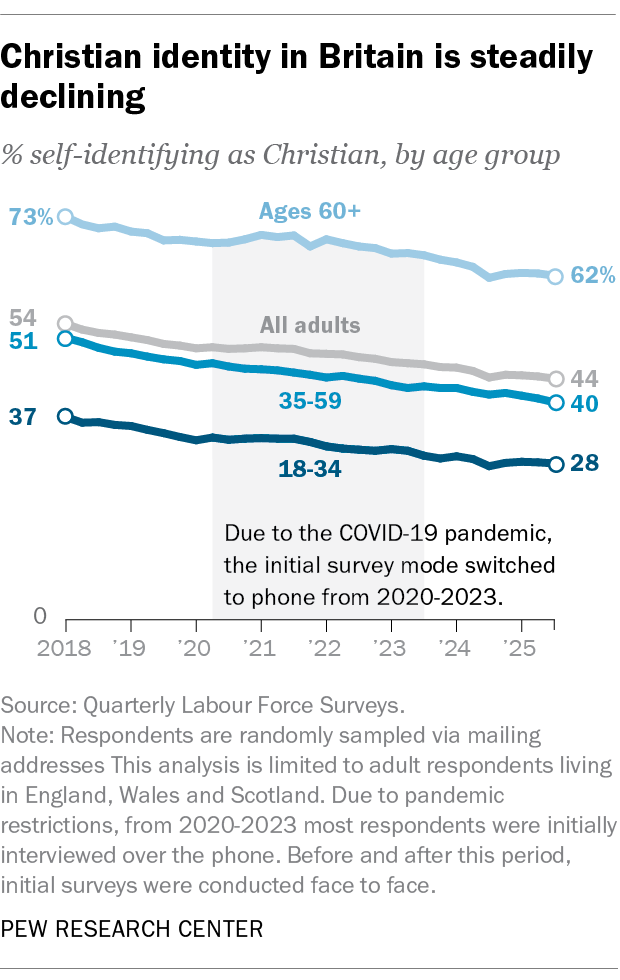
Christian identification is declining across age groups, according to the LFS. For example, 28% of 18- to 34-year-olds identified as Christian in summer 2025, down from 37% in early 2018. Throughout this period, older British adults consistently identified as Christian at higher levels than young adults.
Of course, many self-identified Christians are not regular churchgoers. Since the LFS doesn’t measure worship attendance, we can turn to another long-standing survey that uses random population samples to see how the churchgoing Christian share of the adult population has changed.
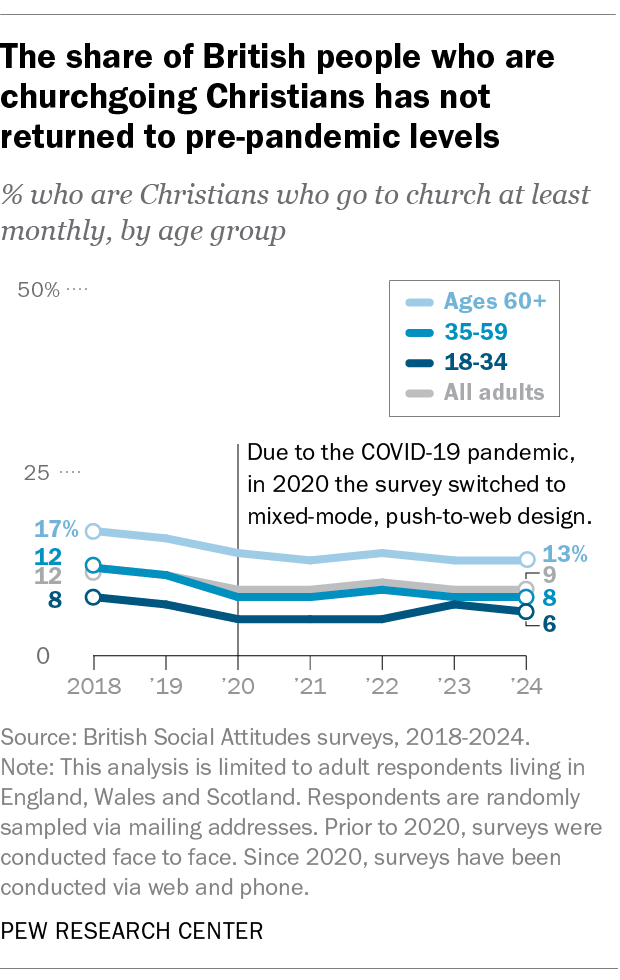
The annual British Social Attitudes (BSA) survey measures religious identity and worship attendance in Britain, based on a random sample of more than 3,000 adults. BSA data shows no clear evidence of a Christian revival. Among all adult respondents, the share who identify as Christians and who go to church at least once a month was 12% in 2018 and 9% in 2024.
Similarly, the share of young adults who are Christian churchgoers has not risen above pre-pandemic levels, according to the BSA survey. Among 18- to 34-year-olds, 6% were in this category in 2024, as were 8% in 2018.
Responses to the Christian revival narrative
Critics, including social scientist David Voas of University College London, have questioned claims about a religious revival in Britain. Voas has noted that churchgoing rates have risen from the lows of the coronavirus pandemic but remain below pre-pandemic levels, according to data from large Christian denominations. Humanists UK has called for The Quiet Revival study to be retracted, but the Bible Society stands by its results and has published its responses to methodological questions in a public document. (Note: The Bible Society retracted its study on March 26, 2026, after YouGov acknowledged that its survey data was flawed.)
The narrative of a religious revival in the U.K. appears to be receiving much more attention than data and commentary challenging this narrative. For example, in a December 2025 briefing paper – posted on the site of the National Centre for Social Research – political scientist John Curtice of the University of Strathclyde concluded that the findings of the BSA survey “do not replicate the Bible Society’s finding that there has been a revival of Christianity in Britain.” In the three weeks following the briefing paper’s publication, it generated no media coverage. However, findings from the April 2025 Quiet Revival study continue to be cited uncritically – for example, in stories published this month in The Guardian and Sky News.
Why survey results based on opt-in samples differ from random samples
Online opt-in surveys do not randomly recruit respondents. Rather, respondents are recruited through methods such as online advertising, self-enrollment and email lists. Survey firms try to make these samples reflect the general population by matching quotas for various characteristics or via statistical modeling. However, results from these surveys may be biased by “bogus respondents” who, instead of answering survey questions honestly, answer with the minimal effort required to complete surveys quickly and receive monetary rewards.
Recently, political scientist Sean Westwood demonstrated that large language models can be easily programmed to take opt-in surveys, even using multiple personas that evade fraud detection methods employed by survey vendors. He describes this as an “existential threat” to the validity of results from online opt-in surveys.
Pew Research Center studies have found that online opt-in surveys may produce especially misleading results for young adults. For example, a widely reported online opt-in poll finding about Holocaust denial among young Americans did not replicate when the Center included the measure in our American Trends Panel, which recruits a random sample of participants via mail. A Center study found that young, online opt-in respondents are much more likely to answer “Yes” in Yes/No questions, regardless of the truth. And another found 12% of young online, opt-in respondents claiming they are licensed to pilot a nuclear submarine (versus 1% of those ages 65 and older).
Online opt-in surveys also find recent religious resurgence among U.S. young adults
While this analysis focuses on claims of religious revival among young adults in the U.K., some opt-in surveys have pointed to a similar trend in the United States.
Barna Group, a research organization serving Christian leaders, has used online opt-in survey data to make claims of rising churchgoing among young adults in the U.S. According to Barna, “Since 2019, both Gen Z and Millennials were the least likely generation to frequently attend church. Today, they are the most engaged.”
However, surveys from Pew Research Center using random samples show no clear evidence of a religious revival among young adults. Nor is there clear evidence of religious revival in two other surveys based on random samples conducted by other organizations: the General Social Survey and the American Time Use Survey.
A note on data availability
There are publicly available websites with tables of survey results for most of the opt-in surveys described in this analysis.
Full datasets are not publicly available for any of these online opt-in surveys. However, full datasets are publicly available for all of the surveys based on random samples described here.
It’s also important to note that the methodological statements for the opt-in surveys mentioned in this analysis do not typically make clear their samples start with people who have “opted in” to take surveys rather than with random samples of the population.